Author Archives: Tita Larasati

Going Banana (Leaf)

As an assignment, I told my students in groups to present an example of our surviving traditional artifact and/or indigenous knowledge in a daily activity, which is actually a practice of a sustainable lifestyle. Banana leaf as a food wrapper was among the presented cases.

The group took Sundanese people (dominant inhabitants of West Java) and their meal tradition as an example. The people are used to eat by gathering and sitting on the floor, using their own hands to eat and a piece of banana leaf as a ‘plate’.

Meal tradition of Sundanese people

Banana leaf as a 'plate'

The discussion include the effects of the wrapper to the food (i.e. its taste and durability), and whether the people still possess the skill to wrap in different styles and to cook those different snacks/food.

Variations of banana leaf wraps

Snacks wrapped in banana leaves

More snacks wrapped in banana leaves

'Full' meal wrapped in banana leaves

Why banana leaf?

“Why Banana Leaf?” question yields, among others, the following answers:

– The banana trees are indigenous to Indonesia and are available in abundance

– Banana production has spread to 16 provinces and 17 regents

– Banana leaf wrapper infuses a certain fragrant to the wrapped food

In the end, it comes back to the matter of practicality. On one hand, banana wrappers have their benefits as an organic, biodegradable, food-grade material that enhance the taste and fragrant of the wrapped food. Moreover, considering the varieties of styles and forms, preserving this wrapping and cooking method also means preserving our food cultures and traditions. But on the other hand, this method requires particular ways of food treatments and preparations, a skill that should be mastered through an intensive exercise (and a huge amount of patience), and therefore can be achieved only by certain people. Food wrapped in banana leaves cannot stay too long, so it cannot stay in supermarket shelves along with i.e. other precooked food (keeping it in freezer would ruin the taste and textures); a fact that reduces its point in practicality. It is now therefore available mostly in particular restaurants and/or food stalls with ‘traditional’ theme.

The discussion went on about the relevant issues of sustainability, and how (Indonesian) designers could derive the essence of this food culture, in order to create a product or service that considers the use of organic materials as containers or perhaps even to adjust our diet and eating habit into the availability of food ingredients and their processing into our meals.

Hot Issue, Cool Solutions

On Thursday, Sept 29, 2011, The Climate Reality Project Indonesia (TCRPI) held a workshop for the youth group at TUNZA 2011 in Bandung. I and three other fellow TCRPI presenters who teamed up for this workshop have only been communicating via emails and telephone conversations, but we eventually made it. We had our session right after lunch time, scheduled from 13:30 to 15:00, and it started unsurprisingly a bit late. The room was filled with about 25-30 young people, mostly from Indonesia (Bali, Madura, Manado, Bangka, etc.) and the Caribbean countries, and also a couple of young boys from Sri Lanka.

Our session was divided into four: Dian started first by explaining about The Climate Reality Project, then continued by Arifah who delivered the scientific background of Global Warming and Climate Change. Between the two presentations, we screened a video of a woman being rescued by her neighbor during a heavy, violent flood in Brazil. That was quite a breathtaking scene that got a conversation going in the room. The video was a part of TCRP new presentation material that we acquired only in the morning, so we wished we could have shown more of the new slides. Anyway. The third presentation by Risa explained about how we – youth – must take the stand, discussing the quitter and climber types. The fourth (and last) presentation was my part, talking about Hot Issue, Cool Solutions, pointing out what youths can do in facing the current environmental situation and in preparing a pleasant, liveable earth, by being creative and active.

At the end of the presentation, we asked if any of the audience has an experience in mobilizing his or her communities, or in conducting a project, which relates to the issue. It turned out that some of them are having ongoing projects, i.e. providing clean water for his village, managing local solid waste, etc. We could see that no matter which part of the world you come from, the problems are similar. Most of us are prone to the impacts of extreme climate, but at the same time most of us – especially young, energetic people – also have the potential to face the challenges and to improve our own environment.

Following are my slides. All images, if taken from external resources, are credited, and I’m very much indebted to greendiary.com for their post about children & youth and their activities.

Among my suggestions is for them to check their ecological footprints and compare them to those of their friends’, classmates’, neighbors’, families’, etc. See who’s most ‘harmful’ for the environment and who’s most friendly, challenge themselves to change their lifestyles into more harmless ones by reducing the widest part of their footprints. I have applied this challenge to my students in several classes, who offered surprising and entertaining solutions, all specific to their (local) situations.

Another challenge might come in the form of controlling your waste. This can also be done collectively, i.e. one classroom competing with another, to see which class comes up with most garbage by the end of the week. It can include not only the classroom facilities, such as chalkboard and cleaning substance, but also the students’ candy bar wrappers, packed juice or bottled drinks, papers, etc.

Youths and their hopes for the Earth should be heard, and in this era of global information access, social media and Internet technology, relaying messages should come in a more creative forms. Groups of youths that are active in the ecological issues can connect to similar groups abroad and share experiences, just like we did in the workshop session. They can post stories, photos, plans, to inspire and encourage others.

Children and young people now are those who will live on Earth many many years from now, so they have the right to decide the kind of world they’ll live in. And they can’t just rely merely on current decision makers, multinational companies, and all adults in general. So let’s change the world into a better place to live!

Clustering Works Better than Individuals

This post has been postponed for a tad too long, and to cancel it altogether feels like a shame, since there’s something to share, although only a little bit. Alright. This is from The 3rd Indonesia International Conference on Innovation, Entrepreneurship, and Small Business (IICIES), held by School of Business and Management (SBM) of Institute of Techology Bandung (ITB) on July 26-28, 2011, at Gedung Merdeka, Bandung. The title of this year’s IICIES was “Creative and Cultural Entrepreneurship in the New Era”.

I was appointed as the moderator for the first panel session, so I might post about it later. But for now, I’d like to note down some points taken from the keynote speech, about “Creative Clusters”, by Gerald Lidstone from Goldsmiths University, London.

He opened the session by complementing that IICIES was much more creative, innovative and exciting, contained more energy and diversity, compared to a meeting he attended previously, before he came to Indonesia.

He then began his speech with a statement: how it is possible to cluster different fields of creativity.

You can’t use up creativity. The more you use it the more you have. – Maya Angelou

UK "creativity" map He continued by presenting a graph that shows how Creativity can be seen as a developing process; in this case, according to the UK government. I recreated the graph in a much simpler form, containing the following phases:

–       (Start) giving children creative education

–       Turning talents into jobs

–       Supporting research and innovation

–       Helping creative business grow and access finance

–       Fostering & protecting intellectual property

–       Supporting creative clusters*

–       Promoting Britain as the world’s creative hub

–       Keeping the strategy up-to-date

From here, we could see the position of Creative Clusters, at which phase they take part within the ‘wheel’.

The next graph showed the levels/scopes of “creative industry”, which starts with (1) core creative fields, which would form (2) cultural industries, leading to (3) creative industry & activities, and end with (4) the rest of economy. In this graph, Creative Clusters exist between the 3rd and 4th levels.

Meanwhile, UNCTAD classification of creative industries is as follows, where Creative Clusters are already visible.

Creativity is the ability to find new solutions to a problem or new modes of expression; thus it brings into existence something new to the individual and to the culture. – Betty Edwards (Drawing on the Right Side of the Brain)

Creative Commons are sometimes a movement against the government and big businesses; to resist controls.

Among the examples given was how creative core actors (artists, etc.) tend to look for neglected/abandoned spaces to work, since it’s the most affordable they can get. Then little businesses cluster around them. People is the creativity software who (re)use the buildings. No fancy place. This kind of live-work facilities is a way that actually works.

Businesses then move to where the workers are, forming cultural activities of an area.

These cases can be seen as the emergence of contemporary arts, etc . What happens to the old crafts production, such as textiles, ceramics and jewelry or metal crafts? They support the new entrepreneur.

See, this reminded me of the amount of old buildings in Bandung that are running down and only waiting to fall down, while the creativity and the energy of the people are alarmingly high. What kind of matchmakers do we need?

There are four levels of development for the Creative Cluster:

1 MATURE: one that has been around for a long time, and is usually a business to business consumption, i.e. Hollywood for film/TV, Milan for fashion and furniture design/products, and New York, Paris and London for fashion.

2 DEPENDENT: one with public investments (public subsidy) by governments, regions, cities, etc., financing SME and micro creative enterprises. This happens to limited and underdeveloped local markets, where governments have stepped in. Examples for this were: UK creative industry quarters in Sheffield, Taipei creative industry development, and digital media city Seoul.

3 ASPIRATIONAL: one with very small beginning but with high levels of public and institutional promotional activity. It starts with a group of people trying to be bigger, as in “How fast can you develop without public money?”. Examples included Creative Precinct Brisbane, Digital Media Singapore and Westergasfabriek Amsterdam.

4 EMERGENT: it’s a start-up cluster with infrastructural investment from the public sector, one that develops local and regional markets. It has visible cultural consumption and internationalization of market reach, i.e. digital media in Barcelona (that gets supports from state companies, European Union and government) and film/TV industries in Cardiff.

As for Indonesia, the question was: where does the Indonesian government put their money? In business, or infrastructure? Because it requires lots of political will and finance to determine a country’s creative industries.

He continued discussing the role of universities and centers of research, presenting an example of Arabianranta in Helsinki, which is a home to 10,000 people, a workplace for 5,000 people, a campus area for 6,000 students (including Aalto applied sciences and Helsinki pop & jazz conservatory) and contains 1,500 professionals. It is also a hub for 300 enterprises that holds 4,000 employees. What’s remarkable is the ability to feed off the creativity, finding new business partners and customers via their website [arabianranta.fi]. Among the ongoing projects they have is Helsinki Living Lab, sponsored by TEKES, which promotes user-driven methods and tools for improving the real-world development of Product and Services.

Another example is Dr. Who, a renowned television series in the UK. The series started in 1963 until 1989, and was revived in 2005. Dr. Who is an old brand. BBC commissioned a new program from a regional center, Wales, which was unusual. Market research showed negative result for the plan, but it turned out that there were 30 million viewers per series, 10.4 million alone in New Year Day 2011. As a consequence, BBC Wales doubled its income in 3 years to 50 million pounds.

This doesn’t stop right there. The success of the series led to the creation of interactive computer games, trailers, etc. Tourism to locations has also increased to more than 40% over the last ten years (it reached up to 13 million visitors in 2008). In Cardiff, a number of activities also turned up as the excess: exhibitions, studio tours, etc. More spillover benefits of course also include the employments of writers, catering, property design, costumes, aviation repair, etc. Based on this experience, BBC has decided to make 50% of BBC Network TV shows outside London by 2016.

That was a result ff government invests in infrastructure to get creativity going.

Creative industries are more innovative than many high-innovation sectors, i.e. professional and business services.

NESTA (National Endowment for Science Technology and the Arts) maps all clusters in UK.

Presence of creative business generate a creative buzz.

All are achieved with collaborations, not individualism.

He closed his presentation by discussing the following list of Myth versus Reality concerning INNOVATION (source: “Leading Innovation”), as follows:

INNOVATION

MYTH

REALITY

Flash of insight Comes from immersion
Brilliant idea Fail early but often
Individualistic Collaborative
New knowledge Admitting ignorance
Invention Mostly development
Originality Borrowing
Look to the future Look sideways and backwards
Internal research and development Networked, open innovation
Product pipeline Consumers as innovators
All about learning But unlearning (questioning, being radical) just as vital

Conclusively, he stated that Clustering works much better than individuals.

Urban Acupuncture: Cikapundung

Notes about the current condition of Cikapundung, as told by an inhabitant

This is a note from an urban acupuncture workshop (held on August 10, 2011), the first one I ever attended, which focused on Cikapundung River that runs across Bandung, West Java, which is actually an important waterline where early citizens of Bandung started to settle. As with a human body, an urban acupuncture is also similar to piercing and fixing ‘nerves’ where problems exist, within an urban area. It doesn’t try to solve everything all at once, but by taking it spot by spot, as it is conducted by individuals and communities, not by an established (government) institution who has the means to make significant changes.

In order to gain different angles in looking at the problems and, consequently, a variety of conclusions, people from different disciplines and interest groups were invited. There were participants from Komunitas Sahabat Kota, House the House, National Geographic, Kompas, WALHI, Bandung Heritage, LABO, students from School of Business and Management, Industrial Design, Architecture, etc., as well as local inhabitants of Cikapundung River, who became the main keys of our workshop.

Notes about the current conditions of Cikapundung River

The workshop started with an introduction to the area. Although most of us have known Cikapundung, or at least parts of it, it was still an eye-opener to watch photos of how the river has been treated, how it used to be, and its current conditions in different parts. It was especially capturing to watch a video of the whole river (taken in 1998, before the existence of Cipularang Highway and Pasupati Brigde), starting from its spring at the Northern part of Bandung, to where it ends at the South upon meeting the bigger Citarum River before flowing into the sea. Even then we could see parts of the riverbanks that were still lavishly green (i.e. within the zoo property), and where they were being pressed by housings and massive constructions (i.e. next to an expanding shopping center).

Notes from Nicolas Buchoud’s presentation

An extra material for the workshop was a presentation by Nicolas Buchoud, a “senior French urban development expert and planner from Paris, France” (quoted from the invitation). At that moment, Nicolas is a guest of Urbane, who initiated the Urban Acupuncture workshop. Nicolas gave an overview about urban planning and projects he has done, but it is important to note, he said, that he was not going to tell us what to do with Cikapundung since he doesn’t know better than us about the site, and that it’s us who knows best about what we want with that part of our city.

A direct visit in the afternoon to a part of Cikapundung was scheduled as a session of that workshop. However, due to time limitation, we had to cancel the site visit and worked right away on the discussion instead. It was a playful discussion session. Here’s how it went:

Notes about the design requirements

Ridwan Kamil, architect/principal of Urbane, who led the workshop, explained the actual potentials of Cikapundung River, divided into a number of purposes. The purposes don’t have to be entirely separated, but can also be overlapping one another. Since we only had less than three hours to hold the discussion and present the results, only one purpose or theme of the river was chosen: river play.  In three groups, we were asked to come up with a design that accommodates people’s needs to interact with the river in a playful way, such as games or other kinds of fun attractions. Among the requirements was that our proposals should be feasible, or affordable and can be realized within about five weeks.

We were given papers and colorful markers to draw our ideas and plans. The group I took part with had a local Cikapundung inhabitant as a member, who could tell us what has been done and what could be possible, which helped us a lot in mapping out possibilities.

Notes about possible themes for riverside activities

At the end of the discussion session, each group was to present its designs. We really came up with a high variety of games and activities, involving not only the local communities but also visitors, either individually or in groups. The activities ranged widely, from leisure walks and ‘treasure hunt’ to adrenaline-rushing plots and energy-taxing games, which didn’t necessarily require ‘buildings’ or massive structures – some proposals even came in the forms of play-rules and systems.

Considering the time span we had, of course all results were at their initial phase that still needed a lot of substantial improvements. However, we have experienced a participatory design process in a pleasant way.

Closing the workshop, also while waiting for the sun to set as a sign to break the fast, Nicolas gave his evaluation about the workshop and about Cikapundung River in general. He drew over a GoogleEarth-projected image of Cikapundung River from North to South and put colorful stick-on strips at a number of points along the river: bright yellow for ‘average pressure’ and pink for ‘high pressure’.

Among the most important points he mentioned were as follows:

–       Along the river, we could see a lot of massive structures and buildings that will never be altered or disturbed, such as ITB campus, the city hall, and so on, around that area, which formed the ‘strong’ points of the river. We could also see that there are ‘weak’ points that can easily push the river to oblivion. The river could one day be a mere sewer if we don’t take care of it.

–       The weak points are, among others, the squatters and semi-legal housing along the riverbanks, and the greeneries that belong to established properties such as the zoo and the sport field. These points are obviously threatened by the expansion of Cihampelas commercial district.

–       One suggestion would be for independent communities to take over the weak points by collaborating with the proprietors of the greeneries sites, in order to strengthen the river line.

–       Another suggestion would be for communities to inform the (semi-legal) inhabitants along the river, who are the actual guardians of the river whose lives depend on it, that if they want to stay there, they should really take care of the river. Keep the river clean and flowing, free of garbage and foul smell, pleasant to look at and be around with.

All in all, the workshop was a productive one. We realized that this once was obviously not enough, that there should be follow-ups and a lot of works, until our hope and ideas for Cikapundung become concrete.

Related links:

– An article in Pikiran Rakyat about the workshop (in Indonesian): Cikapundung Tertata Bisa Jadi Ikon Bandung di Mancanegara

– An article in this site about Ridwan Kamil’s presentation concerning the subject of design & sustainability: Negotiating A New Indonesia

All scribbles were made during the workshop, using Penultimate on iPad2

Ibu-ibu Kita Masih Melahirkan Pejuang

Ungkapan tersebut tentu sudah akrab bagi kita yang pernah membaca atau mendengar mengenai Indonesia Mengajar, termasuk saya sendiri. Telah beberapa kali saya membaca dan mengagumi gerakan ini, dan menganggapnya menjadi sebuah penghiburan yang membesarkan harapan pada Indonesia, “Negri yang pantas dicintai”, kata Kang A’at Soeratin, di tengah-tengah gencarnya berita-berita dari tanah air yang memuakkan. Oleh karena itu, ketika ada kesempatan untuk mendengarkan Pak Anies Baswedan berbicara mengenai pendidikan, saya langsung mendaftar untuk hadir, terutama karena ingin tertular semangat dan optimismenya terhadap kebangkitan bangsa ini.

Acaranya berlangsung di Rumah Belajar Semi Palar, Bandung, 25 Agustus 2011, mulai pukul 3 sore. Ketika saya datang, acara sudah dimulai dengan pengantar dari Kang A’at (bagi yang belum kenal, coba cek situs Garis Depan Nusantara – beliau termasuk salah satu anggota tim ekspedisi GDN). Setelah itu saya mulai mencatat hal-hal yang disampaikan Pak Anies, dalam sketsa dan tulisan berikut ini (mohon maklum kalau tidak runut dan kurang lengkap, karena mengandalkan sketsa dan ingatan)…

sketchnote 1

Kalau kita dengar profesi “guru” di Indonesia ini, konotasinya adalah: kurang memadainya kualitas mereka, rendahnya tingkat kesejahteraan, dan kurang meratanya distribusi tenaga pengajar ke seluruh Nusantara. Ini jelas merupakan masalah, janji negri ini pada bangsanya yang belum terlunasi. Indonesia Mengajar mencoba menjawab masalah ini dengan mengirimkan pengajar-pengajar berkualitas tinggi ke pelosok Nusantara, karena pendidikan merupakan tanggung jawab moral semua orang terdidik.

Mengutip Abah Iwan ketika melepas satu angkatan Pengajar Muda, bahwa “(Menjadi pengajar di pelosok tanpa fasilitas yang memadai) bukanlah pengorbanan, tapi merupakan kehormatan”, memang benar. Sebab para Pengajar Muda ini adalah orang-orang muda terpilih, yang telah mengalami proses seleksi ketat dan pelatihan yang sesungguhnya. Rasio jumlah yang terseleksi dibandingkan jumlah pendaftar jauh mengalahkan rasio perebutan bangku perguruan tinggi favorit di negri ini – bedanya, yang ini nyata dan hasilnya benar-benar diuji langsung di daerah penempatan.

sketchnote 2

Ketika merdeka, penduduk Republik Indonesia sekitar 70 juta jiwa. Jumlah sekolah dasar baru ada 15 ribu, kini ada sekitar 147 ribu, dan mampu menyerap hingga sekitar 94-96% pendaftar. Ketika merdeka, hanya ada segelintir jumlah sekolah menengah dan lanjutan, apalagi perguruan tinggi, sehingga jelas bahwa kualitas SDM kita masih lemah, bahkan sebagian masih buta huruf. Sehingga yang terjadi adalah, ketika membanggakan potensi negri, para pemimpin bangsa ini mengajukan SDA, hasil bumi dan hasil tambang, sebagai yang terunggul. Sekarang seharusnya berbeda: para pemimpin bangsa ini seharusnya kini dapat lebih menghargai SDM kita, dan tidak lagi bergantung pada (eksploitasi) SDA – yang adalah cara berpikir jaman kolonial.

Are we ready to prepare our children to become global citizens? Seharusnya kita sudah menyadari, bahwa letak negara-negara tetangga lebih dekat dan jauh lebih mudah dijangkau ketimbang kota-kota di pulau-pulau lain di Indonesia. Anak-anak di wilayah-wilayah tersebut seharusnya dibekali dengan pengetahuan lebih, terutama keterampilan berbahasanya.

Sebagian besar (20%) dari bangsa Indonesia peraih gelar PhD adalah dalam studi-studi yang berkaitan dengan agama. Setelah itu baru ilmu-ilmu lain: ilmu sosial, ekonomi, sains, engineering, dsb. But we need more than prayers to produce technology.

Berbagai data dan statistik menunjukkan perbandingan jumlah pelajar Indonesia dalam prosentase yang jauh lebih kecil dibandingkan dengan pelajar dari negara-negara lain, yang menempuh pendidikan di negara-negara industri maju. Namun tidak perlu berkecil hati, sebab ternyata sebagian besar dari para pelajar asing ini adalah dalam tingkat vocational, sehingga sekembalinya mereka ke negara masing-masing, mereka akan bekerja di bidang industri manufaktur – yang kurang lebih masih dalam kontrol negara-negara maju tersebut.

Kita seharusnya bisa melakukan loncatan lebih dari mereka, dengan cara mengandalkan, melatih dan menajamkan kreativitas dan daya berpikir kritis.

[youtube=http://www.youtube.com/watch?v=Vc1hgMl3uUk]

[Video yang ditayangkan untuk memberikan gambaran mengenai pentingnya mendidik generasi abad ke-21 dengan tepat. Apakah kita siap?]


Dari data lain, terlihat bahwa sebagian besar pelajar SD di Indonesia tidak dapat melanjutkan ke jenjang-jenjang yang lebih tinggi. Bila melihat angka jumlah pelajar SMA, para pelajar yang memulai SD pada saat yang bersamaan tidak ‘terangkut’ atau tidak dapat terus ke tahap pendidikan lanjut.

Bila orang-orang seangkatan orang tua kita pada saat seumur kita ditanya, 30 tahun lalu berada di mana, jawabannya sebagian besar adalah di kampung, di daerahnya yang letaknya mungkin sangat jauh dari ibukota. Apa yang membawa mereka berhasil berkehidupan di kota-kota besar, menjadi professional yang sukses di bidangnya, bahkan menduduki berbagai posisi penting? Pendidikan. Apakah pendidikan kini masih dapat mengangkat harkat hidup orang-orang dari pelosok Indonesia seperti masa itu?

Kini, bila kita ditanya, 30 tahun berada di mana, jawabannya hampir dipastikan adalah kota-kota besar di Indonesia, dari kaum menengah ke atas. Bukti bahwa pendidikan belum berhasil menjangkau dan meningkatkan kesejahteraan secara merata.

Perancang sistem pendidikan adalah perancang sistem sosial suatu masyarakat. Manusia terdidik akan mampu meningkatkan tingkat sosial dan ekonominya, dengan pendidikan sebagai ekskalatornya.

sketchnote 3

Para Pengajar Muda adalah warga sipil yang kelak dapat mengatakan, “Aku telah membaktikan diri pada negriku”. Mereka ditempatkan di pelosok-pelosok Nusantara untuk tinggal dan mengajar di sana selama satu tahun. Setelah itu mereka harus pulang untuk menjadi professional di bidangnya masing-masing. Posisi mereka di daerah penempatan digantikan oleh Pengajar Muda angkatan berikutnya, dan terus bergantian, hingga lima tahun.

Dengan cara ini, mereka akan memiliki dua ‘rumah’, yaitu daerah asalnya sendiri, dan daerah di mana mereka ditempatkan, yang akan menciptakan keterikatan batin. Empati kebangsaan dan ke-Bhinneka-an mereka terbentuk selama masa penempatan ini. Sehingga akan terbangun dua hal berikut: di satu sisi para Pengajar Muda mendapatkan pengalaman tak ternilai di daerah penempatan masing-masing, sementara di sisi lain daerah penempatan tersebut pasti akan teringat dan terangkat ketika para Pengajar Muda ini kelak berkarya dalam bidangnya masing-masing. Sistem ini menjadikan para Pengajar Muda tersebut leaders with global qualities, with an understanding of their roots.

Acara berlanjut dengan tanya-jawab hingga waktu berbuka puasa tiba, dilanjutkan dengan acara penutupan. Pak Anies diminta menorehkan dengan spontan kata-kata di kanvas yang di bagian atasnya terdapat bendera merah-putih yang dijahit. Bentangan bendera merah-putih dengan robekan yang terjahit juga hadir sebagai latar acara ini, yang menurut Mas Andy Sutioso dari Rumah Belajar Semi Palar, dipakai di acara tujuh belasan yang lalu. Jahitan tersebut merupakan simbol bahwa kita sedang memperbaiki Indonesia, yang tengah mengalami kerusakan. Pada kanvas itu Pak Anies menuliskan, Ibu kita melahirkan pejuang. Hidupi Republik ini dengan gerak maju lewat pendidikan. Masa depan Republik ini akan cemerlang untuk semua!

Relevant links:

Catatan dari acara yang sama (dengan foto):

http://cinnamome37.blogspot.com/2011/08/catatan-diskusi-bersama-pak-anies-1.html

http://cinnamome37.blogspot.com/2011/08/catatan-diskusi-bersama-pak-anies-2.html

http://cinnamome37.blogspot.com/2011/08/catatan-diskusi-bersama-pak-anies-3.html

Situs Rumah Belajar Semi Palar: http://semipalar.blogspot.com/

Situs Indonesia Mengajar: http://indonesiamengajar.org/

Anak-anak Bantar Gebang Selalu Senang

Apa jadinya ketika kita diminta untuk mengajar, tapi akhirnya malah belajar lebih banyak dari kelas yang kita ajar? Jadinya ya seperti hari ini, ketika saya, Ihsan dan Pidi mengisi acara Akademi Berbagi Anak Jalanan di Bantar Gebang dalam rangka Hari Kemerdekaan Republik Indonesia, 17 Agustus 2011.

Bagi yang pernah mendengar sekilas tentang Bantar Gebang, lokasi Tempat Pembuangan (sampah) Akhir atau TPA, pasti yang terbayang adalah bukit sampah bau dan tempat yang kumuh. Saya sendiri baru dengar hari ini bahwa anak-anak yang kita temui ini, dari kelompok belajar Al-Falah, adalah anak-anak dari pemulung, pemilah dan pengolah sampah yang tinggal di Bantar Gebang secara ‘ilegal’. Tempat tinggal mereka, yang hanya serupa bedeng dan tempat teduhan, berada bersama dengan tumpukan sampah. Karena keberadaan mereka yang tidak resmi itulah, mereka tidak mungkin membuat KTP dan memiliki Kartu Keluarga (KK). Di satu sisi, mereka tidak bisa diusir, karena merekalah yang melakukan pemilahan dan pengolahan sampah di TPA tersebut, sebab penduduk ‘resmi’ di sana tidak akan bersedia melakukan pekerjaan tersebut. Tapi di sisi lain, mereka tetap tidak bisa memperoleh KK. Karena tidak ada KK, anak-anak mereka pun tidak bisa bersekolah di SD Negri di sana. Jadi pilihan apa yang dimiliki anak-anak ini untuk mendapatkan pendidikan? Tanpa KK, mereka tidak bisa masuk SD dan dapat ijazah. Padahal tanpa ijazah SD, mereka tidak mungkin masuk SMP. Lalu bagaimana dengan masa depan mereka? Lalu dibentuklah kelompok belajar Al-Falah, setidaknya untuk meluluskan mereka dari jenjang SD, agar dapat masuk SMP. Salut yang teramat sangat untuk pendiri kelompok belajar ini, para guru dan relawannya, yang telah terus menerus  membina anak-anak ini.

Kembali ke beberapa minggu sebelum 17 Agustus. Ketika Mbak Ainun, kepala sekolah Akademi Berbagi, menawarkan untuk mengajar #AkberAnjal di Bantar Gebang, sontak saya setuju. Dalam perjalanan dari Bandung menuju Bantar Gebang, tim pengajar Akber kali ini (saya, Ihsan dan Pidi), sepakat untuk mengajak anak-anak itu bergembira saja, bebas dan merdeka dalam berekspresi, lewat permainan, gambar, lagu, dan apa pun. Kami tiba di wilayah Bantar Gebang sekitar pk.14:00, saat siang sedang terik, lalu mengontak tim Akber yang sudah lebih dulu tiba, untuk menanyakan lokasi acara. Ternyata tempatnya adalah sebuah aula semi-terbuka dalam lahan untuk Al-Falah yang belum selesai digarap, ada 2 ruang lagi + 4-5 WC di sana, tapi belum ada air, dan dua kelas yang sedang dibangun, atas dana sumbangan dari sebuah perusahaan asing.

Aulanya relatif bersih dan luas, tapi tanpa angin yang berhembus, aroma sampah membusuk menguar merata, dan lalat tak terhitung terbang berkeliling. Bayangkan, anak-anak ini setiap hari hidup dalam kondisi seperti ini.

Berhubung ini tanggal 17 Agustus, tim relawan Akber ada yang sudah tiba di tempat sejak pagi, untuk melaksanakan upacara bendera. Salut juga untuk mereka ini, yang kerja tanpa pamrih! Sore itu juga dilaksanakan sedikit upacara, yaitu membacakan teks proklamasi dan menyanyikan lagu Indonesia Raya. Setelah jeda untuk sholat, acara Akbernya dimulai. Ada sekitar 50 anak laki-laki dan perempuan, berusia antara kelas 3 sampai dengan 6 SD. Ihsan, yang memang sering membawa bocah-bocah berkemah dan bertualang, memulai dengan melakukan ice breaking melalui permainan “tupai dan pohon”. Di sini anak-anak belajar teamwork dan koordinasi, di samping konsentrasi dan asosiasi antara verbal dan aktivitas motorik. Selanjutnya, anak-anak diajak menggambarkan diri mereka sendiri, agar mengenali diri sekaligus membiasakan untuk nyaman untuk berekspresi dengan media kertas dan krayon yang mereka pakai siang itu. Setelah ini, permainan yang sesungguhnya dimulai!

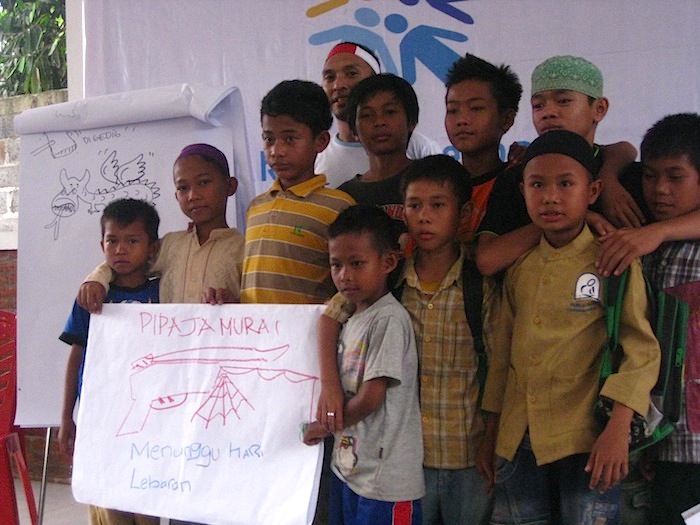
Pertama, mereka masing-masing diminta menggambar “tempat duduk yang bukan kursi”, lalu menampilkannya di depan teman-temannya. Kedua, mereka diminta menggambar “alat penanggulangan tentara dari mars” yang bersenjatakan api dan batu, lalu juga menceritakannya di muka kelas. Ketiga, dalam 5 tim, mereka harus membuat “alat penangkap ular berkepala sapi”, dan harus presentasi di depan semuanya. Yang terakhir ini, ada kakak-kakak relawan dalam tiap tim yang boleh membantu. Di sini, anak-anak diajak untuk berpikir di luar kebiasaan. “Tempat duduk yang bukan kursi” menghasilkan gambar-gambar tikar, pohon, batu, balai-balai, kasur, dan sebagainya. “Alat penanggulangan tentara dari mars” banyak yang berbentuk ember, baskom dan selang air, dan tembok penghalang, namun mereka sambil juga belajar menjelaskan dan tampil di publik untuk menceritakan ide-ide mereka. Di tugas yang terakhir, mereka belajar bahwa berdiskusi itu dapat memunculkan lebih banyak lagi ide, sekaligus melatih cara berkomunikasi dalam sebuah kelompok kerja. Sesi presentasinya tentu tidak kalah seru, karena setiap orang dapat mengajukan pertanyaan untuk regu yang sedang presentasi. Nama-nama regunya pun seru, ada Pelangi Pastel, Menunggu Hari Lebaran, Bunga Matahari, Sinar, dan Robot Kobuzer. Di akhir sesi presentasi, dipilih satu regu pemenang favorit, yang mendapatkan hadiah (lollipop!) dari kepsek Akber. Pemenangnya? Menunggu Hari Lebaran!

Setelah itu tibalah saat yang, ternyata, paling mengharukan. Pidi dengan gitarnya mengajak anak-anak membantunya mengisi kata-kata untuk lagu yang ia buat untuk mereka. Awalnya dimulai dengan kalimat,

Anak-anak Bantar Gebang Bisa Renang

sebagai judul, dengan lirik

Kami anak-anak Bantar Gebang

Satu selalu kasih sayang

lalu

Bisa senang bisa menang

“Ayo, bisa apa lagi?” tantang Pidi.

Bisa renang bisa sayang

Bisa terbang bisa kayang

Itu tadi usulan mereka, yang serima dengan “-ang”, dan masih banyak lagi sebenarnya. Tapi lalu ditutup Pidi dengan:

Selamanya…

Lagu ini, yang menjadi milik anak-anak Bantar Gebang, kami nyanyikan berkali-kali, judulnya direvisi jadi “Anak-anak Bantar Gebang Selalu Senang”. Terakhir kami nyanyikan sambil berdiri. Lihat ekspresi mereka! Gembira dan bangga.

[youtube http://www.youtube.com/watch?v=oLGoVvh7zMc]

Akber kali ini, dalam segala kesederhanaannya, telah menunjukkan kehebatannya. Para relawan tetap di Bantar Gebang, tim Akber yang sudah mempersiapkan acara ini jauh hari sebelumnya, dan para ‘kepsek’ (Akber, Anjal, Bantar Gebang) yang dedikasinya tak diragukan – andai separuh saja dari semua pejabat dan PNS RI memiliki dedikasi terhadap negri ini setinggi itu, Indonesia pasti sudah sejahtera merata sejak dulu!

Anak-anak Bantar Gebang yang luar biasa, dengan segala keterbatasan kondisi mereka, tetaplah anak-anak yang senang bermain dan diperhatikan dengan wajar. Keterpinggiran mereka tidak memadamkan semangat mereka untuk belajar. Siapa lagi yang akan mengurus mereka bila tidak mereka sendiri, dengan sedikit uluran tangan dari kita, “Karena mereka adalah juga kita. Satu.” – ujar Pidi di salah satu twit-nya sepulang dari Bantar Gebang tadi, “Jika kita tidak berbagi bersama mereka, maka kita inilah sampah”.

Terima kasih semuanya atas pengalaman berharga ini. Terima kasih. Selamat memperingati hari jadi Republik Indonesia, semoga bangsa ini makin dapat saling mengurus diri dan menjaga kedaulatan tanah air.

Peneliti Indonesia pada ke mana?

Kamis 12 Mei 2011 malam saya datang ke Goethe Institut Jakarta, untuk acara Akber Akbar-nya Akademi Berbagi. Pembicaranya adalah Yanuar Nugroho, dimoderatori oleh Onno W Purbo, dengan topik Citizens in @ctions yang merupakan penelitian doktoralnya di Manchester University. Sebelum acara dimulai, para peserta yang telah menunggu dapat menonton Linimas(s)a, atau Timeliner(s), sebuah film dokumenter mengenai fenomena masyarakat sipil di Indonesia dalam memanfaatkan teknologi Internet dan social media untuk mencapai tujuan bersama, dengan hasil yang amat signifikan.

Tautan terkait:

Presentasinya sendiri sangat menarik, dapat dijelaskan dengan bahasa sehari-hari meskipun mestinya mengandung perhitungan-perhitungan dan analisa yang tidak sederhana. Sesi tanya-jawabnya tentunya juga sangat menarik karena adanya interaksi yang ekspresif dan spontan, tapi sayangnya saya harus meninggalkan tempat ketika tanya-jawab masuk ke sesi kedua, karena harus mengejar travel terakhir menuju Bandung. Berikut ini hal-hal menarik dan menyentil yang terus-menerus terpikir sejak keluar dari auditorium itu…

– Bagaimana caranya agar teknologi Internet dapat merata, menjangkau seluruh wilayah Indonesia? “Kalau saya bisa menjawab pertanyaan ini, saya sudah jadi presiden”. Akses teknologi ini memang urusannya adalah kebijakan.

– Bagaimana caranya agar gerakan masyarakat sipil melalui internet dan media sosial ini dapat diimplementasikan secara menyeluruh dan dirasakan manfaat positifnya di Indonesia? Berbagi. Berbagi apa pun: informasi, urgensi, berita baik, dan sebagainya.

– Kegiatan online dan offline harus imbang agar ‘ajakan’ atau gerakan-gerakan di media sosial dapat berdampak signifikan. Ini ada hubungannya juga dengan fenomena sebuah gerakan yang berdampak

– Gerakan online sifatnya hanya sementara, berusia pendek, atau ketika tujuan sudah tercapai. Euforia pasti suatu saat akan reda. (Situs-situs Koin Prita, Bibit-Candra, dan sejenisnya kini telah berisi tautan-tautan berjualan yang makin tak jelas. Seharusnya pembuat akun atau moderatornya bisa menutup situs-situs tersebut?)

– ‘Click activist’ adalah mereka yang mengira bahwa hanya sekedar meng-click saja berarti sudah berbuat sesuatu. Ini tidak salah, karena memang berdampak, tapi ini tidak cukup.

– Bagaimana agar gerakan-gerakan semacam ini di Indonesia dapat diliput oleh media internasional, supaya dapat diketahui secara global? Sebenarnya kita bisa menulis tentang kita sendiri, dan ini yang sebenarnya sangat kurang di kita. Biasakanlah mencatat, merekam, menulis hal-hal yang dekat dengan kita dulu. Karena seharusnya kita yang paling tahu tentang diri kita sendiri. Bayangkan, beberapa waktu setelah meletusnya Merapi, peneliti-peneliti asing yang terlihat di wilayah sekitar gunung Merapi. Setelah bencana tsunami di Mentawai, peneliti-peneliti asing pula yang berdatangan ke sana. Seorang peneliti asing, di berbagai jenjang pendidikannya, tekun meneliti tentang makhluk halus di Indonesia. Peneliti Indonesia pada ke mana? Mari kita buat catatan dan publikasi tentang diri kita sendiri, sehingga kita tidak perlu mendatangkan atau bergantung pada media asing untuk meliput kita.

– Hampir semua di negri ini masih mengandalkan ‘strategi darurat’ dalam mengatasi permasalahan (komunikasi).

Kesimpulan utama yang dapat saya tarik dari acara malam itu adalah: Betapa besarnya sesungguhnya potensi masyarakat Indonesia dalam memanfaatkan media sosial ini, mengingat bahwa jumlah pengguna Internet di Indonesia = jumlah penduduk Kanada, jumlah pemilik akun Twitter di Indonesia = jumlah penduduk Singapura. Seharusnya bisa lebih kita optimalkan lagi.

Pasti masih banyak point yang belum saya tuliskan, sebab acaranya seru sekali. Mungkin saya akan kembali ke post ini dan menambahkan hal-hal yang saya ingat kemudian. Terima kasih untuk Akademi Berbagi dan Akber Akbar atas acaranya yang bagus sekali, dan yang telah memberikan kesempatan untuk berjejaring dengan orang-orang Indonesia yang hebat, yang membuat saya makin optimis bahwa masa depan Indonesia bisa menjadi jauh lebih baik!

*sketsa di atas saya buat sambil mendengarkan presentasi

Imagination, Creativity, Innovation

Sir Ken Robinson takes on Creativity in interdisciplinary settings (Summit on Science, Entertainment and Education, February 2011):

[vimeo http://vimeo.com/22441226]

I’m learning a lot from his talk, also by connecting the following excerpts with my own experiences from working in a so-called ‘creative’ field.

============================

Most people go through the whole of their education and never discover what they’re good at or what their talents are.

And I’ve met all kinds of people who only discovered purpose in their lives and who they really are once they’re recovered from their education.

It’s not true of everybody. Some people do wonderfully well from education. But many don’t. And even the people who you think are being favored by the current education system, I believe, are experiencing a lot of diminishing returns.

When politicians talk about “reshaping education” these days, they almost always talk about the stem disciplines as if, on their own, science and technology, engineering and math will deliver us safely into the future. And they won’t. To me it’s fundamentally important to recognize. I think this preoccupation isn’t even good for science, honestly.

We cannot afford to focus on just one group of disciplines in isolation.  I think it fundamentally misrepresents how creativity and innovation work in all disciplines.

The scientists on the group were absolutely worried that the obsession in most of our education systems, which standardized testing, with the narrowing of the curriculum to a particularly prescriptive set of objectives, which leeching the lifeblood from their own disciplines. And they know, as you know, that creativity is the pulse of science. And if you steal that, then you’ll lose another generation.

If you make science arid, you make another generation lose interest in it.

Science, engineering and technology are essential. They are necessary, but not sufficient to the kind of culture of education we need to develop in the future in that science will benefit by making common courses and synergies with the humanities and with the arts.

There was a study done a while ago of cultural differences in visual perception. It was published in Science Magazine. Essentially they took two groups of people: people from South East Asia, and people from Western European countries, including America. Students then sat them down for several hours and showed them hundreds of pictures, for a few second for each slide, asking “What’s that?” And all they had to do was say what’s that. That was it. They noticed a difference as indeed they expected to, because that’s how science is. You start with hypothesis and then you check it out. It’s not you go blindly into the open and hope you discover something. One of the finding was this: that people from Western European countries, when shown an image like that, said that it’s a tiger, as indeed most of you do. People from South East Asian cultures typically didn’t say that. They more often said something like “It’s a tiger in a jungle”, or “It’s a jungle with a tiger”, or sometimes “It’s a jungle” and they didn’t mention the tiger at all.

Now it’s interesting, isn’t it, because we take that for granted that we can see clearly what that is. And yet some other cultures don’t. And the reason is that in the West we are imbued in a culture of individualism and our eyes are naturally drowned toward what we think as a subject of the picture. Some other cultures look at the broader context. Now I’m not saying that they’re right and we’re wrong, and that’s good and this is bad, but it is different, and it’s important to recognize that there is a difference: that even things that seem too obvious to us may not seem obvious to other people at all. And that’s the great quest of science and of discovery in every field. We begin by challenging what we think is obvious and what we take for granted.

If we lived always with the burden of common sense, we’d still be living in caves, and wouldn’t have progressed. And indeed that’s the case for most of the species.

In one respect we are very different from other creatures. We have imaginations. And imagination is everything. The power of imagination is what distinguishes us from other forms of life on earth.

We mediate our expressions to the world through conceptual structures of ourselves.

Imagination is the phantom head of this process, the ability to bring to mind the things that aren’t present to our senses, to conjure up conceptions of alternative possibilities, to step outside our own frame of seeing and to enter somebody else’s consciousness through empathetic connection, to revisit the past or to anticipate the future.

Creativity is a step on from that. People could imagine all day long and not do anything. But you’d never call somebody “creative” for not doing anything. To be creative you have to do something. It’s a very material and practical process.

I define creativity as the process of having original ideas that have value.

These are misconceptions about Creativity:

  1. That only special people are creative. This is not true. If you’re a human being you are born with immense natural creative capacities. The trick is to develop them.
  2. It’s about special things. It is not. People always think it’s about the Art. It’s not. The Art is desperately important, but not because they’re creative, but also because they’re creative. But Science is creative, Physics and Chemistry and Mathematics are extraordinary manifestations of the creative capacities of human mind.
  3. There’s nothing you can do about it. You’re creative enough and that’s the end of it. Actually there’s a huge amount of what you can do to teach people to be more creative.

Innovation is a step on. I think of that as putting good ideas into practice. To be creative you have to apply yourself to things. There’s a myth that being creative is about freedom. It isn’t. It is much about constraints, it’s about discipline, and application. You cannot be creative as a scientist if you don’t understand the disciplines that you’re working within.

Creativity is essentially about making new connections. It’s therefore something that really thrives wonderfully well in interdisciplinary settings. And that’s why we need a broad-based education in which science is central, co-equal with the arts, where the creative impulse is cross-fertilizing the disciplines in creating new sense of possibility.

And I think that’s where the true dynamic of the future lies. And if we can get that right, we can find the best interests, best creative judgments of those who work in entertainment, those who work in the media, those who work as scientists and I hope the arts, too.  I think that’s the creative future we all want to live in.

==========

Similar post: Passion, Creativity, Element, Energy

Negotiating A New Indonesia

Ridwan Kamil filled in my Design & Sustainability class today as a guest lecturer, at the Master Program of The Faculty of Arts and Design, Institute of Technology Bandung (ITB). I invited him to talk about architecture, creative urbanism and creativity. Negotiating A New Indonesia was the title of his lecture, which actually contained lots of images and examples of his works, and activities he’s currently involved in, among others are: Tsunami Museum in Aceh, his renowned Bottle House, the award-winning Al-Irsyad Mosque in Padalarang, a locally-produced school for disaster victims in Padang, One Village One Playground program at Babakan Asih in Bandung, Bandung Creative City Forum, and Urban Farming movement.

Ridwan Kamil (white T-shirt, third from left) with fellow BCCF members, during the launch of Creative Entrepreneur Network of Bandung Creative City Forum in Bandung, 2009

Following are some lines from the session (in Indonesian).

===========================================

Selama ini alam Indonesia yang kita kenal kekayaannya biasanya adalah yang di wilayah pelosok, rural, alam bebas. Seharusnya wilayah urban juga bisa dikenal ke-Indonesia-annya melalui kekayaan alamnya. Tapi kenyataannya tidak demikian.

===

Ruang-ruang yang kumuh di Indonesia ini sebagian besar bukannya diselesaikan, tapi malah disembunyikan.

===

Green issues seharusnya tidak ada kalau cara hidup kita seimbang. Green seharusnya tidak menjadi trend, tapi menjadi hal yang lumrah. Ibaratnya “hidup sehat”, yang seharusnya dialami dan dijalankan setiap orang. Ajakan untuk “hidup sehat” biasanya ditujukan pada seseorang yang sudah mulai sakit, jadi sifatnya mengingatkan.

Begitu pula gaya hidup hijau, ditujukan pada manusia kini yang selama ini ‘lupa’ dan berfoya-foya memakai sumber daya, sehingga merusak kelangsungan hidup manusia sendiri.

===

Gaya hidup hijau ini seharusnya tidak diseminarkan lagi, karena berarti tidak ada perubahan sejak isu itu pertama kita ketahui.

===

Konsep keberlanjutan selalu melibatkan 3 hal: Ekonomi, Lingkungan dan Sosial-budaya. Tambah satu hal lagi: Lokalitas.

===

Tantangannya bagi kita sekarang adalah: mewujudkan keseimbangan 3 hal tersebut, sambil mencari yang “sangat Indonesia”. Jangan secara langsung meniru konsep di negara-negara Skandinavia, misalkan, atau di Jepang.

===

Desainer-desainer di Indonesia belum ‘janjian’ atau membuat manifesto tentang bagaimana karya desain yang ‘berkelanjutan’ itu untuk Indonesia. Sehingga kita sekarang memproduksi banyak hal, tapi tidak mencerminkan spirit yang sama.

===

Biasanya penciptaan karya desain selama ini mengikuti tahap berikut ini: Existing Culture -> Design -> Status Quo Value

Dengan tahap ini, hasilnya tidak akan berbeda dari yang sudah-sudah, tidak akan ada inovasi. Sehingga akan lebih baik kalau memakai tahap berikut ini:

Design -> New Culture -> New Value

Kekuatan terbesar pada tahap ini adalah kreativitas.

===

Desain harus menjadi wacana dan membuat orang berpikir.

===

Masyarakat yang tinggi peradabannya adalah masyarakat yang memiliki apresiasi yang tinggi terhadap desain.

===

Dalam hal Lokalitas terkandung tiga hal: cultural/vernacular, sosial/urban–non urban, dan klimatologis/lingkungan.

===

Desain arsitektur saya adalah desain story-telling. Tidak sekedar mengambil simbol atau ikon visual, tapi menerjemahkan ide dan konsep menjadi bentuk/ruang.

===

Konsep museum seharusnya dibuat sebagai ruang publik, bukan ruang ‘privat’ seperti sekarang ini.

===

Pendidikan arsitektur cenderung mengajarkan doktrin Cartesian: sumbu XYZ, bangun geometri logis, kotak-kotak. Padahal seharusnya tidak selalu begitu.

===

Karya arsitektur saya banyak dikolaborasikan dengan Desain Grafis.

===

Konsep ruang makan sekarang harus memperhatikan dan dapat merangsang semua indera manusia; tidak cukup hanya menawarkan makanan yang enak. Sajikan lokalitas dengan geometri yang baru.

===

Bagi bangunan di iklim tropis, bayangan itu penting. Merasakan keteduhan itu penting.

===

Arsitektur yang paling emosional adalah yang dapat berpuisi.

===

Pendidikan adalah yang membatasi cara kita berpraktik. Saya arsitek, karena saya dididik (formal) dengan ilmu arsitektur. Tapi bukan berarti saya tidak bisa menggarap hal-hal lain di luar arsitektur.

===

Ubahlah Indonesia dan masyarakat Indonesia dengan imajinasi.

===

Jangan pernah mendesain tanpa melihat/ mempelajari lokasi.

===

Desainer paling senang bila pesan yang ia ekspresikan melalui karyanya berhasil disampaikan dan karya tersebut feasible.

===

Sekarang sekitar 20% waktu saya untuk aktivitas sosial. Hidup di Indonesia ini, tidak akan tenang kalau kita makmur sendiir, tapi tetangga kesusahan.

===

Networking is everything. Kita harus bisa bergaul dengan setiap orang.

===

Urbanitas di Indonesia ini sudah ‘sakit’. Indikasinya adalah orang sudah enggan atau takut keluar rumah. Takut berjalan kaki, kuatir tersenggol kendaraan bermotor, takut bersantai di taman dan ruang terbuka lain.

===

Di jam-jam macet, traffic Twitter paling tinggi. Ekonomi kemacetan lahir: tiba-tiba ada tukang bapau, tukang jual minuman, dsb. muncul di jalan raya. Contoh lagi, tukang ojek mangkal sembarangan. Kalau ditanya, pasti jawabnya, “Yang lain juga begitu”.

Ini karena urbanitas kita hanya dalam konteks, bukan mindset.

===

Urban itu kata sifat, yang artinya harus dapat menerima perbedaan, harus mau mengikuti aturan, harus bertoleransi terhadap yang lain, demi kepentingan bersama.

===

Di kota-kota besar Indonesia, manusia dijauhkan dari arsitektur. Ini adalah penghargaan terendah terhadap profesi arsitek.

Pendidikanlah yang menyebabkan terjadinya hal ini. Tugas kita sekarang adalah melawan norma-norma yang salah kaprah. Yang, karena sudah terlalu banyak dilakukan orang dan menjadi biasa, lalu dianggap ‘benar’.

===

Perubahan tidak bisa ditunggu. Ia harus dijemput.

===

Salah satu mimpi saya adalah adanya Bandung Biennale, di mana kreativitas tersedia di ruang-ruang publik, tidak hanya di ruang privat seperti galeri atau museum.

===

*All images, except the first one, are taken from Ridwan Kamil’s presentation slide

The Other Ninety Percent

This semester I teach an “Eco-Design” class at the Master Program of Industrial Engineering at Parahyangan Catholic University, Bandung. Among our main references is Design for Sustainability (D4S) published by UNEP and TU Delft, especially when we were discussing the subject of Design for Sustainability in Developing Countries. I couldn’t help but also included another reference: Design for the Other 90% that was actually an exhibition and is now also a book. What does “The Other Ninety Percent” refer to? According to Dr. Paul Polak from the International Development Enterprises who initiated the exhibition:

“The majority of the world’s designers focus all their efforts on developing products and services exclusively for the richest 10% of the world’s customers. Nothing less than a revolution in design is needed to reach the other 90%”

This statement is similar to the critics of Victor Papanek in his book Design for The Real World (1972), that (industrial/product) designers tend to make products for less than 10% of the world’s population who can afford to buy them, and rarely work for the rest, whose main concerns are the fulfillment of basic human needs: clean water, food, shelter. In this book, he also provided examples of how designed products shouldn’t alienate themselves from people who use them.

An attempt of designers and engineers to make design available for as many people as possible is the site Demotech: Design for Self Reliance where people can freely access information about daily products, tools and machinery: how to build them out of various local resources and materials. Next to those who might need the information, people can also contribute to this site by submitting their designs, suggestions and tips for improvement. The concept of democratic-technology (hence the site name Demotech) indeed aims to reach the majority of people with limited resources, for them to be able to assist themselves.

Having this previous examples in mind, I asked the student of that class to bring an example of a product that is intended for “The Other 90%” and they came up with interesting ones, which I will put in later posts. But, for now, here’s a video about Design for The Other 90% as a prologue:

[youtube http://www.youtube.com/watch?v=_g37QUl6RPI]

Here’s another link worth checking: a review of the Copper-Hewitt exhibition at Core 77