Author Archives: Tita Larasati

A fuss over a lid part 2

About half a year ago, an encounter with a disposable lid urged me to post about it with great concerns. Back to now, beginning 2012. A friend gave me this cup. See something familiar? Of course, it’s the lid. However, this one is not meant to be thrown away after one use. The cup itself is made of ceramics, the lid is rubber.

The "Pick Your Nose" Cup

So I’ve been using this cup for almost two weeks now. I am used to have a cupful of hot tea to get my work going, so the cup is very functional. However, I’ve never used the lid for its purpose: to keep the heat of the liquid inside the cup and to sip from (the tiny hole at the brim).

Why? Because:

(1) I don’t feel comfortable covering the cup with piping hot liquid in it with a piece of rubber. I always think that the rubber would melt and so, and affecting the taste of the liquid, although it might not be the case here – the rubber being intended with the purpose to handle (hot) beverage(?)

(2) It’s simply not comfortable to sip hot tea through small, ruber-y hole

(3) I’m thinking about the maintenance. Will hot (and sometimes sweet) beverage stick to the rubber? Will it damage the surface?

So, to save me from another fuss all over again, I rather not use the rubber lid as a lid when I’m using the cup. However, nice touch, gimmicky-cup factory.

Bamboo Products Exhibition at Rempah, Solo

Promotional poster for the exhibition

This post is perhaps a press release that didn’t get written in due time. It’s about our exhibition in Surakarta (or Solo, as people here say), a town in Central Java that is recently known as progressing in preserving local cultures and resources, thanks to the modest, smart mayor. “Our” refers to the Industrial Design research group I belong to, at Institute of Technology Bandung (ITB), and the “exhibition” includes bamboo products with contemporary styles and production processes that have been developed in the past couple of years. The exhibition took place on 10-19 December 2011, hosted by Rempah Rumah Karya, whose owner is a businessman with progressive visions.

Rempah itself needs its own explanation, but to keep it short, it’s a place where designers/ craftsmen/ cabinet makers/ students/ etc. can stay, develop and create their products with available supports: guest rooms, a workshop with wood-working tools and machines, an office, materials, and whatever else. The place had its soft-opening in July 2011 and is still being worked on, but its direction is quite visible already: almost all materials are reused pieces, retaining their rustic look, and natural lighting and ventilation are kept to maximum.  A place that can intrigue a mood to create.

The front yard of Rempah, the roof is iron beams and plant pots, so it provides shading but not sheltering from rain

Anyway. Back to the exhibition. The owner of Rempah and I actually met at a workshop in Temanggung previously, where I presented some slides that showed our bamboo products. We were then invited to hold an exhibition at his place, which we accepted happily. Come to think of it, we have been developing bamboo products since 2008, and not once had the products been exhibited outside academic/research contexts(!). So the invitation was truly an opportunity to have our products ‘tested’ publicly, especially to (potential) costumers and, most importantly, to (furniture) industry professionals such as the Rempah owner and his colleagues.

The bamboo products we brought were results of experiments in forms and production processes, often collaborated with research institutions and craftsmen. We made a sort of ‘family tree’ for our bamboo products, all were produced with different means but all have the similarity of aiming for contemporary lifestyles and to eliminate the stigma of bamboo as a ‘cheap’ material. According to the family tree, these products started from an experiment that was conducted in a collaboration with the Biomaterial R&D Unit of the Indonesian Science Institute (LIPI), which resulted in pressed bamboo strips and containers. The next collaboration, with craftsmen of Tasikmalaya, resulted in coiled bamboo disks that were made into stools. The legs of the first generation of the stools, pressed bamboo beams, were made by the R&D Center of Housing Technology (Puskim) that belongs to the Indonesian Department of Public Works. On to the next variants of the stools, different legs were designed to try different possibilities. A huge coiled bamboo disk was formed into a wide round seat, supported by a rattan structure (which is rare, since rattan is considered a ‘non-structural’ material that fits only for weaving and tying).

Setting up the display at Rempah

Next to coiling, we also presented our bamboo veneer and ‘wengku’ (bending bamboo strips into closed-curves) products: food containers, a set of cutlery, sling bags, backpacks, etc. The technique might not look new, since it’s been conducted in other countries where bamboo grows as well, but we wouldn’t know our capacities until we tried the basic ones to our SME. During our research, we had to introduce new techniques and standards that required some adjustments and, of course, an acceptance from the producers/ craftsmen as a production unit.

When shown to industry professionals, of course it was discovered that more adjustments should be made of the bamboo products, in order to fulfill safety standards, etc. However, the exhibition had raised a notion that a design research and development is necessary in a search for new products and innovation, both in forms and production process. It should also be noted that a production system also relies on constant material supply. Concerning bamboo (furniture, home accessories) products, we still need proper bamboo propagation for such industry purposes.

Exhibition: display

The next day after the opening we held a discussion session, which also opened new viewpoints toward bamboo products, contemporary design, new methods of processing, etc. The audience were students of diverse backgrounds, artists, industry professionals, etc. All in all it was a productive but relaxed event, of which hopefully new insights could be acquired, concerning wise and creative utilization of our natural resources. It is hoped also that this exhibition is a start of a continuous collaboration among the fields of academics and industries, which could be accelerated with appropriate supports from the government.

World AIDS Day: Sharing Life

Cover (c)MiaDiwasasri2009

Mid-2008. The day was like any other Sunday. But the church service that day was a bit different: a group of children, accompanied by a number of teenagers and young adults, including the ones carrying some infants, came up to perform a song and a poem. These children were not like any other “vocal groups”. They came from different backgrounds, with different religions. They stood in front to tell us that they have HIV/AIDS and that they are not afraid to live. The two small boys who read the poem said that they are actually also common children, who – like any other children – like to play, have fun, learn, and be loved. They said they didn’t want our pity; they just want to be recognized. Not to be avoided, but to be treated indiscriminately.

(c)TitaLarasati2009

I sat at the very front row and I lied to you if I didn’t admit that I was deeply moved. I couldn’t get my mind off their looks and their words, and I had this urge to do something about it. So young, yet so brave, despite the difficulties they would face ahead. I let it sunk until something came to me: in The Netherlands, a foundation called Teken Mijn Verhaal (Draw My Story) arranges a collaboration between renown (Dutch) comics artists and diffable children, where each artist is coupled with a child, to create a story about the child. About her dreams, her wishes, her fantasies, etc. The stories are then compiled and published into a book, of which sales are donated to the foundation. I intended to produce similar publication, but for these children with HIV/AIDS!

(c)SheilaRooswitha2009

By then I just co-founded a small independent publishing company that concentrates on graphic diary genre, which fits the plan. I searched the contact person from the foundation (that brought the kids to perform at church the other day) to get a permission and assistance for the stories. I asked several artists-friends, who expressed different reactions. They were all basically into it, and were willing to contribute (as this is a no-payment job), but they face a similar obstacle: anxiety. One even said that he might not be able to hold his tears if he had to face his child-partner, knowing that she has AIDS. All in all, I and my business partner managed to gather a number of friends who would participate. Since there were time and space limit, we never did meet those children in person again. Instead, we have the foundation gathered data and stories of the children (all of which we still keep confidentially). The artists then chose a child from the data, and each created a four-page based on the characters of the child, his/her hobbies, favorite food, experiences, and so on. After a relatively speedy process, we had the book launched on December 28, 2009. The title is “Berbagi Hidup” (Sharing Life), taken from the name of the foundation that took care of these children. We gave the whole batch of books to the foundation, not for sale, but to give to people who donate. After all, it contains their own stories.

(c)Adiputra2009

It’s a pity that we were getting gradually uncomfortable in working with the foundation, and decided not to continue our collaboration after the project ended [for whoever is curious, a bit is explained in the FAQ file in this post, in Indonesian: KABH_FAQ]. My thoughts still go to those children, especially on Dec 1, today, being the World AIDS Day. I’m actually looking forward to work with a new partner for a similar project; a community where children and teenagers with HIV/AIDS gathered and shared their joys, their sorrows, and their lives.

==========

(c)TriPrasetyaningtyas2009

It has been about two years since this book was published, and current media technology has made it possible for us to acquire so many news; much more than we are able to absorb. However, a significant incident caught the eyes of most Internet users in Indonesia today, on the very day for AIDS awareness. A school expelled a child based on the reason that the child’s father is HIV positive, although the child herself is not. I remember the father of being a fellow participant of The Climate Project Asia Pacific Summit in Jakarta, January 2011, who told his amazing story at that event about his condition. Now, upon having his daughter discriminated, he vows to stand for his rights and plans to sue the school. I don’t think I need to elaborate on that issue since most (Indonesian-Internet) people have already been doing a lot for support. However, this incident also urged me to reminisce the project I mentioned earlier, and strengthen my desire to work on a similar project one day. Especially for the sake of eliminating the stigma, and ‘educating’ our paranoid society. Wish everyone a great reminiscence of people with HIV/AIDS, their struggles, their courage, and hopes for a healthier life.

(c)MaliaHartati&RonyAmdani2009

==========UPDATE==========

Concerning the incident, the elementary school mentioned above eventually apologized and accepted the girl, and even held a workshop about HIV/AIDS especially for teachers and parents. This attitude deserves an applause.

SecondPage: extending papers’ lives

SecondPage documents

In a class called SENDAL by students (SENDAL stands for SENi, DesAin & Lingkungan), or Arts, Design & The Environment, taught by five lecturers from each programs at our faculty (Industrial Design, Visual Communication Design, Interior Design, Craft, Visual Arts), we asked students to form groups for their end-term exam. Each group was to bring up an ecological issue and respond to it using their capacities as creative individuals. At the end of the term, they had to submit a video explaining their projects and other documents from their projects (products, photos, posters, etc.)

SecondPage was among the groups that participated in the class in 2011. This project brought up the issues of paper waste, especially the one produced by final year students, who usually have to do several revisions. The first video shows the whole project, the second one gives an introduction to SecondPage, and the third video contains a step-by-step way to produce new notebooks out of used papers. If conducted seriously, this project can be developed into its own business entity, enterprising in taking in used papers, employing (slightly trained) workers, and producing commercially valuable products.

Laut kita juga perlu program “penghijauan”

Terumbu karang (c)Tita1997

Seperti biasa, dalam satu set perkuliahan, saya selalu mengundang setidaknya seorang narasumber yang dapat menambahkan wawasan pada para mahasiswa. Kali ini, di kuliah Desain Berkelanjutan, saya mengundang Daniel Edward V, salah seorang Duta Terumbu Karang Indonesia yang tinggal di Bandung. Kenapa? Karena, meskipun kita tinggal di pegunungan, kita harus selalu ingat bahwa Indonesia adalah negara kepulauan yang sesungguhnya kaya akan potensi laut dan pesisirnya. Diharapkan, sebagai para calon desainer, para peserta kelas ini dapat menentukan pilihannya dalam berkarya saat masuk ke dunia profesional dengan pertimbangan menyeluruh.

Selain mahasiswa reguler, di sesi ini saya juga mengundang teman-teman dari Forum Hijau Bandung; yang hadir adalah dari YPBB, Komunitas Sahabat Kota, dan U-Green ITB. Berikut ini adalah beberapa hal yang diambil dari sesi pagi ini, Jumat 25 November 2011. Terima kasih untuk Daniel Edward atas waktunya dan kesediaannya berbagi cerita mengenai kekayaan terumbu karang di Indonesia, terima kasih juga untuk para mahasiswa dan peserta kuliah sesi ini. “Indonesia memang edan!” 🙂

Indonesia itu sebenarnya negara kepulauan, tapi yang lebih dieksplorasi adalah hal-hal lainnya seperti bahan tambang. Mineral bumi terus menerus dikeruk hingga habis, seperti timah di Bangka dan Belitung.

Kenapa di Jawa Barat tidak ada terumbu karang? Sebenarnya sekitar tahun 60-70an ada dan mash bagus, tapi sekarang sudah hilang, karena perlahan-lahan dihancurkan oleh masyarakatnya sendiri. Nelayan yang memakai bom, racun, dsb.

Yang sekarang terkenal adalah wilayah Karimun Jawa, tapi yang diangkat hiunya, bukan terumbu karangnya. Jadi kurang perhatian ke arah itu.

Bunaken di Manado itu adalah Taman Nasional, tapi sekarang sudah kalah dari Wakatobi, karena dieksploitasi berlebihan.

Salah satu tugas Duta Terumbu Karang adalah melaksanakan program sosialisasi ke penyedia trip/ perjalanan, supaya tidak sembarangan. Misalkan (mengingatkan wisatawan) untuk tidak berdiri di atas karang ketika melakukan kegiatan snorkeling atau menyelam. Karena sebuah karang, bila patah sedikit pun, akan mati seluruhnya.

Ada kapal di dasar laut Sabang, tapi sudah tidak berbentuk kapal, karena sudah jadi habitat terumbu karang. Terumbu karang itu tumbuh di besi. Terlihat indah, karena selain warna-warni, berarti juga oksigen untuk kehidupan lautnya sangat baik.

Bagaimana daur hidup terumbu karang?

Terumbu karang adalah kumpulan berbagai makhluk laut. Mereka bergerak, meskipun dalam satu satu hari mungkin hanya beberapa sentimeter. Dimulai dari hard coral dulu, yang makin lama makin membesar. Pertumbuhannya bisa 1cm per tahun. Yang sangat besar umurnya bisa puluhan, bahkan ratusan tahun. Hard coral ini lalu dihampiri oleh hewan-hewan laut lain.

Bila di Jawa Barat tidak ada lagi terumbu karang, mungkinkah ada lagi kalau kita tanam lagi?

Mungkin saja. Sekarang di Pulau Pramuka dan Tidung sedang dilakukan, dalam program COREMAP.

Selain Duta Terumbu Karang, ada juga Duta Karang. Duta Karang adalah siswa-siswa SMA dari pesisir yang membuat tulisan tentang daerahnya masing-masing. Yang terpilih adalah yang bertugas untuk menanami kembali daerahnya dengan terumbu karang. Masalahnya, di Jawa Barat belum ada yang mau konservasi. Kapan-kapan mari menanam di Ujung Genteng dan sekitarnya.

Kalau misalkan terumbu karang itu habis, efeknya bagaimana?

Sama seperti kalau hutan di darat habis, tidak akan ada oksigen di dalam laut, hewan-hewan tidak ada yang bisa tinggal di dalamnya, dan polusi dari kapal, dll. tidak terserap.

Makanya, sebenarnya, jangan sampai habis.

Pernah dengar di sebuah siaran, bahwa bintang laut itu makan terumbu karang dan merupakan hama, jadi harus diambil?

Tidak hanya bintang laut, tapi ada beberapa jenis udang yang memakani terumbu karang juga. Untuk saya pribadi, meskipun memang seperti hama, perputaran hidup alaminya sudah seperti itu.

Anemon itu illegal untuk dipelihara?

Sebenarnya terumbu karang itu di mana-mana tidak boleh dibawa atau diambil, kecuali untuk keperluan penelitian, dengan surat-surat ijin khusus. UU khusus untuk ini sepertinya belum ada.

Bagaimana standar kebersihan air laut supaya terumbu karang bisa hidup?

Ada terumbu karang dalam dan ada terumbu karang atas, semuanya sama-sama bisa hidup dengan PH (tingkat keasaman) 27.

Air yang tidak sehat, indikatornya adalah banyaknya bulu babi, karang tidak bisa tumbuh. Kalau sudah begitu, laut harus dibersihkan dulu sebelum membiakkan terumbu karang .

Jumlah terumbu karang di Indonesia bagaimana?

RI negara dengan luasan terumbu karang terbesar di dunia. Australia sangat mengagungkan Great Barrier Reef, padahal lebih besar punya kita. Di Raja Ampat sendiri ada 90ribu hektar.

Tapi promosi dari pemerintah kita yang kurang. Kita agak kesulitan untuk menyebarkan informasi/ sosialisasi tentang hal ini. Inginnya sih dari media atau TV berskala internasional.

Dari pemerintah sendiri, hanya ada dua program per tahun. Pertama adalah program pengenalan ke kampus-kampus yang ada unit selamnya, yang kedua adalah Deep Extreme, sebuah acara besar di JHCC, Jakarta.

Jadinya kita harus lebih banyak berinisiatif sendiri. Para duta terumbu karang yang sekarang ada ditugaskannya adalah untuk ngobrol dulu ke sebanyak mungkin anak-anak muda. Tujuan utamanya adalah supaya orang-orang suka ke laut saja dulu.

Bila dikaitkan dengan Global Warming. Bila es kutub mencair, dan es itu air tawar, maka intrusinya bisa mengurangi kadar garam, yang berarti juga mengurangi keasaman laut? Sehingga kadar PHnya tidak memadai lagi bagi terumbu karang untuk dapat hidup dan berkembang? Sehingga besar kemungkinannya akan mengganggu kehidupan terumbu karang?

Terumbu karang memang sangat sensitif atau rapuh. Jadi memang mungkin saja akan mempengaruhi. Ini topik bagus, karena belum terpikirkan sebelumnya, akan saya cari tahu lebih jauh.

Kalau ingin melihat terumbu karang: mana yang paling dekat, tapi lumayan bagus dan murah?

Dari Bandung sini, mungkin ke Karimun Jawa, perlu biaya sekitar 550rb.

Kalau hanya ingin main saja, pulau seribu juga ada, tapi kecil-kecil.

Penjaga terumbu karang, ada kah?

Ada patroli laut, tugasnya juga menjaga terumbu-terumbu karang itu. Karena terlalu ramainya suatu kawasan bisa berbahaya juga utk terumbu karang di situ.

Dibandingkan dengan Australia, bagaimana sistemnya?

Terus terang mereka lebih baik, karena masyarakatnya lebih sadar bahwa kekayaan alamnya harus dijaga.

Sabang, setelah terkena Tsunami, masih bagus?

Terumbu karang bisa jadi alat pendeteksi gempa, sebetulnya. Garis-garis di gugusan terumbu karang adalah akibat saat terjadinya bleaching, ketika air surut sebelum gempa/ tsunami. Jadi dapat diukur ‘siklus’nya.

Saat terjadinya tsunami, karang di permukaan mungkin mati, tapi yang terletak di bawah 15-30 meter tidak mati.

Disebutkan bahwa salah satu perusak terumbu karang adalah nelayan. Mungkin pengrusakan yang mereka lakukan kecil-kecil dan sedikit, tapi bagaimana dengan industri besar, dibandingkan dengan nelayan? Apakah mereka tidak melakukan pengrusakan yang lebih hebat?

Sebenarnya, jumlahnya lebih banyak nelayan. Bagi industri, ada wilayah tertentu utk mengambil ikan. Pada nelayan, bila diusulkan untuk membuat tambak, mereka malah minta modal untuk hidup selama dilarang mengambil ikan dan menunggu hasil tambak.

Sebenarnya mereka sudah sejak dahulu melaut dan mengambil ikan, tapi sekarang berlebihan dan cenderung merusak karena ada perubahan cara mengambil (ingin cepat dan banyak sekaligus), tujuan (untuk dijual) dan jumlah nelayan yang ada sekarang. Apakah ada organisasi pendamping masyarakat pesisir?

Tidak ada, kecuali duta terumbu karang dan duta karang.

Berbagai pengalaman yang paling berkesan…

Pernah di SeaWorld, sedang asyik ngobrol dengan instruktur selam sambil menyelam, tiba-tiba menabrak hiu. Langsung diberi isyarat untuk tenang, dan diam. Jangan bergerak. Inilah yang harus dilakukan bila dihampiri hiu.

Pernah juga menolong orang yang kena sengat ubur-ubur. Obat penawarnya, selain dikencingi, adalah pakai tembakau. Tidak bisa pake rokok putih, hanya bisa pakai kretek.

Pernah juga kena bulu babi, yang begitu menusuk, patahan durinya tertinggal di dalam daging. Supaya bisa keluar, harus dihancurkan.

Bagaimana dengan eksploitasi berlebihan, misalkan di daerah Karimun Jawa sekarang?

Jumlah pengunjung yang berlebihan memang bisa berbahaya bagi kelestarian terumbu karang. Penyelam bersertifikat mungkin sudah mengerti cara melindungi terumbu karang, tapi tidak demikian halnya bagi kaum awam yang belum mengerti.

Apa yang paling memotivasi duta terumbu karang untuk melakukan inisiatif-inisiatif lingkungan?

Pada dasarnya, dari awal sudah tertarik pada laut, lalu menjadi duta terumbu karang ketika bertemu Departemen Kelautan dan Perikanan pada tahun 2009. Satu lagi, duta itu tidak dibayar, hanya ditanggung biayanya ketika berpromosi mengenai terumbu karang.

Twitter: @DanielEdwardV

Ilustrasi: cuplikan graphic diary saya ttg pengalaman berenang di Bunaken th.1997

I wish these trees could stay…

The story of Babakan Siliwangi Forest Walk goes a long way back, although the Forest Walk itself has been around for only less than three months. I won’t go in length here to tell the story, but anyone living in Bandung knows that Babakan Siliwangi (Baksil) has become one of the most disputable areas in Bandung, concerning building rights and ownership status. Being about the only forest in a dense urban area that is gradually being cramped by concrete buildings, roads and automobiles, it naturally becomes our concern to protect it. The concern becomes more intense upon knowing that a developer plans to build multi-stories apartment, a restaurant, and so on. The struggle goes on, especially since the municipal government seems to take on the developer’s side instead of ours.

Baksil Forest Walk

Therefore it was such an opportunity when about 1300 children and youths from 120+ countries gathered in Bandung for the TUNZA event in September 2011, held by The Indonesian Ministry of Environment (KLH) and The United Nations Environmental Program (UNEP). The venue was SABUGA conference hall, which is actually located within the Baksil area, so it was relatively easy to grab the attention of whoever attended and/or covered the event to the preservation of Baksil forest. Partnering with KLH, Bandung Creative City Forum (BCCF) therefore made sure that the following important events happened during TUNZA: the launching of Baksil as The World City Forest, the opening of Baksil Forest Walk, and the declaration of Urban Farming Global Network. Why are these things important? They somehow validated the existence of Baksil as a city forest that needs to be conserved, voiced by the world’s young generations, who are going to face the consequences of what we do today.

Here’s a video that shows a glimpse of BCCF contribution to the TUNZA event.

Back to the Forest Walk. It’s such a shame if you lived in Bandung, especially in the Northern part, and had never experienced the Walk. It was build at the height of the trees, so one doesn’t walk below the trees, next to the roots on the ground, but at the level of the trees’ huge branches, leaf crowns and the hanging, curtain-like roots. The Walk was built without disrupting any tree, giving way for them to keep living and growing by providing holes wherever necessary.

Dhanu's "Apple Birdhouse"

I took our kids to the Walk in separate times. Getting back home, Dhanu (10) who read about the fact (at info boards placed along the Walk) that Baksil is a habitat for various animals, especially birds, right away designed a birdhouse for the birds that live in the forest. Lindri (8), who was very much impressed by her surroundings, spontaneously exclaimed, “I wish these trees could stay forever”.

Lindri at The Forest Walk

Her wish, I’m sure, also belongs to a lot of people who live and breathe the air of Bandung. Baksil is among a few green sites in the city that provide us with oxygen, and whoever plans to demolish these sources must be ignorant of common human rights to have access to clean air and water. Baksil Forest Walk is a design that serves as a form of protest, to show what people actually want and need, as opposed to what the government and the developer have planned. Let’s just hope that the Walk stays intact, or even grows bigger, and that people can take care of it: keeping it clean, safe and comfortable. Let’s express our care for the site by enjoying the space, making it our playground – like HUB!, a community that concentrates on having fun activities at Baksil, does.

Save. Babakan. Siliwangi.

Bicycle Line: Repeating Mistakes?

As a person who has spent about ten years living in The Netherlands, and as a believer in all the goodness of a bicycle, I got intrigued when an acquaintance posted a link at Twitter to a YouTube video about How The Dutch Got Their Cycle Path.

The video tells the history about how, in the early 70s, The Netherlands was full of cars. Buildings had to be demolished to make ways for cars. A lot of people rode their bikes, but since there’s no proper paths, road accidents bound to happen. It’s similar to our current condition here, where cars and other vehicles are kings, roads and highways are being made and getting wider, with very few considerations toward pedestrians and bicycles.

[Read also the blog: How the Dutch got their cycling infrastructure]

The remarkable lesson from this history is the struggle of the people to fulfill their demand: having proper bicycle lanes, which was also backed by political willingness. Authorities joined in the voice of the people in their demand, and therefore appropriate bicycle lanes could be provided. They started by having car-free days, then gradually changed the road plans (widening the lines for pedestrians and bicycles). As the result, city centers became entirely car-free up to today, and The Netherlands becomes among the most bicycle-friendly countries. Numbers of road accidents have been greatly declining within the decades, and roads become a safe space for children and elderly people.

Watching this video has brought to mind a comment from an exchange student from Germany who currently joins my Design & Sustainability class. We were discussing strategies for eco-design, when he said that Indonesia, as a developing country with a lot of resources, should be able to skip all the mistakes that advanced industrial countries made. The industrial countries are now ‘paying for their mistakes’ by ‘cleaning up the mess they’ve made’ in an expensive way, such as restructuring their infrastructures and facilities to become more humane.

Concerning the bicycle line, cars and roads. We are indeed going to the direction where cars are considered as having more rights to the roads, compared to pedestrians and cyclists. There’s no policy limiting the use and purchase of motored vehicles, not to mention the loose regulations and practices concerning driving licenses. Although people (including children and elderly people) keep using the roads as pedestrians, there’s no guarantee about their safety even in crossing the street or walking at the sidewalk (which, if available at all, are mostly occupied by street vendors). Bicycle paths, if any, are almost impossible to ride on, since they’re merely (fading) blue paints over existing paving block sidewalks, which are lined by electricity poles, etc. – and also are often blocked by parking cars and motorbikes.

Are we really going to repeat the mistakes of the developed countries, or even making worse mistakes? Do we really want to live in a world where human beings worth less than automobiles and motorbikes? Aren’t we concerned about the safety of our young children and our elderly parents?

Whatever the answers are, I’d refer to the lessons from the video: public demands can only be fulfilled if the authorities have the strong political will to change. Like Al Gore once said, during The Climate Project Asia Pacific Summit (January 2011):

“You can always change your light bulbs with the energy-saving ones, but it takes the government’s commitment to change the energy policy, to create significant impacts”

==========


P.S. I should also mention about the availability and improvement of public transportation facilities, since it is among the crucial factors of successful, well-planned mobility, especially within a dense urban area. But I’m sure you’ve got the point.

Carrot and Cucumber Ice Cream

Perhaps it’s already been existing since years ago. Perhaps it’s actually already available in many places. But I found out about it only recently, when I met a student who belongs to a group that runs the business: vegetable ice cream. These ice creams are not merely vegetable-flavored, but are made of real vegetables, mixed with soya milk and other substances that form the texture. They said it is sold in its production site in Lembang (will have to ask again where it is exactly) and at the canteen of SBM (School of Business and Management) of ITB. They just started with this business and is still attempting to make improvements. Of course, out of curiosity, I and a friend dropped by SBM ITB canteen the next day to have a taste.

left: carrot, right: cucumber-mint

It cost IDR 5000 per cup, this time with a bonus of an extra cup: the tomato variation. We took both the available variations, carrot and cucumber-mint, which turned out to be quite satisfactory. The texture was just right, not as creamy/milky as most ice cream. The cucumber taste came up to surface, with a hit of mint (not too strong), and it’s not as sweet as one would expect from an ice cream. The same went for the carrot variation: you’d still taste the carrot and the natural sweetness of a carrot instead of the sugary-milky sweetness of a common ice cream. The tomato variation wasn’t really appealing to me, since I prefer tomatoes in their natural form. The taste of the tomato ice cream resembles that of a frozen tomato juice, with its sourness and all.

Legume

I think this start-up business has a positive prospect, especially concerning the current awareness toward healthier food and the increasing tendency to live a vegetarian lifestyle. It’s also witty to leave the term “veg” for the brand, since that would commonly repel people who consciously avoid the categorizing of “green” lifestyles. Well, hope to see (taste) more variations of Légume!

Indonesia is a country full of “but”s!

MAGNO workshop, October 16, 2011

positive prejudice

In such a short notice, Singgih managed to invite his friends and colleagues to Temanggung for a one-day workshop with Oliver Errichiello, who distributes Magno products in Europe. About 30 people, a mix of students, designers, academics, entrepreneurs, etc. from Bandung, Yogyakarta, Solo and Jakarta, gathered in Kandangan Village, Temanggung, that day. For Oliver, who has been working with Singgih for five years, it was his first time to visit Indonesia and Magno production site. The workshop started at about 9AM and was divided into two sessions, the first one was a presentation about “BrandSociology” by Oliver, who is also a sociologist and a lecturer at a university in Hamburg, Germany, the second one was when he presented about Magno in Europe. The two sessions were split by a break, where all participants visited the old (first) Magno production site: a rented neighbor’s house, which is within a walking distance from the current site, before having lunch back at Magno. The sessions were closed with presentations from the audience about their products, which gained comments from Oliver, Singgih, and Katrin Greiling, a designer from Sweden who currently resides in Bandung and went to Temanggung with us.

Following are some pointers taken during the day.

=====

Singgih started his introduction by showing a photo of Oliver and his family. “Business is not about transaction. It’s about interaction”, he said, explaining that it is more comfortable to exchange ‘business’ emails with a personal touch.

=====

Oliver and audience (photo by: S.Riyadi)

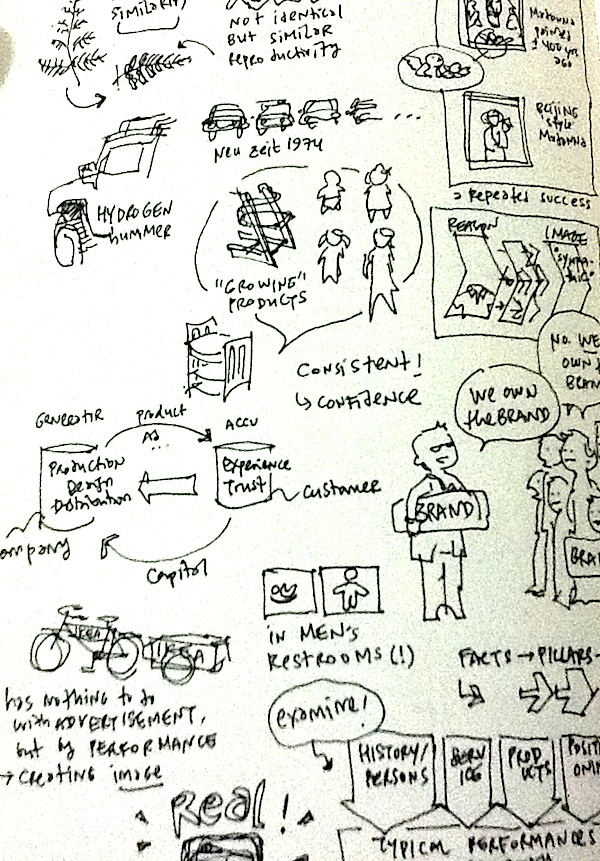
Brandsociology: how to develop & manage brands. There’s no rational or marketing reason for people to choose the range of prices of something they’d buy.

Currently, people are faced with endless choices in the market. They will have to choose which items to purchase, and they will choose the ones that have a positive prejudice. It takes years to create the prejudice.

Brand = advertisements + logo? Not so. Brand has to do with image.

There should be a repeated pattern – not identical, but similar reproduction.

A brand that consistently repeats success gains confidence and a sympathetic image.

performing, not just stating, your brand

Companies often said that they own the brand. Wrong. Actually customers, people, are the ones owning the brand, since it is formed in their minds.

An example is IKEA, the first shop that puts up the “baby” sign on men’s restroom, indicating gender equality when it comes to caring for a baby. They also provide bikes with a cart attached to each, to enable people, who shop at IKEA but drive no car, to bring their purchased items home.

These services have nothing to do with advertisement, but they create image for IKEA by performance.

Communication is important. Brand shouldn’t merely say what they are, but they should perform accordingly.

Combining things that are not usually combined is also a strategy to make a brand stand out.

=====

Q&A with Oliver:

certifications?

How did you raise the need for Magno? By relaying the true story about its production, and by not introducing it as a mass-product, but creating a connection between the producer and the end-users.

Did you do a marketing study before selling Magno to Europe? For the first generation of Magno, I did it by feelings. No prior market studies or anything, I’m not so comfortable in “targeting consumers”. Take Apple, there’s no market research prior to product creation.

How would you develop further products (from Indonesia) that can achieve the same success as Magno? Give a stage to one designer in an international trade fair or exhibition, who has a product ‘champion’. It would be much better compared to what has been happening: Indonesia is often represented in such events by the government but not in a good way. Often than not, the person standing at the booth know nothing about the products, and nothing is explained by the display, so the products get drowned among other products at the events.

=====

Magno in Germany. It started in 2006 when we had nothing but passion.

no prior market research

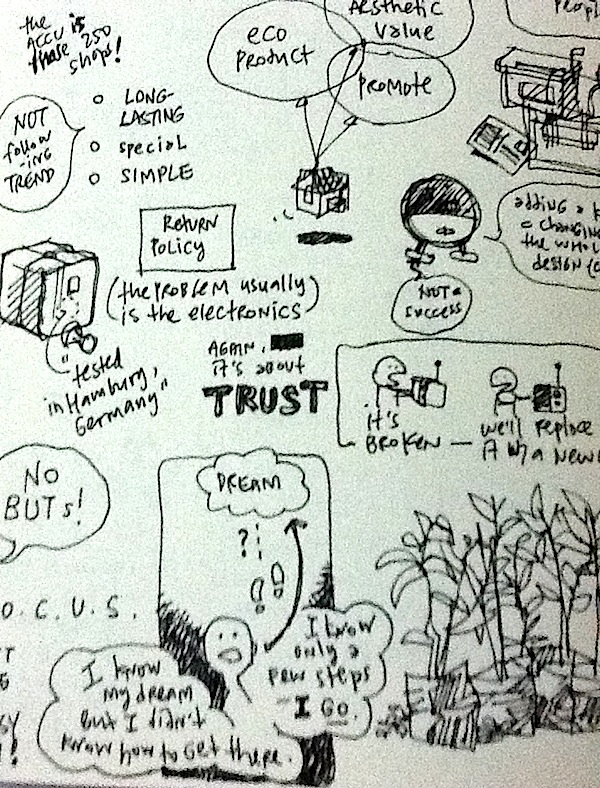
Today, we are specializing in fine EcoDesign products for European market only, based in Hamburg, distributes to 250 shops all over Europe, and frequent participants of renown international fairs, all based on trust.

People should LIKE the products first, then they could feel like they DO GOOD due to the background of the products. Not the other way around.

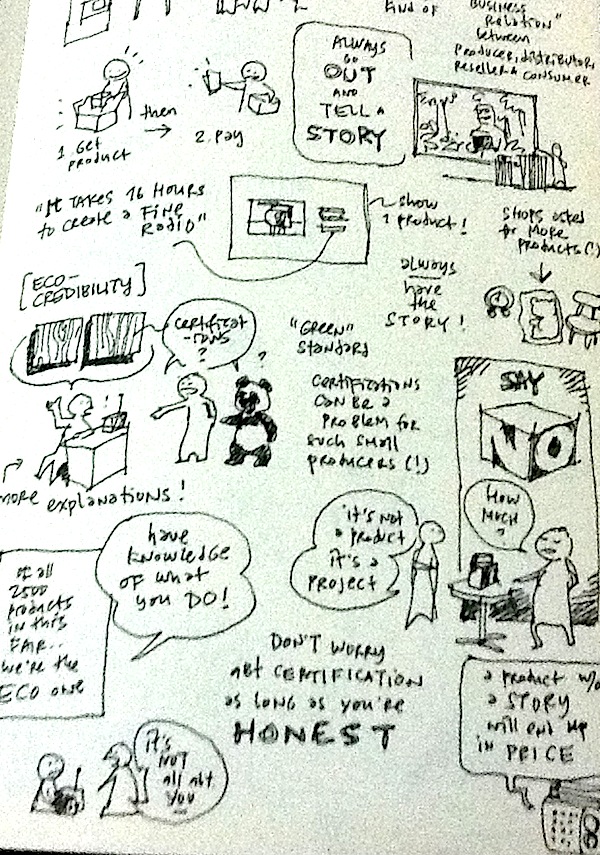
EcoDesign = creating another kind of “business relation” between producer, distributor, reseller and consumer.

Eco-Credibility and “Green” standard: certifications can be a problem for such small producers. Don’t worry about certification as long as you’re honest.

Learn to say NO. When asked about the price of Magno, the answer is that it’s not a product, but it’s a project. A product without a story will end up merely in (production) price considerations.

=====

Singgih:

I know only a few steps. I go.

It’s the smile. The first impression of people looking at Magno is a smile. That, for me, means that my design is a success.

We sometimes lose contacts with things we do.

Magno’s copyright has never been registered. Aren’t you worried about copycats? I’m not focusing on copycats, but on creating products that educate people.

People can copy the design but not the story behind.

Besides, it’s not easy to copy my products: the small Magno wooden radio series contain more than 100 steps to produce, and the table clock takes more than 70 steps.

The principles of Magno products are: long lasting, special, and simple. They don’t follow trends.

Indonesia is a country full of “but”s. People who want to start something commonly say, “Yes it’s possible, BUT…” – continued with difficulties they’re facing. Don’t take the easy way!

I know my dream, but I didn’t know how to get there. All I know is only a few steps. I GO.

=====

Magno site: magno-design.com

Jamu Gendong, Mutu-Coet

Still about surviving traditional artifact or habit that is actually a practice of ‘sustainability’, another groups presented jamu gendong, the traditional herbal drinks with certain medicinal purposes (jamu) that are sold by a woman who carry (gendong) the jamu bottles on foot, going around a marketplace or a neighborhood, and mutu-coet, a set of mortar-and-pestle made of stone that is still used to crush or ground food ingredients.

Jamu gendong

The group that proposed the subject of jamu gendong compared the system to food supplements or medications that are sold in conventional shops and come in packed pills. The group suggested to retain the system, since jamu gendong does not provide only herbal drinks, but also a social exchange between the seller and the customers. The conversation led to the fact that almost all local medicines are actually ‘modernized jamu‘, which are produced in a mass quantity to reach wider customers and therefore should be available in a more practical form (pills, capsules) and sold in vacuumed packages. It was also mentioned that some jamu gendong sellers are also using instant jamu (that comes in sachets) instead of fresh ingredients that they ground and mix themselves.

Jamu bottles

There’s also an issue of jamu gendong as a consumption of people from the lower class, and is only upgraded by having them in a gendong setting in restaurants and hotels, with ‘exotic’ and ‘traditional’ taglines. Seems like genuine jamu gendong is diminishing, since it is indeed rarely seen anymore in marketplaces and streets, especially in urban areas. But the need remains: both the genuine needs of people who actually consume jamu gendong for its purposes and people who don’t want to see the tradition diminishes and gone.

mutu-coet

The group that discussed mutu and coet, or pestle and mortar, stated that it’s not only the function of the set that’s irreplaceable, but also the myth that goes around it. It is believed, in Sundanese tradition, that a couple who wants to have a daughter should exchange a pestle with a mortar that belongs to a couple who wants to have a son, and vice versa. Mutu and coet are commonly made of volcanic stones and are known to be quite durable, the set is even handed down for generations. Food ingredients that are grounded with mutu and coet have different qualities in textures and taste, compared to those processed in an electric kitchen processor, and therefore are preferred in preparing (traditional) dishes. Like the jamu, it takes a certain skill to ground and mix food properly with mutu-coet, a skill that we might all lose when we stopped using them altogether.

What do they have to do with “sustainability”? Considering the issues of jamu gendong, mutu-coet and, previously, banana leaf as a food wrapper, they all come down to the matter of food and eating habit. It would lead to the discussion about fast food vs. slow food, energy-consumptive vs. labor-intensive process, time-saving vs. time-consuming, artificial vs. organic, etc. As people living in highly populated urban areas, with all those choices, we sometimes prefer to choose something fast and easy. We should be smarter in choosing what’s good not only for our body, but also for the resources they come from and the impacts they would cause.