Category Archives: bamboo

Be Like Bamboo

During a session of Culture and Creative Economy Foresight at The International Training Centre of the International Labour Organization in Turin (ITCILO), 23-25 April 2025, I was given this question, “Your early research explored bamboo—an incredibly adaptable, resilient, and regenerative material. If you had to design a learning ecosystem for creative entrepreneurs with the qualities of bamboo, what would it look like in 2035? What are the ‘bamboo-like’ skills we should be nurturing today?”

It was actually fun the make the analogy; big thanks to Stefano Merante for the question! 🙂

1 Resilient | For centuries, bamboo has been considered as a reliable structural material. It has been used as skyfoldings, bridges, towers, houses, and many more; its flexibility enables the bending techniques, its strength retains the forms while holding the burdens, its lightness makes it easy to transport and work with. It grows fast; it can be harvested within months, depending on the kind of products it is aimed for — hence earning its reputation as a renewable, rapidly regenerative material. It withstands new ‘tricks’, or new production processes, which makes it a potential material for the future. | Resilience in creatives should also make them spring back or stand a strain of challenges in their line of work; they should learn (grow) fast and be agile when faced with new ‘tricks’ (system, technology, environment, etc.) that would turn them into future-ready creatives. Creatives should also regenerate their skills, experience and knowledge, particularly considering the rapid acceleration of media and technology development.

The bamboo doodle on my sketchbook, made right after the session

2 Healing | Bamboo has numerous properties that make it welcome by all living beings in any environment. It releases more oxygen compared to average trees, its groves provide shadings and nesting spaces for a variety of small species (birds, insects, snakes); its hollow tubes are used as a cooking ‘pot’ and to hold liquids; its shoot is known as delicacies in many cultures; its roots neutralize the soil from toxic substances. Its positive impacts have been proven, recorded and measured. | Creatives should also spread goodness and heal, or provide solutions to, the issues they are delving in; their works should be impactful and relevant in a long term.                 

3 Binding | It is not directly visible, but the roots of bamboo – being actually a giant grass – connect and tangle beneath the ground. The roots form a network that binds the soil, strengthening its structure, preventing landslides at critical landscapes. The stronger the binds, the more solid the grounds, ensuring a more productive landscape. | Creatives rarely work alone; they would always establish networks in different ecosystems, creating resources and supports, ensuring strong advancements of their works.       

4 Vulnerable | Despite being praised as a “material of the future”, bamboo surely has its vulnerability. Once taken from its groves and unprotected by its silicon-invested skin, bamboo poles are prone to insect and fungi attacks. Therefore it requires proper preservation, appropriate treatments, and the right supports in order to be able to optimally perform. | Creatives often face multiple challenges, ending up in self burn-outs and substandard performance. Their vulnerability should also be addressed and coped with, to maintain productivity and excellence.    

There are a lot more to bamboo than this, of course, but that would take an entire book to write. But as far as creatives are concerned, these are at least the qualities of bamboo that we can relate to.


Bamboo Bike from Temanggung

Singgih S. Kartono, one of o2indonesia contributors, is currently testing his bamboo bike prototypes. In these series of photos, taken along the routes of Balun – Kelingan – Citran – Bendokuluk, he shows that bamboo has indeed been a part of village people’s daily lives. More photos from this trip can be seen in his Facebook photo album:  3rd Day Proto#2 Test

More albums that contain Singgih’s bamboo bike prototypes:

Bamboo bike testing

Prototype #2 Bamboo Bike Tested

2nd Day Proto#2 Test

Visit his Facebook for more photos about bamboo bikes, bikes, design workshops, Magno wooden radio, and the mesmerizing, tranquil scenery of Temanggung, Central Java, where he set up his design studio, manufacture and home: https://www.facebook.com/singgih.s.kartono

bamboosinggih01 bamboosinggih02 bamboosinggih03 bamboosinggih04 bamboosinggih05 bamboosinggih06 bamboosinggih07 bamboosinggih08 bamboosinggih09 bamboosinggih10 bamboosinggih11

Design Thinking? Design Action!

Design Thinking? Design Action!

Catatan dari d.confestival di Jerman, 20-22 September 2012

Tita & Fiki, dengan latar tenda sirkus yang merupakan venue utama d.confestival

Tita & Fiki, dengan latar tenda sirkus yang merupakan venue utama d.confestival

Pada tanggal 20-22 September 2012 lalu, BCCF diundang ke Jerman untuk berpartisipasi dalam d.confestival, sebuah konferensi internasional pertama mengenai Design Thinking yang diadakan di Hasso-Plattner-Institut (HPI) School of Design Thinking di Potsdam. Dalam acara ini BCCF diminta untuk mempresentasikan program-programnya yang telah dan sedang berlangsung, terutama yang berhubungan dengan tema d.confestival ini: Re-Designing Your City. Awalnya adalah ketika direktur dari HPI School of Design Thinking, Prof. Ulrich Weinberg, yang berada di Bandung sebagai salah satu pembicara utama di Artepolis ITB, hadir di Lightchestra. Lightchestra yang digelar sebagai acara pembuka Helarfest2012, berupa sebuah konser musik dan cahaya di hutan Babakan Siliwangi dengan tujuan mendekatkan masyarakat pada keberadaan Hutan Kota Dunia tersebut, rupanya sangat berkesan bagi Prof. Weinberg, apalagi setelah beliau mendapatkan informasi mengenai berbagai program yang telah digarap oleh BCCF. Prof. Weinberg menyatakan bahwa yang telah dilakukan oleh BCCF dan berbagai komunitas di Bandung adalah aplikasi Design Thinking yang sebenarnya, yang selama ini teori dan konsepnya mereka sampaikan di kampus-kampus d.school (sebutan untuk School of Design Thinking), sehingga beliau mengundang BCCF untuk tampil dalam d.confestival sebagai salah satu presenter.

Salah satu diorama di d.school

Salah satu diorama di d.school

Di d.school ini, para mahasiswanya terdiri dari mahasiswa dari perguruan-perguruan tinggi yang berbeda, dengan disiplin ilmu yang berbeda pula, yang bergabung selama satu tahun dalam d.school untuk bekerja dalam tim dalam menyelesaikan permasalahan dan tantangan yang diberikan oleh berbagai perusahaan yang berkolaborasi dengan HPI. Setelah masa ini selesai, para mahasiswa kembali ke kampus asalnya masing-masing dan menyelesaikan studinya di sana, namun semuanya telah membawa pengalaman Design Thinking, kreativitas, dan semangat berkolaborasi antar disiplin ilmu. Sehingga tidak heran bila peserta d.confestival ini tidak hanya terdiri dari desainer, seniman atau orang-orang yang bekerja dalam bidang “kreatif”, tapi berasal dari berbagai bidang ilmu, seperti ekonomi, sosial, kimia, teknologi informasi, dan sebagainya.
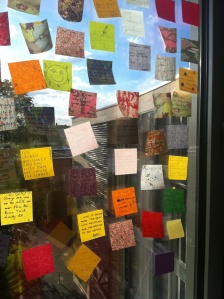
Salah satu proses studi design thinking dengan menuangkan ide lewat tulisan di atas Post-It warna-warni

Salah satu proses studi design thinking dengan menuangkan ide lewat tulisan di atas Post-It warna-warni

Acara yang berlangsung selama tiga hari tersebut digelar di kampus HPI, dengan tema “Sirkus”, sehingga venue utamanya bukanlah sebuah aula biasa, melainkan sebuah tenda sirkus yang didirikan di lahan kampus. Untuk melengkapinya, serombongan pemain sirkus profesional dikerahkan untuk menyelingi acara. Jadi tidak heran bila di kampus tersebut tampak berkeliaran pengendara sepeda roda satu, juggler, dan sebagainya. Hal ini mengakibatkan suasana konferensi menjadi lebih mudah cair, dan – terutama karena bentuk ruang yang bundar – menghilangkan hirarki antara para ahli yang menjadi narasumber berpengalaman, dengan para mahasiswa dan peserta lain.

Detail dari acara ini pun digarap dengan baik. Mulai dari gelang semi-permanen yang menjadi “tanda masuk” peserta di semua venue, “koin HPI” yang digunakan di setiap waktu makan, hingga bantal dan selimut berwarna oranye cerah yang disediakan di tenda-tenda makan semi terbuka.

Hari pertama diisi dengan presentasi para pembicara utama dan beberapa sesi parallel. Hal yang paling menarik di hari ini adalah presentasi berjudul The Difference between Design Thinking and Design, yang dibawakan oleh Oliviero Toscani (fotografer, desainer kampanye iklan kontroversial United Colors of Benetton) dan George Kembel (co-founder dan Direktur Eksekutif d.school Stanford University), di mana keduanya menjelaskan posisi masing-masing dalam isu Design Thinking ini.
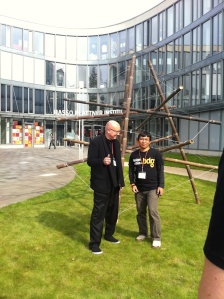
Prof. Ulrich Weinberg, direktur HPI d.school dengan Andry dan struktur bambo tensegrity yang baru selesai dibangun

Prof. Ulrich Weinberg, direktur HPI d.school dengan Andry dan struktur bambo tensegrity yang baru selesai dibangun

Hari kedua adalah di mana tim BCCF melakukan presentasi dan dua workshop. Dalam salah satu workshop ini, BCCF berkolaborasi dengan Andry Widyowijatnoko, dosen Arsitektur ITB yang baru menyelesaikan studi doktoralnya di Aachen. Di workshop ini Andry mengundang peserta untuk membangun bamboo tensegrity structure, di mana batangan-batangan bambu saling terhubungkan dengan tali logam, tanpa saling bersentuhan. Ketika seluruh bagian bambu dan tali logam sudah selesai dihubungkan, struktur bambu ini dapat diposisikan dalam berbagai arah. Struktur bambu ini kemudian berfungsi sebagai semacam tiang ‘totem’, di mana semua orang dapat berjejaring dengan menggantungkan identitas dan pesannya mengenai Design Thinking yang dituliskan di atas kertas yang disediakan oleh BCCF.

Di workshop yang satu lagi, tim BCCF berkolaborasi dengan Prof. Eku Wand dari HBK Braunschweig dan KBRI di Berlin, mengajak peserta bermain angklung. Hubungannya dengan Design Thinking? Di sini angklung merupakan representasi dari individu, yang memiliki karakter tersendiri. Namun sebuah lagu hanya dapat dimainkan bila masing-masing angklung dapat bekerja sama dan saling melengkapi, seperti halnya kolaborasi antar disiplin ilmu dalam mencapai inovasi.

Presentasi dilakukan di Feedback Room, di mana kasus “Redesigning Your City” di berbagai belahan dunia ditampilkan, masing-masing selama 15 menit, lalu dilanjutkan dengan diskusi dan tanya-jawab. Karena keterbatasan waktu, tentu tidak semuanya mendapat kesempatan menanggapi, sehingga setiap orang yang masuk mendapatkan satu lembar kertas untuk diisi dengan tanggapan, usulan, dan sebagainya. Kertas tanggapan ini, setelah diisi, dapat diberikan langsung pada presenter yang membawakan subyek yang ditanggapi.

Presentasi di Feedback Room

Presentasi di Feedback Room

Dalam kesempatan ini, tim BCCF menyampaikan sekilas informasi mengenai Bandung (ada pertanyaan, “Bandung itu kota di negara apa?”), sejarah berdirinya BCCF, dan aktivitasnya yang “merancang ulang kota”, seperti TUNZA, Lightchestra, Kampung Kreatif, dan Semarak.bdg, dan berbagai program Urban Acupuncture yang telah dan sedang dilaksanakan. Di awal presentasi, BCCF menyatakan belum pernah mendalami Design Thinking, meskipun menurut Prof. Weinberg menyatakan bahwa yang kita lakukan selama ini adalah Design Thinking, sehingga yang disebutkan di presentasi (dan semua materi yang dibawa) menerakan Design Action, sebab itulah yang kita lakukan. Selain slide, BCCF juga menampilkan video-video pendek dari berbagai event tersebut. Tanggapan yang diperoleh BCCF sangat positif, sebab rata-rata yang hadir, pada awalnya belum pernah mendengar tentang Bandung, namun langsung menyatakan ketertarikannya untuk mengunjungi Bandung dan melihat sendiri program-program BCCF, dan bahkan menyatakan minat untuk berkolaborasi dengan kota asal mereka masing-masing. Hal yang dinilai paling menonjol dari BCCF adalah kemampuan kita untuk berkumpul dan bekerja sukarela demi kehidupan kota yang lebih nyaman untuk semuanya, dan semangat kita untuk selalu berbagi, yang seluruhnya dilakukan dengan cerdas dan dengan daya kreatifitas tinggi.

Di hari ketiga, yang merupakan hari terakhir dari rangkaian d.confestival, tim BCCF menyimak presentasi Prof. Kees Dorst (dari Sydney University of Technology), yang menguraikan konsep dan analisa mengenai Design Thinking, yang memetakan berbagai kasus yang terjadi di Sydney. Dari presentasi ini lah BCCF menyadari bahwa kekurangan utama kita adalah hampir tidak adanya analisa atau evaluasi yang terstruktur terhadap berbagai program yang selama ini kita jalankan.

Ruang bundar di tengah-tengah tenda sirkus di penutup acara

Ruang bundar di tengah-tengah tenda sirkus di penutup acara

Di akhir acara, penyelenggara mempersilakan siapa pun yang bersedia untuk maju dan duduk di tengah-tengah lingkaran tenda sirkus, untuk dapat mengutarakan pendapat, kritikan, dan sebagainya, terhadap Design Thinking dan d.confestival. Hal ini juga di luar kebiasaan konferensi pada umumnya, di mana hal-hal disimpulkan dan dibuatkan resumenya oleh sebuah tim perumus yang terdiri dari orang-orang yang terpilih. Saat penutupan d.confestival, tim BCCF mendadak diminta untuk sekali lagi melakukan workshop angklung untuk seluruh peserta. Sambutan para peserta terhadap acara penutupan ini sangat meriah, dan permainan angklung berhasil meninggalkan kesan gembira bagi setiap peserta yang hadir.

Sisa waktu di Berlin dimanfaatkan oleh tim BCCF untuk membuka kontak dan mengawali jejaring dengan berbagai komunitas dan organisasi di Berlin, seperti Create Berlin, Webcuts, Asia-Pacific Berlin Forum, dan International Design Center Berlin. Berbagai rencana kolaborasi telah didiskusikan, dan siap untuk dilanjutkan dan diwujudkan oleh berbagai komunitas di Bandung. Berikutnya? BCCF harus tetap mempertahankan kontribusi positifnya terhadap Kota Bandung, dan Bandung harus sanggup menjadi tuan rumah untuk acara sejenis d.confestival, yang berskala internasional dengan detail yang digarap baik, dan melibatkan berbagai unsur masyarakat dan disiplin ilmu, demi memperoleh solusi yang inovatif dalam menghadapi tantangan kehidupan urban di masa mendatang.

Oktober 2012,

Tim BCCF: Fiki & Tita

Why do people run out of a building when a quake happens?

Because it’s not the quake that kills them; it’s the building. Why do we make unsafe buildings? Don’t we learn anything from nature that has produced excellent examples of perfect shelters?

One of Prof. Bando’s presentation slides, showing viruses, ‘sheltered’ by their forms

These questions were often heard recently at our department, Industrial Design at ITB, during lectures by Professor Takaaki Bando, from Science of Design Department, Musashino Art University, Tokyo, who has been staying for almost one year in Bandung. His passion toward biomimicry, Buckminster Fuller’s concepts, bamboo and structures is obvious from his energy during the presentations. Now that his one-year period at ITB is almost up, as a closure Prof. Bando conducts a Bamboo Shelter Project. He’ll deliver an open lecture concerning this project so, comprehensive explanations should come from him, but as far as I know, this project is a realization of a shelter concept that is save for people living in it during quakes, flood, and such. The form is obviously a slight modification of a Bucky Ball, which is strongly inspired by structures of virus molecules and the form of Apollo 11 that landed the first human on the moon in 1969 (Prof. Bando has also delivered a lecture concerning interconnected inspirations within the history of great designs).

Detail of the structure’s joint system

This project involves not only students from Industrial Design department, but also from other departments in ITB such as Architecture, Interior Design, Visual Art, Aerospace Engineering, and Civil Engineering.

The realization itself is not without challenge. First, it was the supply of material – in less than one week, around 800 sliced bamboo had to be provided, cut according to the precise, required measurements. A number of requirements had to be compromised, among others concerning the bamboo slices: initially, the skin of the bamboo should still be intact, which was not possible considering the amount of wasted slices that would be generated while lots of slices are needed. This skinless-bamboo condition might affect the strength of the structure, but we’ll never know for sure until we try it full scale. All other flaws, especially the detailed, technical ones that are happening during the building process, are not ones that can’t be solved, and they added to the valuable experience.

How the shelter looked on Day-3: still completing the ball shape, before inserting the platform (support) into the ball

Although not fully equipped with ‘real’ dwelling facilities, this bamboo structure serves as a model of a safe shelter. As Prof. Bando mentioned in one of his lectures, “Design does not explain how society is, but how it can be”. This bamboo shelter is surely the beginning of a process in discovering how humanity may thrive and cope with extreme global changes. So- let’s discuss some more: you’re all welcome to attend Prof. Bando’s lecture on Monday, 26 March 2012 at FSRD ITB!


Bamboo Products Exhibition at Rempah, Solo

Promotional poster for the exhibition

This post is perhaps a press release that didn’t get written in due time. It’s about our exhibition in Surakarta (or Solo, as people here say), a town in Central Java that is recently known as progressing in preserving local cultures and resources, thanks to the modest, smart mayor. “Our” refers to the Industrial Design research group I belong to, at Institute of Technology Bandung (ITB), and the “exhibition” includes bamboo products with contemporary styles and production processes that have been developed in the past couple of years. The exhibition took place on 10-19 December 2011, hosted by Rempah Rumah Karya, whose owner is a businessman with progressive visions.

Rempah itself needs its own explanation, but to keep it short, it’s a place where designers/ craftsmen/ cabinet makers/ students/ etc. can stay, develop and create their products with available supports: guest rooms, a workshop with wood-working tools and machines, an office, materials, and whatever else. The place had its soft-opening in July 2011 and is still being worked on, but its direction is quite visible already: almost all materials are reused pieces, retaining their rustic look, and natural lighting and ventilation are kept to maximum.  A place that can intrigue a mood to create.

The front yard of Rempah, the roof is iron beams and plant pots, so it provides shading but not sheltering from rain

Anyway. Back to the exhibition. The owner of Rempah and I actually met at a workshop in Temanggung previously, where I presented some slides that showed our bamboo products. We were then invited to hold an exhibition at his place, which we accepted happily. Come to think of it, we have been developing bamboo products since 2008, and not once had the products been exhibited outside academic/research contexts(!). So the invitation was truly an opportunity to have our products ‘tested’ publicly, especially to (potential) costumers and, most importantly, to (furniture) industry professionals such as the Rempah owner and his colleagues.

The bamboo products we brought were results of experiments in forms and production processes, often collaborated with research institutions and craftsmen. We made a sort of ‘family tree’ for our bamboo products, all were produced with different means but all have the similarity of aiming for contemporary lifestyles and to eliminate the stigma of bamboo as a ‘cheap’ material. According to the family tree, these products started from an experiment that was conducted in a collaboration with the Biomaterial R&D Unit of the Indonesian Science Institute (LIPI), which resulted in pressed bamboo strips and containers. The next collaboration, with craftsmen of Tasikmalaya, resulted in coiled bamboo disks that were made into stools. The legs of the first generation of the stools, pressed bamboo beams, were made by the R&D Center of Housing Technology (Puskim) that belongs to the Indonesian Department of Public Works. On to the next variants of the stools, different legs were designed to try different possibilities. A huge coiled bamboo disk was formed into a wide round seat, supported by a rattan structure (which is rare, since rattan is considered a ‘non-structural’ material that fits only for weaving and tying).

Setting up the display at Rempah

Next to coiling, we also presented our bamboo veneer and ‘wengku’ (bending bamboo strips into closed-curves) products: food containers, a set of cutlery, sling bags, backpacks, etc. The technique might not look new, since it’s been conducted in other countries where bamboo grows as well, but we wouldn’t know our capacities until we tried the basic ones to our SME. During our research, we had to introduce new techniques and standards that required some adjustments and, of course, an acceptance from the producers/ craftsmen as a production unit.

When shown to industry professionals, of course it was discovered that more adjustments should be made of the bamboo products, in order to fulfill safety standards, etc. However, the exhibition had raised a notion that a design research and development is necessary in a search for new products and innovation, both in forms and production process. It should also be noted that a production system also relies on constant material supply. Concerning bamboo (furniture, home accessories) products, we still need proper bamboo propagation for such industry purposes.

Exhibition: display

The next day after the opening we held a discussion session, which also opened new viewpoints toward bamboo products, contemporary design, new methods of processing, etc. The audience were students of diverse backgrounds, artists, industry professionals, etc. All in all it was a productive but relaxed event, of which hopefully new insights could be acquired, concerning wise and creative utilization of our natural resources. It is hoped also that this exhibition is a start of a continuous collaboration among the fields of academics and industries, which could be accelerated with appropriate supports from the government.

Laminated Bamboo Stool

Sadhiya Hanindita completed his study at the Industrial Design Program, FSRD ITB, in early 2011. His final project was an exploration of laminated bamboo technique, applied to furniture for children – in this case, preschool kids’ classroom stool. He collaborated with a preschool in Bandung during his research, where he could observe the students’ behaviors in the classroom, especially when interacting with their seating facilities. He focused also on the potentials of Indonesian bamboo craftsmen in rural areas in the production process, in order to make sure of the production feasibility, by actually working together with local craftsmen in producing his prototypes.

Although the bend-press and/or laminating method has been known worldwide, it is the first time it was practiced in a semi-industrial setting, with particular production concept in mind. The result was satisfactory, although improvements can be made for a number of details, such as the joints and the cushions. However, this product is expected to set off a lot more explorations in bamboo-based products for contemporary needs, yet with production processes that are suitable for Indonesian craftsmen and SME. Following are photos of the prototypes and a couple of slides from his presentation materials.

[klipping] Fight Climate Change with Bamboo!

An article from World Bamboo: http://worldbamboo.net/cop16-cancun/fight-climate-change-with-bamboo/

In addition to providing livelihoods for people, bamboo forests would be an invaluable weapon against carbon dioxide (CO2), the principal greenhouse gas, through photosynthesis, INBAR said.
Some species of bamboo can suck up CO2 at least as fast as Chinese fir and eucalyptus, among the swiftest-growing commercial species of trees, according to a scientific report presented last month.
In addition, bamboo roots reduce soil erosion, preventing hillsides and riverbanks from washing away in floods and landslides.

Bamboo Modular Furniture for Post-Disaster Shelters

This furniture set is a graduation project at the Industrial/Product Design Section of the Faculty of Arts and Design at Institute of Technology Bandung (ITB), Indonesia. The student (now designer/fresh graduate), Artha Sanjaya, has been interested in exploring bamboo in the recent years of his study at ITB. His project concerns not only the ‘new’ treatment to bamboo as a constructional material, but also how bamboo can be quickly acquired, built and used in a post-disaster condition (provided the availability of abundant bamboo groves). Artha has conducted a number of experiments in forming bamboo for construction purposes; he also contacted an Indian designer whose construction type “Truss Me” inspired him, who allowed him to develop and modify the treatments and applications.

Following are a number of slides from Artha’s materials that were presented during his project defence.

Experiments

A slide that shows the results of his experiments and a brief analysis that ends up in the choice of construction variation.

Sketches

Samples of sketches in the process of determining the forms and assembling phases of the products (a set of furniture for temporary shelters)

Final Design

Here are the variations he came up with. Below at the left handside is the basic module, which, after assembling, can be formed into shelves, a table and a low bed.

Building prototypes

In building the prototypes, Artha was assisted by a local bamboo craftsman. These photos show a bit of the process.

Manuals

Artha also included a booklet that includes a guideline in how to build the furniture.

Artha graduated with a satisfactory grade in 2010. He currently lives and works in Bandung.


Hybrid Methods for Bamboo Product Enterprises in Indonesia

This article is published by the American Bamboo Society in BAMBOO Magazine (December 2010). I received the magazine yesterday, sent by BAMBOO Magazine editor, Betty Shor.

BAMBOO Magazine, ABS, Dec 2010

My article starts at page 13 and ends at page 16. All photos in this magazine are black and white.

Page 13, where the article starts

Hybrid Methods for Bamboo Product Enterprises in Indonesia

In Indonesia, where 11% of bamboo species grows indigenously (KLH, 1998), bamboo has been used for centuries for various purposes, from construction and furniture to musical instruments and kitchen utensils. Bamboo has been carrying the stigma of being a substandard material, due to lack of its application to permanent contemporary products. However, since the emergence of global issues concerning environmental qualities and sustainability, bamboo started to gain attention as a potential material to supplement or substitute wood or other conventional materials for construction, furniture or other products.

Bamboo product manufacturing methods in Indonesia are categorized into traditional and advanced methods. The traditional methods are generally applied by Small- and Medium-sized Enterprises (SME) and home industries, which are located in rural areas. The workers are craftsmen who inherit their weaving and carving skills from their predecessors, using simple household tools (often only a single knife), producing bamboo products whose designs have existed for generations and are used for their original purposes as kitchen utensils, containers, etc. The advanced methods are commonly conducted by research/academic institutions and particular companies who have access to technology and other resources. They manufacture bamboo products using conventional machineries, or machines that are specifically designed for processing bamboo, commonly resulted in laminated boards.

These two methods, however, are not quite strategic for the development of bamboo products in Indonesia, especially if the main purpose is to change people’s perception on bamboo: no longer as a substandard material, but as a potential, durable material that fits current needs and demands. On one hand, Indonesian bamboo products manufactured with traditional methods can hardly compete with traditional bamboo products from other countries, or with mass-manufactured products made of other materials with similar functions. Moreover, the products retain their ‘traditional’ image, which limits their market to people who want them for their exoticism. On the other hand, bamboo products that are manufactured with advanced methods require substantial efforts in order to guarantee raw material supply, mass-production machineries, financial capital and other resources, which would be impracticable for the near future. Therefore, applicable, appropriate methods for bamboo product manufacture in Indonesia are necessary, here of which hybrid methods are proposed. The hybrid methods are combinations of traditional and advanced methods in three levels, as follows (Fig.1. Levels of Technology in Bamboo Product Enterprises in Indonesia):

–       Modified Traditional Method, in order to create improved traditional products

–       Combination of Traditional and Advanced Methods

–       Adapted Advanced Method, which is adjusted to the conditions of the producer communities

All hybrid methods put an emphasis on labor-intensive industry in a modified SME, involve a considerable portion of a designer’s role in increasing product values, and aim the product to users or consumers with contemporary lifestyles.

Fig.1. Levels of Technology in Bamboo Product Enterprises

As an attempt to demonstrate the concept of hybrid technology for manufacturing bamboo products that fit current lifestyles, a number of prototypes have been produced in different occasions, using various techniques and resources. Among the first ones was a set of eating utensils made of bamboo veneer and bamboo splits, which required no weaving technique (Fig.2. Bestrek). Further design explorations resulted in another set of eating utensils that were mainly made using bamboo veneer (Fig.3. Pincuk). This set was designed along with creating a prototype of a manually, one-man operation bamboo veneer machine, considering that the manual bamboo veneering technique is gradually diminishing among current craftsmen.

Fig.2. Bestrek Set

Fig.3. Pincuk Set

More experiments using veneer and customized, precise handy work resulted in lighting facilities (table lamp and hanging lamp), produced by Apikayu Foundation, an establishment that focuses on community development through design and local natural resources (Fig.4. Apikayu). Common technique that is employed to make a certain kitchen utensil is now applied to an entirely different form that can function as a frame of a bag called Taraje (Fig.5a & 5b. Taraje). One last example is a couple of bamboo stools (Fig.6. Stoolboo) that were produced by applying the adapted advanced method. These hybrid products prove that bamboo products can have an entirely different appearances and performances compared to the existing bamboo products that are known in Indonesia. By developing the designs and the industries that produce the improved bamboo products, it is expected that bamboo could be recognized as a potential industrial material and could provide income for SME.

Fig.4. Experiments by Apikayu Foundation

Fig.5a. Taraje Bag

Fig.5b. Taraje Bag

Fig.6. StoolBoo

Dwinita Larasati

I was born in Jakarta, Indonesia, in 1972. I studied Industrial Design at the Institute of Technology Bandung (ITB) until 1997, with a graduation project on advanced treatment for bamboo as a construction material in Indonesia, with a design of a bamboo garden hut (a gazebo) to demonstrate the concept, collaborating with the Applied Physics Department of the Indonesian Science Institute (LIPI). I chose to work on bamboo material exploration for my graduation project, since I acquired a substantial amount of data and information about bamboo from the International Bamboo Congress that was held in Bali in 1995 and believed that, from the design perspectives, bamboo actually has a huge opportunity to be developed and that bamboo should be regarded as a valuable material.

In 1998 I continued my study to the Industrial Design Postgraduate Program at The Design Academy Eindhoven, The Netherlands. I acquired my Master of Arts in Design Research with a thesis titled Uncovering the Green Gold of Indonesia, about bamboo as a competent material for industrial and constructional products, emphasizing on the application of appropriate technology. Dr. Jules Janssen acted as one of my tutors during this study. The Hybrid Methods that are proposed as an appropriate technology for Indonesian bamboo product enterprises are the main content of my thesis, of which development and examples are continuously being made up to present. In 2007 I completed my doctoral research at Delft University of Technology, The Netherlands, with a dissertation about sustainable housing in Indonesia, with bamboo housing as study cases. Dr. Janssen acted as a supervisor and examiner during the last half of my research. Returning to Indonesia, and back to working at ITB as a lecturer and researcher at the Industrial Design department, I proceed with my bamboo research as it is gradually getting more popular. The examples of bamboo hybrid products that are presented in the article are results of design competitions, workshops, exhibitions and research projects, which were conducted following my return to Indonesia. It is due to the hybrid technology research for Indonesian bamboo products and enterprises that I received an award as a Technology Innovator on the 15th National Technology Resurrection Day in July 2010, which focused on the theme “Strengthening the National Innovation System”.