Category Archives: design

contribution to improve and encourage sustainable life style by design

I wish these trees could stay…

The story of Babakan Siliwangi Forest Walk goes a long way back, although the Forest Walk itself has been around for only less than three months. I won’t go in length here to tell the story, but anyone living in Bandung knows that Babakan Siliwangi (Baksil) has become one of the most disputable areas in Bandung, concerning building rights and ownership status. Being about the only forest in a dense urban area that is gradually being cramped by concrete buildings, roads and automobiles, it naturally becomes our concern to protect it. The concern becomes more intense upon knowing that a developer plans to build multi-stories apartment, a restaurant, and so on. The struggle goes on, especially since the municipal government seems to take on the developer’s side instead of ours.

Baksil Forest Walk

Therefore it was such an opportunity when about 1300 children and youths from 120+ countries gathered in Bandung for the TUNZA event in September 2011, held by The Indonesian Ministry of Environment (KLH) and The United Nations Environmental Program (UNEP). The venue was SABUGA conference hall, which is actually located within the Baksil area, so it was relatively easy to grab the attention of whoever attended and/or covered the event to the preservation of Baksil forest. Partnering with KLH, Bandung Creative City Forum (BCCF) therefore made sure that the following important events happened during TUNZA: the launching of Baksil as The World City Forest, the opening of Baksil Forest Walk, and the declaration of Urban Farming Global Network. Why are these things important? They somehow validated the existence of Baksil as a city forest that needs to be conserved, voiced by the world’s young generations, who are going to face the consequences of what we do today.

Here’s a video that shows a glimpse of BCCF contribution to the TUNZA event.

Back to the Forest Walk. It’s such a shame if you lived in Bandung, especially in the Northern part, and had never experienced the Walk. It was build at the height of the trees, so one doesn’t walk below the trees, next to the roots on the ground, but at the level of the trees’ huge branches, leaf crowns and the hanging, curtain-like roots. The Walk was built without disrupting any tree, giving way for them to keep living and growing by providing holes wherever necessary.

Dhanu's "Apple Birdhouse"

I took our kids to the Walk in separate times. Getting back home, Dhanu (10) who read about the fact (at info boards placed along the Walk) that Baksil is a habitat for various animals, especially birds, right away designed a birdhouse for the birds that live in the forest. Lindri (8), who was very much impressed by her surroundings, spontaneously exclaimed, “I wish these trees could stay forever”.

Lindri at The Forest Walk

Her wish, I’m sure, also belongs to a lot of people who live and breathe the air of Bandung. Baksil is among a few green sites in the city that provide us with oxygen, and whoever plans to demolish these sources must be ignorant of common human rights to have access to clean air and water. Baksil Forest Walk is a design that serves as a form of protest, to show what people actually want and need, as opposed to what the government and the developer have planned. Let’s just hope that the Walk stays intact, or even grows bigger, and that people can take care of it: keeping it clean, safe and comfortable. Let’s express our care for the site by enjoying the space, making it our playground – like HUB!, a community that concentrates on having fun activities at Baksil, does.

Save. Babakan. Siliwangi.

Indonesia is a country full of “but”s!

MAGNO workshop, October 16, 2011

positive prejudice

In such a short notice, Singgih managed to invite his friends and colleagues to Temanggung for a one-day workshop with Oliver Errichiello, who distributes Magno products in Europe. About 30 people, a mix of students, designers, academics, entrepreneurs, etc. from Bandung, Yogyakarta, Solo and Jakarta, gathered in Kandangan Village, Temanggung, that day. For Oliver, who has been working with Singgih for five years, it was his first time to visit Indonesia and Magno production site. The workshop started at about 9AM and was divided into two sessions, the first one was a presentation about “BrandSociology” by Oliver, who is also a sociologist and a lecturer at a university in Hamburg, Germany, the second one was when he presented about Magno in Europe. The two sessions were split by a break, where all participants visited the old (first) Magno production site: a rented neighbor’s house, which is within a walking distance from the current site, before having lunch back at Magno. The sessions were closed with presentations from the audience about their products, which gained comments from Oliver, Singgih, and Katrin Greiling, a designer from Sweden who currently resides in Bandung and went to Temanggung with us.

Following are some pointers taken during the day.

=====

Singgih started his introduction by showing a photo of Oliver and his family. “Business is not about transaction. It’s about interaction”, he said, explaining that it is more comfortable to exchange ‘business’ emails with a personal touch.

=====

Oliver and audience (photo by: S.Riyadi)

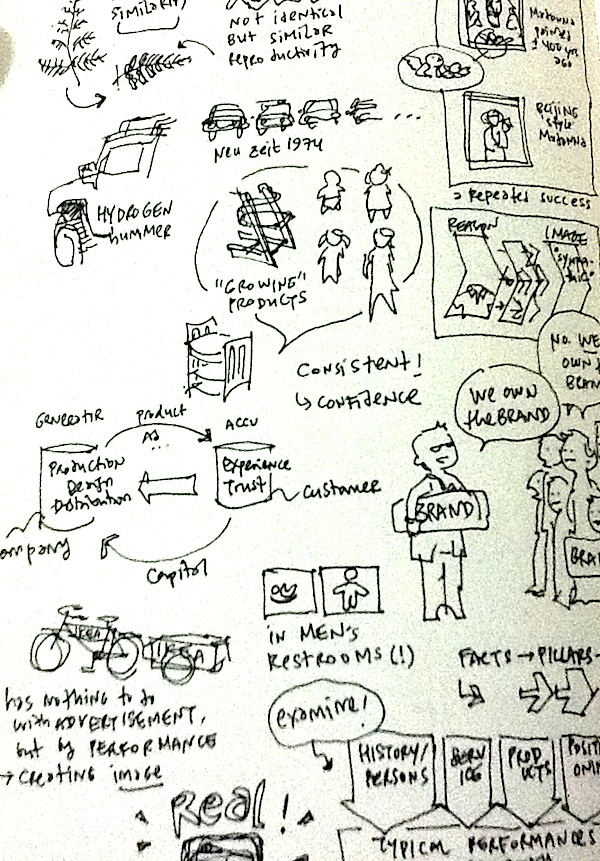
Brandsociology: how to develop & manage brands. There’s no rational or marketing reason for people to choose the range of prices of something they’d buy.

Currently, people are faced with endless choices in the market. They will have to choose which items to purchase, and they will choose the ones that have a positive prejudice. It takes years to create the prejudice.

Brand = advertisements + logo? Not so. Brand has to do with image.

There should be a repeated pattern – not identical, but similar reproduction.

A brand that consistently repeats success gains confidence and a sympathetic image.

performing, not just stating, your brand

Companies often said that they own the brand. Wrong. Actually customers, people, are the ones owning the brand, since it is formed in their minds.

An example is IKEA, the first shop that puts up the “baby” sign on men’s restroom, indicating gender equality when it comes to caring for a baby. They also provide bikes with a cart attached to each, to enable people, who shop at IKEA but drive no car, to bring their purchased items home.

These services have nothing to do with advertisement, but they create image for IKEA by performance.

Communication is important. Brand shouldn’t merely say what they are, but they should perform accordingly.

Combining things that are not usually combined is also a strategy to make a brand stand out.

=====

Q&A with Oliver:

certifications?

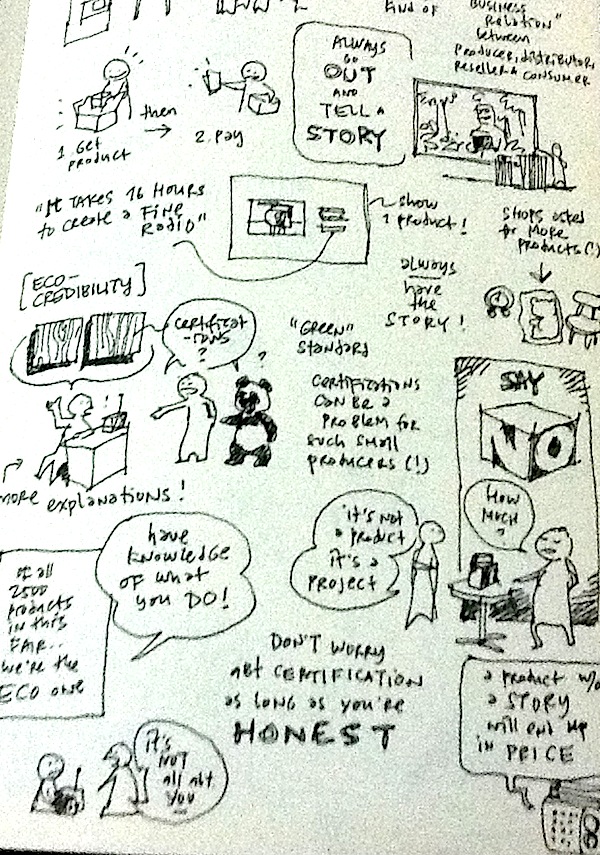
How did you raise the need for Magno? By relaying the true story about its production, and by not introducing it as a mass-product, but creating a connection between the producer and the end-users.

Did you do a marketing study before selling Magno to Europe? For the first generation of Magno, I did it by feelings. No prior market studies or anything, I’m not so comfortable in “targeting consumers”. Take Apple, there’s no market research prior to product creation.

How would you develop further products (from Indonesia) that can achieve the same success as Magno? Give a stage to one designer in an international trade fair or exhibition, who has a product ‘champion’. It would be much better compared to what has been happening: Indonesia is often represented in such events by the government but not in a good way. Often than not, the person standing at the booth know nothing about the products, and nothing is explained by the display, so the products get drowned among other products at the events.

=====

Magno in Germany. It started in 2006 when we had nothing but passion.

no prior market research

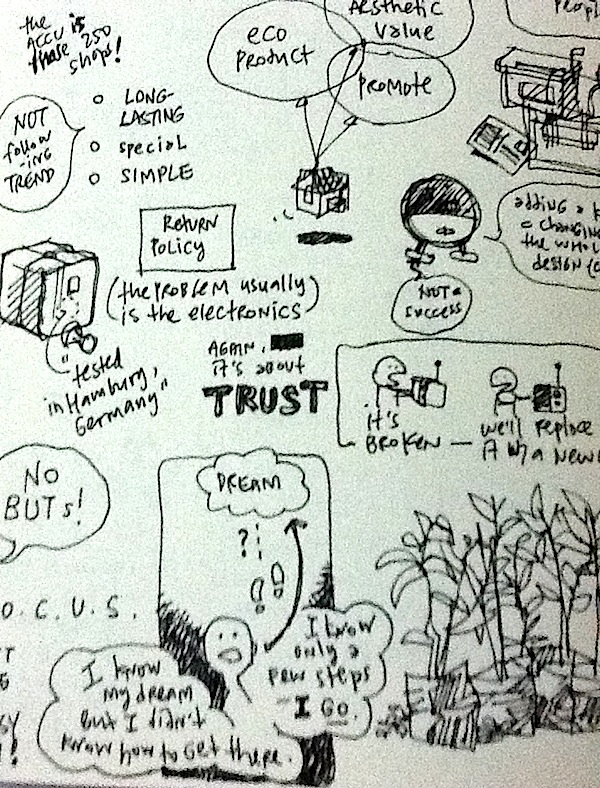
Today, we are specializing in fine EcoDesign products for European market only, based in Hamburg, distributes to 250 shops all over Europe, and frequent participants of renown international fairs, all based on trust.

People should LIKE the products first, then they could feel like they DO GOOD due to the background of the products. Not the other way around.

EcoDesign = creating another kind of “business relation” between producer, distributor, reseller and consumer.

Eco-Credibility and “Green” standard: certifications can be a problem for such small producers. Don’t worry about certification as long as you’re honest.

Learn to say NO. When asked about the price of Magno, the answer is that it’s not a product, but it’s a project. A product without a story will end up merely in (production) price considerations.

=====

Singgih:

I know only a few steps. I go.

It’s the smile. The first impression of people looking at Magno is a smile. That, for me, means that my design is a success.

We sometimes lose contacts with things we do.

Magno’s copyright has never been registered. Aren’t you worried about copycats? I’m not focusing on copycats, but on creating products that educate people.

People can copy the design but not the story behind.

Besides, it’s not easy to copy my products: the small Magno wooden radio series contain more than 100 steps to produce, and the table clock takes more than 70 steps.

The principles of Magno products are: long lasting, special, and simple. They don’t follow trends.

Indonesia is a country full of “but”s. People who want to start something commonly say, “Yes it’s possible, BUT…” – continued with difficulties they’re facing. Don’t take the easy way!

I know my dream, but I didn’t know how to get there. All I know is only a few steps. I GO.

=====

Magno site: magno-design.com

Urban Acupuncture: Cikapundung

Notes about the current condition of Cikapundung, as told by an inhabitant

This is a note from an urban acupuncture workshop (held on August 10, 2011), the first one I ever attended, which focused on Cikapundung River that runs across Bandung, West Java, which is actually an important waterline where early citizens of Bandung started to settle. As with a human body, an urban acupuncture is also similar to piercing and fixing ‘nerves’ where problems exist, within an urban area. It doesn’t try to solve everything all at once, but by taking it spot by spot, as it is conducted by individuals and communities, not by an established (government) institution who has the means to make significant changes.

In order to gain different angles in looking at the problems and, consequently, a variety of conclusions, people from different disciplines and interest groups were invited. There were participants from Komunitas Sahabat Kota, House the House, National Geographic, Kompas, WALHI, Bandung Heritage, LABO, students from School of Business and Management, Industrial Design, Architecture, etc., as well as local inhabitants of Cikapundung River, who became the main keys of our workshop.

Notes about the current conditions of Cikapundung River

The workshop started with an introduction to the area. Although most of us have known Cikapundung, or at least parts of it, it was still an eye-opener to watch photos of how the river has been treated, how it used to be, and its current conditions in different parts. It was especially capturing to watch a video of the whole river (taken in 1998, before the existence of Cipularang Highway and Pasupati Brigde), starting from its spring at the Northern part of Bandung, to where it ends at the South upon meeting the bigger Citarum River before flowing into the sea. Even then we could see parts of the riverbanks that were still lavishly green (i.e. within the zoo property), and where they were being pressed by housings and massive constructions (i.e. next to an expanding shopping center).

Notes from Nicolas Buchoud’s presentation

An extra material for the workshop was a presentation by Nicolas Buchoud, a “senior French urban development expert and planner from Paris, France” (quoted from the invitation). At that moment, Nicolas is a guest of Urbane, who initiated the Urban Acupuncture workshop. Nicolas gave an overview about urban planning and projects he has done, but it is important to note, he said, that he was not going to tell us what to do with Cikapundung since he doesn’t know better than us about the site, and that it’s us who knows best about what we want with that part of our city.

A direct visit in the afternoon to a part of Cikapundung was scheduled as a session of that workshop. However, due to time limitation, we had to cancel the site visit and worked right away on the discussion instead. It was a playful discussion session. Here’s how it went:

Notes about the design requirements

Ridwan Kamil, architect/principal of Urbane, who led the workshop, explained the actual potentials of Cikapundung River, divided into a number of purposes. The purposes don’t have to be entirely separated, but can also be overlapping one another. Since we only had less than three hours to hold the discussion and present the results, only one purpose or theme of the river was chosen: river play.  In three groups, we were asked to come up with a design that accommodates people’s needs to interact with the river in a playful way, such as games or other kinds of fun attractions. Among the requirements was that our proposals should be feasible, or affordable and can be realized within about five weeks.

We were given papers and colorful markers to draw our ideas and plans. The group I took part with had a local Cikapundung inhabitant as a member, who could tell us what has been done and what could be possible, which helped us a lot in mapping out possibilities.

Notes about possible themes for riverside activities

At the end of the discussion session, each group was to present its designs. We really came up with a high variety of games and activities, involving not only the local communities but also visitors, either individually or in groups. The activities ranged widely, from leisure walks and ‘treasure hunt’ to adrenaline-rushing plots and energy-taxing games, which didn’t necessarily require ‘buildings’ or massive structures – some proposals even came in the forms of play-rules and systems.

Considering the time span we had, of course all results were at their initial phase that still needed a lot of substantial improvements. However, we have experienced a participatory design process in a pleasant way.

Closing the workshop, also while waiting for the sun to set as a sign to break the fast, Nicolas gave his evaluation about the workshop and about Cikapundung River in general. He drew over a GoogleEarth-projected image of Cikapundung River from North to South and put colorful stick-on strips at a number of points along the river: bright yellow for ‘average pressure’ and pink for ‘high pressure’.

Among the most important points he mentioned were as follows:

–       Along the river, we could see a lot of massive structures and buildings that will never be altered or disturbed, such as ITB campus, the city hall, and so on, around that area, which formed the ‘strong’ points of the river. We could also see that there are ‘weak’ points that can easily push the river to oblivion. The river could one day be a mere sewer if we don’t take care of it.

–       The weak points are, among others, the squatters and semi-legal housing along the riverbanks, and the greeneries that belong to established properties such as the zoo and the sport field. These points are obviously threatened by the expansion of Cihampelas commercial district.

–       One suggestion would be for independent communities to take over the weak points by collaborating with the proprietors of the greeneries sites, in order to strengthen the river line.

–       Another suggestion would be for communities to inform the (semi-legal) inhabitants along the river, who are the actual guardians of the river whose lives depend on it, that if they want to stay there, they should really take care of the river. Keep the river clean and flowing, free of garbage and foul smell, pleasant to look at and be around with.

All in all, the workshop was a productive one. We realized that this once was obviously not enough, that there should be follow-ups and a lot of works, until our hope and ideas for Cikapundung become concrete.

Related links:

– An article in Pikiran Rakyat about the workshop (in Indonesian): Cikapundung Tertata Bisa Jadi Ikon Bandung di Mancanegara

– An article in this site about Ridwan Kamil’s presentation concerning the subject of design & sustainability: Negotiating A New Indonesia

All scribbles were made during the workshop, using Penultimate on iPad2

Negotiating A New Indonesia

Ridwan Kamil filled in my Design & Sustainability class today as a guest lecturer, at the Master Program of The Faculty of Arts and Design, Institute of Technology Bandung (ITB). I invited him to talk about architecture, creative urbanism and creativity. Negotiating A New Indonesia was the title of his lecture, which actually contained lots of images and examples of his works, and activities he’s currently involved in, among others are: Tsunami Museum in Aceh, his renowned Bottle House, the award-winning Al-Irsyad Mosque in Padalarang, a locally-produced school for disaster victims in Padang, One Village One Playground program at Babakan Asih in Bandung, Bandung Creative City Forum, and Urban Farming movement.

Ridwan Kamil (white T-shirt, third from left) with fellow BCCF members, during the launch of Creative Entrepreneur Network of Bandung Creative City Forum in Bandung, 2009

Following are some lines from the session (in Indonesian).

===========================================

Selama ini alam Indonesia yang kita kenal kekayaannya biasanya adalah yang di wilayah pelosok, rural, alam bebas. Seharusnya wilayah urban juga bisa dikenal ke-Indonesia-annya melalui kekayaan alamnya. Tapi kenyataannya tidak demikian.

===

Ruang-ruang yang kumuh di Indonesia ini sebagian besar bukannya diselesaikan, tapi malah disembunyikan.

===

Green issues seharusnya tidak ada kalau cara hidup kita seimbang. Green seharusnya tidak menjadi trend, tapi menjadi hal yang lumrah. Ibaratnya “hidup sehat”, yang seharusnya dialami dan dijalankan setiap orang. Ajakan untuk “hidup sehat” biasanya ditujukan pada seseorang yang sudah mulai sakit, jadi sifatnya mengingatkan.

Begitu pula gaya hidup hijau, ditujukan pada manusia kini yang selama ini ‘lupa’ dan berfoya-foya memakai sumber daya, sehingga merusak kelangsungan hidup manusia sendiri.

===

Gaya hidup hijau ini seharusnya tidak diseminarkan lagi, karena berarti tidak ada perubahan sejak isu itu pertama kita ketahui.

===

Konsep keberlanjutan selalu melibatkan 3 hal: Ekonomi, Lingkungan dan Sosial-budaya. Tambah satu hal lagi: Lokalitas.

===

Tantangannya bagi kita sekarang adalah: mewujudkan keseimbangan 3 hal tersebut, sambil mencari yang “sangat Indonesia”. Jangan secara langsung meniru konsep di negara-negara Skandinavia, misalkan, atau di Jepang.

===

Desainer-desainer di Indonesia belum ‘janjian’ atau membuat manifesto tentang bagaimana karya desain yang ‘berkelanjutan’ itu untuk Indonesia. Sehingga kita sekarang memproduksi banyak hal, tapi tidak mencerminkan spirit yang sama.

===

Biasanya penciptaan karya desain selama ini mengikuti tahap berikut ini: Existing Culture -> Design -> Status Quo Value

Dengan tahap ini, hasilnya tidak akan berbeda dari yang sudah-sudah, tidak akan ada inovasi. Sehingga akan lebih baik kalau memakai tahap berikut ini:

Design -> New Culture -> New Value

Kekuatan terbesar pada tahap ini adalah kreativitas.

===

Desain harus menjadi wacana dan membuat orang berpikir.

===

Masyarakat yang tinggi peradabannya adalah masyarakat yang memiliki apresiasi yang tinggi terhadap desain.

===

Dalam hal Lokalitas terkandung tiga hal: cultural/vernacular, sosial/urban–non urban, dan klimatologis/lingkungan.

===

Desain arsitektur saya adalah desain story-telling. Tidak sekedar mengambil simbol atau ikon visual, tapi menerjemahkan ide dan konsep menjadi bentuk/ruang.

===

Konsep museum seharusnya dibuat sebagai ruang publik, bukan ruang ‘privat’ seperti sekarang ini.

===

Pendidikan arsitektur cenderung mengajarkan doktrin Cartesian: sumbu XYZ, bangun geometri logis, kotak-kotak. Padahal seharusnya tidak selalu begitu.

===

Karya arsitektur saya banyak dikolaborasikan dengan Desain Grafis.

===

Konsep ruang makan sekarang harus memperhatikan dan dapat merangsang semua indera manusia; tidak cukup hanya menawarkan makanan yang enak. Sajikan lokalitas dengan geometri yang baru.

===

Bagi bangunan di iklim tropis, bayangan itu penting. Merasakan keteduhan itu penting.

===

Arsitektur yang paling emosional adalah yang dapat berpuisi.

===

Pendidikan adalah yang membatasi cara kita berpraktik. Saya arsitek, karena saya dididik (formal) dengan ilmu arsitektur. Tapi bukan berarti saya tidak bisa menggarap hal-hal lain di luar arsitektur.

===

Ubahlah Indonesia dan masyarakat Indonesia dengan imajinasi.

===

Jangan pernah mendesain tanpa melihat/ mempelajari lokasi.

===

Desainer paling senang bila pesan yang ia ekspresikan melalui karyanya berhasil disampaikan dan karya tersebut feasible.

===

Sekarang sekitar 20% waktu saya untuk aktivitas sosial. Hidup di Indonesia ini, tidak akan tenang kalau kita makmur sendiir, tapi tetangga kesusahan.

===

Networking is everything. Kita harus bisa bergaul dengan setiap orang.

===

Urbanitas di Indonesia ini sudah ‘sakit’. Indikasinya adalah orang sudah enggan atau takut keluar rumah. Takut berjalan kaki, kuatir tersenggol kendaraan bermotor, takut bersantai di taman dan ruang terbuka lain.

===

Di jam-jam macet, traffic Twitter paling tinggi. Ekonomi kemacetan lahir: tiba-tiba ada tukang bapau, tukang jual minuman, dsb. muncul di jalan raya. Contoh lagi, tukang ojek mangkal sembarangan. Kalau ditanya, pasti jawabnya, “Yang lain juga begitu”.

Ini karena urbanitas kita hanya dalam konteks, bukan mindset.

===

Urban itu kata sifat, yang artinya harus dapat menerima perbedaan, harus mau mengikuti aturan, harus bertoleransi terhadap yang lain, demi kepentingan bersama.

===

Di kota-kota besar Indonesia, manusia dijauhkan dari arsitektur. Ini adalah penghargaan terendah terhadap profesi arsitek.

Pendidikanlah yang menyebabkan terjadinya hal ini. Tugas kita sekarang adalah melawan norma-norma yang salah kaprah. Yang, karena sudah terlalu banyak dilakukan orang dan menjadi biasa, lalu dianggap ‘benar’.

===

Perubahan tidak bisa ditunggu. Ia harus dijemput.

===

Salah satu mimpi saya adalah adanya Bandung Biennale, di mana kreativitas tersedia di ruang-ruang publik, tidak hanya di ruang privat seperti galeri atau museum.

===

*All images, except the first one, are taken from Ridwan Kamil’s presentation slide

The Other Ninety Percent

This semester I teach an “Eco-Design” class at the Master Program of Industrial Engineering at Parahyangan Catholic University, Bandung. Among our main references is Design for Sustainability (D4S) published by UNEP and TU Delft, especially when we were discussing the subject of Design for Sustainability in Developing Countries. I couldn’t help but also included another reference: Design for the Other 90% that was actually an exhibition and is now also a book. What does “The Other Ninety Percent” refer to? According to Dr. Paul Polak from the International Development Enterprises who initiated the exhibition:

“The majority of the world’s designers focus all their efforts on developing products and services exclusively for the richest 10% of the world’s customers. Nothing less than a revolution in design is needed to reach the other 90%”

This statement is similar to the critics of Victor Papanek in his book Design for The Real World (1972), that (industrial/product) designers tend to make products for less than 10% of the world’s population who can afford to buy them, and rarely work for the rest, whose main concerns are the fulfillment of basic human needs: clean water, food, shelter. In this book, he also provided examples of how designed products shouldn’t alienate themselves from people who use them.

An attempt of designers and engineers to make design available for as many people as possible is the site Demotech: Design for Self Reliance where people can freely access information about daily products, tools and machinery: how to build them out of various local resources and materials. Next to those who might need the information, people can also contribute to this site by submitting their designs, suggestions and tips for improvement. The concept of democratic-technology (hence the site name Demotech) indeed aims to reach the majority of people with limited resources, for them to be able to assist themselves.

Having this previous examples in mind, I asked the student of that class to bring an example of a product that is intended for “The Other 90%” and they came up with interesting ones, which I will put in later posts. But, for now, here’s a video about Design for The Other 90% as a prologue:

[youtube http://www.youtube.com/watch?v=_g37QUl6RPI]

Here’s another link worth checking: a review of the Copper-Hewitt exhibition at Core 77

A fuss over a lid

This is probably the most mundane subject I bring up here, but hey- I need to get it out of my system. It’s about this thing.

It’s not because I’m unfamiliar with this object. On the contrary, I used to use this thing a lot of times during my commuting years in The Netherlands. When you have to catch a morning train, especially in Fall and Winter, or on your way back, when the sky’s already dark before 4pm, the wind’s blowing hard and cold, and you think of nothing much else but your warm home, it’s such a comfort to have one of these in your already-enveloped-in-gloves hands while waiting for the train to come and/or to depart at the platform of a train station. Filled with a piping hot drink of your choice (mine’s usually hot chocolate or cappuccino), ready to be consumed sip by sip before it loses its heat.

See, in such situation, it’s necessary to have such an elaborate design for a lid. A throw-away-after-each-use plastic lid for a throw-away-after-each-use paper cup. I was indeed delighted when I first saw the details put into such lid. See here: it has a tiny hole that allows smooth sipping; moreover, it also has a part that can be loosened to reveal a gap where you’d put your mouth.

But one has to be extra careful in estimating the distance between the gap and the hot liquid, the elevation and the speed of the hand tilting the cup, so no tongue would get scalded.

Anyway. Back to the details of the lid. The “lock” is a pretty neat trick, or so I thought, since one doesn’t have to throw away a small part, as with a beverage can, while one also doesn’t have to be bothered by a hanging piece of whatever that might obstruct the sipping process.

This type of lid is getting quite common now in Indonesia, although I think it’s for the worse, not for the better. Why? Regardless of all meticulous details it offers: this thing must have been imported (a quick Google search directed producers’ location in China, duh) and we don’t have a proper recycling system yet to handle plastic waste so it will end up along with other plastic varieties in landfills. This lid will outlive the beverage, the paper cup, and the person who drank and purchased the whole thing by tens of years.

I’m not saying that we should ban this lid altogether, for this is a wonderfully engineered, designed utility object – if used within an appropriate condition. Considering that the one I use as a model here comes from a fast food restaurant (I don’t think the urgency is there to serve every dine-in customer with this type of cup & lid), we should think of a better system that doesn’t generate waste or excess materials that we can’t process.

Laminated Bamboo Stool

Sadhiya Hanindita completed his study at the Industrial Design Program, FSRD ITB, in early 2011. His final project was an exploration of laminated bamboo technique, applied to furniture for children – in this case, preschool kids’ classroom stool. He collaborated with a preschool in Bandung during his research, where he could observe the students’ behaviors in the classroom, especially when interacting with their seating facilities. He focused also on the potentials of Indonesian bamboo craftsmen in rural areas in the production process, in order to make sure of the production feasibility, by actually working together with local craftsmen in producing his prototypes.

Although the bend-press and/or laminating method has been known worldwide, it is the first time it was practiced in a semi-industrial setting, with particular production concept in mind. The result was satisfactory, although improvements can be made for a number of details, such as the joints and the cushions. However, this product is expected to set off a lot more explorations in bamboo-based products for contemporary needs, yet with production processes that are suitable for Indonesian craftsmen and SME. Following are photos of the prototypes and a couple of slides from his presentation materials.

Iklan Luar Ruang dan Ekologi Visual Kota di Indonesia

M. Syahril Iskandar

(UTS DS5025 Sm.II/2010-2011)

Maraknya Media Iklan Luar Ruang di setiap sudut kota tanpa diimbangi pelaksanaan aturan yang jelas, baik dari segi desain, dimensi, maupun peletakannya dari pemerintah membuat kota tampak semrawut (tidak tertata dengan baik). Pemandangan ini dapat ditemukan di hampir keseluruhan kota-kota besar di Indonesia. Belum lagi, kondisi ini diperburuk ketika masuk musim kampanye partai politik dan calegnya. Setiap sudut jalan dapat ditemukan baligho, reklame dan berbagai media iklan luar ruang lainnya dengan berbagai ukuran yang terpajang secara sembarang. Berikutnya, karena tidak adanya tindakan dari pemerintah untuk mencopot baligho, reklame dan media iklan luar ruang lainnya yang sudah melebihi batas akhir pemasangan,sehingga menjadi sampah yang kian memperburuk citra kota tersebut.

Kota-kota besar seperti Jakarta, Bandung, Surabaya, dan Jogjakarta menjadi tempat di mana reklame bermunculan tanpa mengikuti aturan yang ditetapkan. Sebagai contoh, di Surabaya reklame berukuran besar, memiliki materi iklan sebuah produk rokok yang berdiri di depan dealer mobil samping Graha SA, dari pantauan lapangan, kaki reklame berdiri di badan jalan atau di luar torotoar. Padahal sesuai Perda 8/2006 tentang Penyelenggaraan Reklame dan Pajak Reklame, dinyatakan jika reklame tidak boleh berdiri di badan jalan. Itu termuat dalam pasal 19 ayat (1) huruf h yang berbunyi, penyelenggaraan reklame di lokasi bukan persil harus memenuhi ketentuan kaki kontruksi tidak boleh berada saluran air, sungai atau badan jalan. Sedangkan reklame ini dua kaki kontruksinya berada di badan jalan.

Malioboro sebagai pusat wisata Jogjakarta, dipenuhi oleh reklame sepanjang jalan. Wisatawan asing yang tertarik pada arsitektur unik harus bersusah susah untuk melihat dari sisi terbaik dari Apotek Kimia Farma di Depan Hotel Garuda. Padahal apotek ini merupakan Bangunan Cagar Budaya (BCB) yang saat ini tertutupi oleh papan reklame.

Di Bandung data Tim Penertiban Reklame Satpol PP menunjukkan dari 21 reklame yang terpasang di jembatan penyebrangan orang (JPO), hanya satu reklame yang tidak memiliki izin yakni di Jalan Pajajaran. Dari 21 reklame tersebut dua milik pemerintah daerah (Pemda) dan 19 milik swasta, yang milik swasta 18 reklame tersebut mempunyai izin tapi sudah habis. Sedangkan satu tidak punya izin. Sementara untuk billboard, ada 56 buah yang bermasalah terletak pada titik lelang, yaitu lokasi yang belum diperbolehkan dipasang materi iklan. Wajah-wajah kota di segenap wilayah Indonesia dan ruang publiknya yang sudah semrawut didominasi aneka iklan media luar ruang (outdoor media) produk-produk konsumsi kapitalisme global. Poster, billboard, pamflet, baliho, banner, spanduk, bendera bahkan mural dan graffiti dengan beragam ukuran, desain, dan material cetaknya ditempel, dipaku, ditali, di-display, dicorat-coretkan nyaris di seluruh sudut dan penjuru ruang publik dan ruang privat kota.

Banyak faktor yang seharusnya diperhatikan dalam penataan sebuah kota. Struktur kota, ekologi perkotaan, citra visual kota, sampai pada hal-hal yang bersifat abstrak seperti karakter kota.

Sistem Ekologi Visual Kota

Sistem ekologi visual kota merupakan faktor yang sangat penting dalam menciptakan kota yang sehat dan berkelanjutan. Pertumbuhan kota yang sangat pesat seringkali membuat keseimbangan lingkungan terganggu. Kehadiran masa bangunan dan sistem jaringan jalan raya yang memenuhi lingkungan perkotaan, seringkali dilakukan dalam mengakomodasi kepentingan ekonomi dan industri belaka, sementara kepentingan lingkungan menjadi terabaikan. Dampak yang sangat jelas dirasakan adalah terjadinya banjir, polusi udara, suhu udara yang meningkat, pencemaran air, dan permasalahan lingkungan lainnya.

Kurangnya ruang-ruang terbuka yang berfungsi sebagai ruang ‘penangkap angin’ juga menjadi faktor penyebab lainnya. Seperti halnya sebuah rumah, kota memiliki sistem ventilasi udara yang sangat buruk karena ketidakseimbangan wilayah terbangun (solid) dan wilayah terbuka (void).

Dalam konteks makro, seperti yang disampaikan oleh Parmonangan Manurung, ST, dalam tulisannya berjudul Indonesia sudah mendesak menata kota secara komprehensif dijelaskan bahwa:

“….penataan elemen-elemen perkotaan sangat berpengaruh pada kondisi pergerakan angin. Penataan massa bangunan dan ruang-ruang terbuka,  perbandingan tinggi bangunan dan lebar jalan, serta penataan elemen vegetasi (urban green) memiliki peranan yang sangat penting dalam menentukan kecepatan aliran angin pada sebuah kota…”

Menempatkan reklame pada tempatnya secara baik, akan mengurangi dampak buruk dan kesemrawutan kota yang ditimbulkannya.

Melihat kondisi ekologi visual kota di Indonesia, justru kota-kota kecil, terutama yang berada di Daerah Tingkat II yang mampu menciptakan sistem ekologi visual kota yang baik. Hanya saja, perkembangan kota-kota tersebut harus senantiasa dipantau agar tidak mengulangi kesalahan yang dilakukan kota-kota besar. Dengan tetap mempertahankan sistem ekologi visual kota, bukan berarti perkembangan kota dan dunia periklanan di Indonesia terutama kota-kota besar akan menjadi terhambat. Sebuah kota tetap dapat berkembang, baik secara fisik maupun non fisik, bahkan mampu menjaga keberlangsungannya (sustainable).

Reklame dan Lingkungan

Untuk menciptakan citra visual yang baik, harus dilakukan penataan secara menyeluruh pada elemen-elemen visual kota, seperti desain bangunan yang kontekstual dengan elemen kota lainnya, furnitur jalan, elemen vegetasi, lampu jalan, bahkan sampai penataan papan-papan reklame.

Kota-kota di Indonesia seringkali belum memperhatikan pentingnya penciptaan citra visual yang baik. Papan-papan reklame bermunculan tanpa adanya aturan yang jelas, baik dari segi desain, dimensi, maupun peletakannya. Kondisi ini seringkali menyebabkan terjadinya polusi visual di lingkungan perkotaan. Wajah kota menjadi kacau dan tidak mampu menunjukkan jati diri yang sesungguhnya. Tampilan bangunan, furnitur jalan, dan media informasi hadir tanpa adanya arahan rancangan (design guidelines) yang jelas, dan yang terjadi tentu saja kualitas kota yang buruk.

Citra visual kota sangat terkait dengan terbentuknya identitas sebuah kota, sebuah jati diri yang membuat kota dikenal secara spesifik dan berbeda dengan kota-kota lainnya. Namun tentu saja, hanya citra visual yang baik yang mampu memberikan identitas yang baik pula, dan di lain sisi, citra kota yang buruk akan memberikan identitas yang buruk pada kota tersebut.

Kasus paling nyata dari chaos-nya ekologi visual yang mempengaruhi tata kelola visual kota adalah serangkaian teror visual yang dilakukan partai-partai politik beserta para calegnya (calon legislatif) saat berlangsungnya kampanye.

Dengan kreatifitas yang sangat pas-pasan dan nyaris seragam, wajah para caleg dengan pose yang gesture-nya statis membosankan lengkap dengan senyum narsisnya, mengisi bidang-bidang gambar tampilan visual media-media kampanye yang disebar-luaskan itu.

Gambar 1. Baligho dengan menggunakan paku

Gambar 2. Penempatan Baligho yang semrawut

Hampir di semua perempatan, pertigaan dan jalan-jalan strategis berisi reklame beragam foto diri calon legislatif dengan berbagai ukuran. Dari yang kecil hingga jumbo. Teror visual yang dilancarkan pada media ini memang jarang memperhatikan perspektif berbeda bahwa tindakan mereka membahayakan pengguna jalan merusak konsentrasi berkendara, membuat suasana jalan tambah ramai semrawut, merusak infrastruktur di sepanjang jalan raya bahkan merusak keindahan pohon (ironis), dan membuat suasana hati manusia bertambah runyam.

Terkait dengan pembentukan jati diri atau identitas sebuah kota, kekhasan kota yang berangkat dari kearifan lokal dapat menjadi titik tolak pembentukan ekologi visual. Dengan tetap berpihak pada nilai-nilai budaya lokal, sebuah kota akan mampu membentuk karakter yang kuat dan membedakannya dari kota-kota lain.

Penghargaan terhadap arsitektur lokal dan bangunan-bangunan lama harus diberikan, langkah ini bukan berarti menjadikan kota sebagai ‘museum hidup’, namun lebih pada suatu upaya dalam mempertahankan kekhasan kota. Pembangunan gedung-gedung baru sebaiknya berangkat dari pencarian dan pengembangan pada arsitektur lokal, serta memperhatikan secara kontekstual bangunan-bangunan lama yang masih tersisa.

Daftar Referensi

Prasetyowibowo, Bagas. 2002. Manajemen Desain. Bandung:Yayasan Delapan Sepuluh

Sachari, Agus. 1986. Desain, Gaya dan Realitas. Jakarta:CV Rajawali

Farbey, AD. 1997. How to Produce Succesful Advertising, Marketing in Action Series. Jakarta:PT. Gramedia Pustaka Utama

Jefkins, Frank. 1997. Periklanan. Jakarta:Erlangga

Subakti, Baty. 1993. Reka Reklame: Sejarah Periklanan Indonesia 1744 – 1984. Yogyakarta:Galang Press

Sumarwan, Ujang.2002.Perilaku Konsumen:Teori dan Penerapannya dalam Pemasaran. Bogor: Penerbit Ghalia Indonesia

http://www.gong.tikar.or.id

http://www.pikiran-rakyat.com

http://dasarbali.wordpress.com

Political Trash

These recent weeks are the beginning of a new semester, where I teach – among others – a Design & Sustainability class for Master students. As usual, after the introduction session, I ask each student to present a slide that relays his/her own understanding about design and sustainability. How design might affects the balance of our ecological,social and economic systems, both negatively and positively. One student came up with an interesting data of paper waste we created after an election period.

100 tons of paper waste

100 tons of paper waste was created within one voting period, and this was only  in Gunung Kidul (a region in Central Java) only(!). Imagine how many tons we gathered from all over the archipelago!

Burning papers

There is also a rule that every piece of paper from the voting activity should be destroyed. In this case, by burning. Imagine burning tons of papers. Imagine the amount of carbon dioxide it releases into the air. Not a pretty sight. I’m just wondering… may the destruction of this ‘voting evidence’ involve paper shredding, instead of burning? Turned into pulps and made into card boards?

And, just in case you didn’t vote in Indonesia at that time, or have never seen the actual paper: it’s huge, due to the ridiculous amount of political parties to choose from.

"Stupid Election"

This slide shows one piece of voting paper that, instead of being legally stabbed on the party of the voter’s choice, was written: “The most foolish election since the Soeharto regime”. Look at the size of the paper. Our next presidential election will be in 2014. Now is 2011 and more than 500,000 candidates are already registered. Imagine the size of the voting papers, times the number of Indonesian population who can legally vote. How many trees would be destroyed? Then the printing ink. How many more rivers would be polluted? Then the budget needed to destroy everything, afterward. And so on.

Designers, what can we do? What contributions can we make? Smaller, but still clear, voting papers? Different voting materials, different systems? There should be a smarter way to conduct an election, the one that doesn’t destruct our natural resources, nor polluting our water and air. Electronic voting comes to mind, along with its complexities and potential faults within our Indonesian contexts as well, but should be seriously considered.