Author Archives: Tita Larasati

DesignAction.bdg, coming soon!

Following are excerpts from my tweets about DesignAction.bdg #designthinking #DesignActionBDG #DAbdg #urbanmobility

=====

Prop DAbdg cover.jpg

This year Bandung Creative City Forum (BCCF) will host the 2nd international conference on design thinking: DesignAction.bdg #DAbdg

Now that about 70% of the world population lives in urban areas, “development” doesn’t always mean “giant structures”.

Solutions other than costly infrastructures should fulfill the needs of urban citizens. Creativity and innovation are crucial.

Therefore BCCF looks into #designthinking and urban acupuncture methods to inject creative interventions to the city.

Why Bandung? Because almost 70% of its citizens are below 40 y.o. This demographic bonus is a huge potential with lots of energy.

These dominant, young, productive citizens should be able to make Change for a better living space. The government can’t do it (alone).

DesignAction.bdg brings out #urbanmobility as the theme. Why? Every time we talk about Bandung, this issue comes up more and more often.

Urban Mobility isn’t merely about roads and vehicles. It’s also about mindsets and city elements that cause obstacles in mobility… such as shops in residential areas, cafes without parking space, schools where private cars take and pick up students.

Where laws are weak, solutions should be made from different viewpoints. #designthinking is therefore used and applied.

DesignAction.bdg conference is in Oct, but lots of Pre-Events, equally important, start in March until July 2013.

In March, Riset Indie team will conduct an expert opinion research, so the whole #DAbdg events can proceed with better strategies, based on data.

In April, BCCF will have an internal #designthinking workshop, to experience the design thinking process, facilitated by a former IDEO designer. #DAbdg

In May, Pecha Kucha Night Bandung is on! Gathering public opinions and having conversations about #urbanmobility issues, in a fun way.

In June, Riset Indie is on the role again: providing new experiences in interacting with Bandung’s notorious “angkot” in “Angkot Day”!

July will see the last series of #DAbdg pre-events: Sahabat Kota holds “Riung Gunung”, involving children as co-designers. Children in this workshop are 9-12yo, but they own the city in 20+years. They have to create their own urban space and mobility NOW.

All results, artifact & documentations from these pre-events will be exhibited and presented at #DesignActionBDG conference in October.

The #DesignActionBDG conference itself aims to give recommendations of #urbanmobility solutions other than conventional infrastructures.

We’ll surely publish more details about #DesignActionBDG conference & pre-events. Follow @BCCF_bdg and stick around for updates! 🙂

***Related post: Design Thinking? Design Action! (in Indonesian)

Membeli Kayu Sonokeling, Segoroyoso-Wonosari

Sonokeling merupakan salah satu kayu eksotis Jawa, di mana bagian tengah kayu berwarna hitam gelap dengan urat-urat kayu yang sangat indah. Kayu kehitaman dengan nuansa kehijauan, keunguan, kekuningan, kemerahan, tergantung lokasi dan jenis tanah di mana dia hidup. Wonosari merupakan daerah yg sesuai, ini terlihat dari luas penampang ‘galeh’ kayu yang hampir penuh menutup seluruh penampang melintang batang. Kayu sonokeling ini semakin langka, karena cukup banyak juga industri yang menggunakan bahan yang sama dengan volume yang tinggi, bahkan ada yang diproses hanya dalam bentuk papan dan kemudian diekspor. Kayu ini memiliki kecepatan tumbuh yang lambat, konsumsi nampaknya melebihi kecepatan tanaman ini beregenerasi. Magno dalam 1 tahun hanya membeli maksimum 4 truk atau setara dengan 4x4m3 log (16 btg pohon), mampu menghidupi 35-40 perajin dalam setahun dan terus melakukan penanaman kembali. Saat ini saya telah memiliki 300 batang sonokeling yang saya tanam di lahan sendiri dan ratusan yang ditanam petani di lahan masing-masing secara tersebar.

Singgih S. Kartono, 25 Januari 2013

tanah lereng dipinggir kali kuas ini saya beli murah karena katanya 'wingit' ... setelah dibersihkan dan digarap kembali ternyata menjadi tidak menyeramkan

tanah lereng dipinggir kali kuas ini saya beli murah karena katanya ‘wingit’ … setelah dibersihkan dan digarap kembali ternyata menjadi tidak menyeramkan

setiap membeli pohon ke penebang, saya selalu mengedukasi ke mereka ttg pentingnya melakukan penanaman kembali. dan menyampaikan bahwa saya telah melakukan penanaman kembali. "mas, kalau anda menanam kembali pohon yg anda tebang, rejeki akan terus mengalir"... bhs sederhana semacam ini sering mengena mereka. atau saya juga sering mengajak mereka untuk menjadi pedagang kayu yg berbeda, berbeda karena melakukan upaya penanaman kembali. saya sampaikan ke mereka, menanam kembali tidak membutuhkan biaya besar, hanya perlu niat dan ketekunan menjalankannya.

setiap membeli pohon ke penebang, saya selalu mengedukasi ke mereka ttg pentingnya melakukan penanaman kembali. dan menyampaikan bahwa saya telah melakukan penanaman kembali. “mas, kalau anda menanam kembali pohon yg anda tebang, rejeki akan terus mengalir”… bhs sederhana semacam ini sering mengena mereka. atau saya juga sering mengajak mereka untuk menjadi pedagang kayu yg berbeda, berbeda karena melakukan upaya penanaman kembali. saya sampaikan ke mereka, menanam kembali tidak membutuhkan biaya besar, hanya perlu niat dan ketekunan menjalankannya.

menanam sonokeling, menanam untuk anak cucu kita.. karena kita juga telah dihadiahi oleh kakek buyut kita

menanam sonokeling, menanam untuk anak cucu kita.. karena kita juga telah dihadiahi oleh kakek buyut kita

baru kali ini saya harus melihat sendiri pohon sonokeling yg akan ditebang, ada perasaan sedih dan tidak tega melakukannya... karena pohon ini telah tumbuh puluhan tahun, bisa jadi lebih tua dari umurku sendiri... namun saya bisa merasa sedikit tenang, karena telah lama melakukan penanaman kembali tanaman ini. pohon ini terendam bagian bawah karena baru saja hujan deras sehari sebelumnya. saya sempat khawatir kualitas 'galih'nya kurang bagus, tapi ternyata cukup baik.

baru kali ini saya harus melihat sendiri pohon sonokeling yg akan ditebang, ada perasaan sedih dan tidak tega melakukannya… karena pohon ini telah tumbuh puluhan tahun, bisa jadi lebih tua dari umurku sendiri… namun saya bisa merasa sedikit tenang, karena telah lama melakukan penanaman kembali tanaman ini.
pohon ini terendam bagian bawah karena baru saja hujan deras sehari sebelumnya. saya sempat khawatir kualitas ‘galih’nya kurang bagus, tapi ternyata cukup baik.

keindahannya merupakan rekaman perjalan hidupnya...

keindahannya merupakan rekaman perjalan hidupnya…

harga kayu sonokeling log sekarang ini sekitar Rp. 6 juta/m3, kayu ini semakin langka dan akan semakin mahal. proses penanamannya sebenarnya sederhana, hanya dengan stek akar. namun membutuhkan kesabaran yg luar biasa menanti dia dewasa, bahkan kerelaan ketika kita nanti tidak memanennya. menanam sonokeling adalah menghadiahi generasi penerus kita karena kita telah menerima hadiah tersebut saat ini.

harga kayu sonokeling log sekarang ini sekitar Rp. 6 juta/m3, kayu ini semakin langka dan akan semakin mahal. proses penanamannya sebenarnya sederhana, hanya dengan stek akar. namun membutuhkan kesabaran yg luar biasa menanti dia dewasa, bahkan kerelaan ketika kita nanti tidak memanennya. menanam sonokeling adalah menghadiahi generasi penerus kita karena kita telah menerima hadiah tersebut saat ini.

jumlah lingkaran tahun 23 = umurnya 23 tahun

jumlah lingkaran tahun 23 = umurnya 23 tahun

A Note on Tradition and Design

Traditions are a cultural mechanism. The basic underlying rule is: we do or make things in a particular way because we have always done it this way. This mechanism serves to safeguard the values and identity of a community. It can also strengthen the bonds within the community because of collaboration involved.

There is room for change in a tradition, but only gradual change. If a traditional way of doing things changes too fast, then by definition it is not traditional anymore (or not the same tradition). Traditions can be beautiful, but there is some danger in romanticizing them too much. Human memory is not very reliable. If a tradition lasts more than three generations it is perceived as “always”.

Traditions are invented all the time – it seems contradictory, but it is not. Communities have to adapt to new circumstances and a community that doesn’t innovate will grow stale. An invented tradition will become a “real” tradition if it is embraced by a community. An example is the Balinese kecak dance, based on traditional Balinese dances but choregraphed by two German filmmakers in the 1930s. Some aspects of a tradition can be quite alien, like the patterns characteristic for batik from Cirebon, which have a Chinese origin. Another example, less defined and culturally elevated, is Car Free Day. This new tradition actually creates a new urban community around the modern and abstract value of “we care for the environment”.

A tradition, invented or not, is not owned by anyone and it shouldn’t be forced upon anyone. Otherwise, it will not perform its social function of strengthening the identity and values of the community; it will only enforce someone else’s values.

It is a reality that some traditions or traditional skills will not survive when they are outdated and don’t serve a social purpose anymore. To a certain extent this is a normal process. However, modernization and globalization may speed up this process to an abnormal level. Economic value (the power of money) takes precedence over any other value. Sometimes traditional skills are still preserved by individuals who perform them as a hobby (as happens in Western countries, where modern technology has all but erased traditional craft), and sometimes they are documented by research institutions. This means there can still be hope for reviving such a skill, but it is by no means a secure way of preserving it.

Designers basically say: let’s forget about the way we have always been making things and rethink it completely – make a fresh start and come up with something new. Therefore, compared to a traditional way of making things, design is at the other end of the scale. Designers generally want to optimize the product and the production process. They do this for the sake of novelty and optimization, and not (necessarily) for the benefit of a community. A designer can ask people with traditional skills to make his design for him, or he can use traditional materials, but this has nothing to do with the mechanism of tradition. In so doing the designer uses a tradition, but does not become part of it. The community does not own the design, he does.

It is possible to invent a new tradition by introducing a design in a community of people with traditional skills. But this can only happen if they embrace it, and if the designer is willing to give away his design.

In a tradition change is evolutionary: small and slow, with many iterations. Designers want to achieve as much improvement as possible in one iteration. They want to leap forward, but the discontinuity this causes can destroy a tradition. Although it is possible that a community will benefit from an optimization process by design, again, this has nothing to do with tradition. It is a different mechanism, with a different, even opposite goal, i.e. change and not continuity.

If a designer wants to help a community of people with traditional skills, he has to be careful not to break their tradition’s mechanism. If the goal is to help them economically – a fair enough goal – there is a risk that the “new ways” that are introduced will destroy not only the tradition but with it also the community. For example, some people who catch on fast will make a lot of money (relatively), while others, maybe because they are less smart or “purists”, will remain poor.

Having people with tradional skills execute designs that are owned by a designer is basically providing them with work. In itself it is a good thing that they are still able to use those skills, but they sold them, in a manner of speaking; they don’t own them anymore. If they don’t have a sense of ownership and control towards their skills, there is a risk that they feel no pride for them anymore, will not care for them anymore, will not develop them anymore, and will not necessarily want to hand them over to the next generation anymore – all of which is the opposite of what you want.

One economical problem with many traditional skills is their low value. Realistically speaking, only because they are traditional doesn’t mean they are exceptionally refined skills. Many were developed to provide poor people with cheap utensils (or, poor people could provide themselves with cheap utensils). Nowadays, mass-produced alternatives are available in the market that offer better quality or durability for a good price. Theoretically, it should be possible to “upgrade” traditional skills, i.e. raise quality levels or add client customization, in order to be able to ask a higher price for the product. This is a big change from the perspective of the makers, who are not used to addressing the issues of durability and quality, and have no social connection with the new market they would be aiming at.

You could offer people with traditional skills potentially helpful information about marketing, materials, techniques, finishing, treatments, etc. Show them examples, and very carefully guide them in making their decisions, if at all. Recognize other skills they have besides their making skills (they are more than a production tool). On an economical level, you could try to provide them with access to new market opportunities. Direct selling would be the preferred situation, although in a society dominated by consumerism (the supermarket model) the buying process tends to deteriorate into a mere transaction of money for goods everywhere, which does not “feed” the mechanism of traditional production. Ideally, the makers should never be disconnected from the buyers, and local selling can still cover quite a large area (think what a handphone can do).

It is a good thing to examine if an endangered tradition or skill can be revived or redirected by design, but I think it is a very delicate matter. To begin with, the designer and the craftsperson should be equal partners in this process, but it is not certain that this is possible. The design method is based on rationalized technological conditions, and as such it is a natural enemy of traditional ways of making things. No amount of good intentions can change that.

Cultural preservation and economic development are not exactly good friends, so you have to think of a really clever way of combining both, or you could end up doing neither, or even the opposite.

Sybrand Zijlstra, December 2012

Design Thinking? Design Action!

Design Thinking? Design Action!

Catatan dari d.confestival di Jerman, 20-22 September 2012

Tita & Fiki, dengan latar tenda sirkus yang merupakan venue utama d.confestival

Tita & Fiki, dengan latar tenda sirkus yang merupakan venue utama d.confestival

Pada tanggal 20-22 September 2012 lalu, BCCF diundang ke Jerman untuk berpartisipasi dalam d.confestival, sebuah konferensi internasional pertama mengenai Design Thinking yang diadakan di Hasso-Plattner-Institut (HPI) School of Design Thinking di Potsdam. Dalam acara ini BCCF diminta untuk mempresentasikan program-programnya yang telah dan sedang berlangsung, terutama yang berhubungan dengan tema d.confestival ini: Re-Designing Your City. Awalnya adalah ketika direktur dari HPI School of Design Thinking, Prof. Ulrich Weinberg, yang berada di Bandung sebagai salah satu pembicara utama di Artepolis ITB, hadir di Lightchestra. Lightchestra yang digelar sebagai acara pembuka Helarfest2012, berupa sebuah konser musik dan cahaya di hutan Babakan Siliwangi dengan tujuan mendekatkan masyarakat pada keberadaan Hutan Kota Dunia tersebut, rupanya sangat berkesan bagi Prof. Weinberg, apalagi setelah beliau mendapatkan informasi mengenai berbagai program yang telah digarap oleh BCCF. Prof. Weinberg menyatakan bahwa yang telah dilakukan oleh BCCF dan berbagai komunitas di Bandung adalah aplikasi Design Thinking yang sebenarnya, yang selama ini teori dan konsepnya mereka sampaikan di kampus-kampus d.school (sebutan untuk School of Design Thinking), sehingga beliau mengundang BCCF untuk tampil dalam d.confestival sebagai salah satu presenter.

Salah satu diorama di d.school

Salah satu diorama di d.school

Di d.school ini, para mahasiswanya terdiri dari mahasiswa dari perguruan-perguruan tinggi yang berbeda, dengan disiplin ilmu yang berbeda pula, yang bergabung selama satu tahun dalam d.school untuk bekerja dalam tim dalam menyelesaikan permasalahan dan tantangan yang diberikan oleh berbagai perusahaan yang berkolaborasi dengan HPI. Setelah masa ini selesai, para mahasiswa kembali ke kampus asalnya masing-masing dan menyelesaikan studinya di sana, namun semuanya telah membawa pengalaman Design Thinking, kreativitas, dan semangat berkolaborasi antar disiplin ilmu. Sehingga tidak heran bila peserta d.confestival ini tidak hanya terdiri dari desainer, seniman atau orang-orang yang bekerja dalam bidang “kreatif”, tapi berasal dari berbagai bidang ilmu, seperti ekonomi, sosial, kimia, teknologi informasi, dan sebagainya.
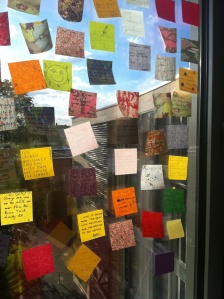
Salah satu proses studi design thinking dengan menuangkan ide lewat tulisan di atas Post-It warna-warni

Salah satu proses studi design thinking dengan menuangkan ide lewat tulisan di atas Post-It warna-warni

Acara yang berlangsung selama tiga hari tersebut digelar di kampus HPI, dengan tema “Sirkus”, sehingga venue utamanya bukanlah sebuah aula biasa, melainkan sebuah tenda sirkus yang didirikan di lahan kampus. Untuk melengkapinya, serombongan pemain sirkus profesional dikerahkan untuk menyelingi acara. Jadi tidak heran bila di kampus tersebut tampak berkeliaran pengendara sepeda roda satu, juggler, dan sebagainya. Hal ini mengakibatkan suasana konferensi menjadi lebih mudah cair, dan – terutama karena bentuk ruang yang bundar – menghilangkan hirarki antara para ahli yang menjadi narasumber berpengalaman, dengan para mahasiswa dan peserta lain.

Detail dari acara ini pun digarap dengan baik. Mulai dari gelang semi-permanen yang menjadi “tanda masuk” peserta di semua venue, “koin HPI” yang digunakan di setiap waktu makan, hingga bantal dan selimut berwarna oranye cerah yang disediakan di tenda-tenda makan semi terbuka.

Hari pertama diisi dengan presentasi para pembicara utama dan beberapa sesi parallel. Hal yang paling menarik di hari ini adalah presentasi berjudul The Difference between Design Thinking and Design, yang dibawakan oleh Oliviero Toscani (fotografer, desainer kampanye iklan kontroversial United Colors of Benetton) dan George Kembel (co-founder dan Direktur Eksekutif d.school Stanford University), di mana keduanya menjelaskan posisi masing-masing dalam isu Design Thinking ini.
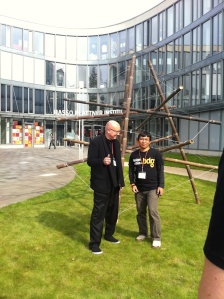
Prof. Ulrich Weinberg, direktur HPI d.school dengan Andry dan struktur bambo tensegrity yang baru selesai dibangun

Prof. Ulrich Weinberg, direktur HPI d.school dengan Andry dan struktur bambo tensegrity yang baru selesai dibangun

Hari kedua adalah di mana tim BCCF melakukan presentasi dan dua workshop. Dalam salah satu workshop ini, BCCF berkolaborasi dengan Andry Widyowijatnoko, dosen Arsitektur ITB yang baru menyelesaikan studi doktoralnya di Aachen. Di workshop ini Andry mengundang peserta untuk membangun bamboo tensegrity structure, di mana batangan-batangan bambu saling terhubungkan dengan tali logam, tanpa saling bersentuhan. Ketika seluruh bagian bambu dan tali logam sudah selesai dihubungkan, struktur bambu ini dapat diposisikan dalam berbagai arah. Struktur bambu ini kemudian berfungsi sebagai semacam tiang ‘totem’, di mana semua orang dapat berjejaring dengan menggantungkan identitas dan pesannya mengenai Design Thinking yang dituliskan di atas kertas yang disediakan oleh BCCF.

Di workshop yang satu lagi, tim BCCF berkolaborasi dengan Prof. Eku Wand dari HBK Braunschweig dan KBRI di Berlin, mengajak peserta bermain angklung. Hubungannya dengan Design Thinking? Di sini angklung merupakan representasi dari individu, yang memiliki karakter tersendiri. Namun sebuah lagu hanya dapat dimainkan bila masing-masing angklung dapat bekerja sama dan saling melengkapi, seperti halnya kolaborasi antar disiplin ilmu dalam mencapai inovasi.

Presentasi dilakukan di Feedback Room, di mana kasus “Redesigning Your City” di berbagai belahan dunia ditampilkan, masing-masing selama 15 menit, lalu dilanjutkan dengan diskusi dan tanya-jawab. Karena keterbatasan waktu, tentu tidak semuanya mendapat kesempatan menanggapi, sehingga setiap orang yang masuk mendapatkan satu lembar kertas untuk diisi dengan tanggapan, usulan, dan sebagainya. Kertas tanggapan ini, setelah diisi, dapat diberikan langsung pada presenter yang membawakan subyek yang ditanggapi.

Presentasi di Feedback Room

Presentasi di Feedback Room

Dalam kesempatan ini, tim BCCF menyampaikan sekilas informasi mengenai Bandung (ada pertanyaan, “Bandung itu kota di negara apa?”), sejarah berdirinya BCCF, dan aktivitasnya yang “merancang ulang kota”, seperti TUNZA, Lightchestra, Kampung Kreatif, dan Semarak.bdg, dan berbagai program Urban Acupuncture yang telah dan sedang dilaksanakan. Di awal presentasi, BCCF menyatakan belum pernah mendalami Design Thinking, meskipun menurut Prof. Weinberg menyatakan bahwa yang kita lakukan selama ini adalah Design Thinking, sehingga yang disebutkan di presentasi (dan semua materi yang dibawa) menerakan Design Action, sebab itulah yang kita lakukan. Selain slide, BCCF juga menampilkan video-video pendek dari berbagai event tersebut. Tanggapan yang diperoleh BCCF sangat positif, sebab rata-rata yang hadir, pada awalnya belum pernah mendengar tentang Bandung, namun langsung menyatakan ketertarikannya untuk mengunjungi Bandung dan melihat sendiri program-program BCCF, dan bahkan menyatakan minat untuk berkolaborasi dengan kota asal mereka masing-masing. Hal yang dinilai paling menonjol dari BCCF adalah kemampuan kita untuk berkumpul dan bekerja sukarela demi kehidupan kota yang lebih nyaman untuk semuanya, dan semangat kita untuk selalu berbagi, yang seluruhnya dilakukan dengan cerdas dan dengan daya kreatifitas tinggi.

Di hari ketiga, yang merupakan hari terakhir dari rangkaian d.confestival, tim BCCF menyimak presentasi Prof. Kees Dorst (dari Sydney University of Technology), yang menguraikan konsep dan analisa mengenai Design Thinking, yang memetakan berbagai kasus yang terjadi di Sydney. Dari presentasi ini lah BCCF menyadari bahwa kekurangan utama kita adalah hampir tidak adanya analisa atau evaluasi yang terstruktur terhadap berbagai program yang selama ini kita jalankan.

Ruang bundar di tengah-tengah tenda sirkus di penutup acara

Ruang bundar di tengah-tengah tenda sirkus di penutup acara

Di akhir acara, penyelenggara mempersilakan siapa pun yang bersedia untuk maju dan duduk di tengah-tengah lingkaran tenda sirkus, untuk dapat mengutarakan pendapat, kritikan, dan sebagainya, terhadap Design Thinking dan d.confestival. Hal ini juga di luar kebiasaan konferensi pada umumnya, di mana hal-hal disimpulkan dan dibuatkan resumenya oleh sebuah tim perumus yang terdiri dari orang-orang yang terpilih. Saat penutupan d.confestival, tim BCCF mendadak diminta untuk sekali lagi melakukan workshop angklung untuk seluruh peserta. Sambutan para peserta terhadap acara penutupan ini sangat meriah, dan permainan angklung berhasil meninggalkan kesan gembira bagi setiap peserta yang hadir.

Sisa waktu di Berlin dimanfaatkan oleh tim BCCF untuk membuka kontak dan mengawali jejaring dengan berbagai komunitas dan organisasi di Berlin, seperti Create Berlin, Webcuts, Asia-Pacific Berlin Forum, dan International Design Center Berlin. Berbagai rencana kolaborasi telah didiskusikan, dan siap untuk dilanjutkan dan diwujudkan oleh berbagai komunitas di Bandung. Berikutnya? BCCF harus tetap mempertahankan kontribusi positifnya terhadap Kota Bandung, dan Bandung harus sanggup menjadi tuan rumah untuk acara sejenis d.confestival, yang berskala internasional dengan detail yang digarap baik, dan melibatkan berbagai unsur masyarakat dan disiplin ilmu, demi memperoleh solusi yang inovatif dalam menghadapi tantangan kehidupan urban di masa mendatang.

Oktober 2012,

Tim BCCF: Fiki & Tita

Greater than Trophies

I know next to nothing about street soccer. I hardly ever felt how it is to be marginalized and socially stigmatized. But I have witnessed how the former becomes a remedy for the latter.

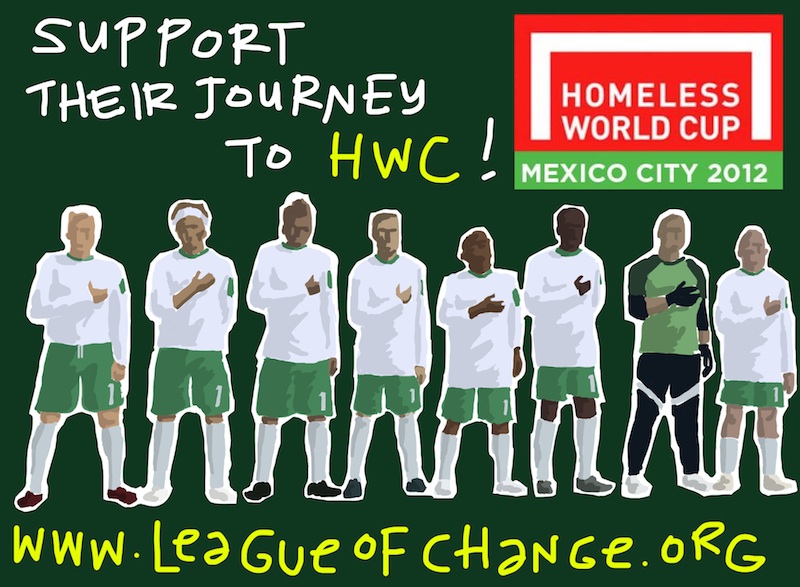
An illustration I made to gain fund in an event

An Indonesian team consisting of people who are either homeless, (former) drug addicts, or HIV/AIDS positive, was invited to participate in the Homeless World Cup 2012 tournament in Mexico. My previous post tells a bit about their initial attempt to raise funding for the trip, which was emotionally quite overwhelming. Eventually, they managed to gather just enough to send the team to Mexico. We saw them off on October 4th, 2012. Then, remarkable things happened…

I am not directly involved with their preparation, etc., so just take my words as a supportive onlooker: this team has become an inspiration for many.

“Why do I have so much faith in them?”

I tweeted one day,

“Because they have the guts to accept their condition and to be better persons”.

Which is true. It’s already hard for them to free themselves from their current circle (poverty, drug addiction, stigmatized illness, along with the social consequences). Their limitation is the one that pushes them forward and proves that their will knows no boundaries. What makes them what they are now is their own might. Each man has to conquer himself and they have gone beyond that. Not just anyone can say such things for himself.

During the tournament, their reputation was built not only of their sporting skills, but also of their charming personality. [Read this article at Detik Sport, for one, then click all the links with the same topics at the bottom of the article for more stories] Although they are entitled to be depressed, they choose not to. Instead, they lift up the spirits of others, and be positive about the game, winning or losing. They got a champion’s attitude.

What’s unexpected was that they made it into the semi-final! They’ve made it to the fourth place, bringing along with them hopes and prides of everyone who has followed their journey. Thanks to the team, all crew, and everyone who supports them, for being unsung heroes for all of us. Tomorrow they’ll arrive in Indonesia, back to their families, friends, communities, ready to inspire more. Welcome home, brothers, we’re proud of you. Quoting Ridwan Kamil (the team’s supervisor) and Ginan Koesmayadi (the team’s predecessor),

“You’re all greater than trophies;

more honorable than any title!”

R E S P E C T !

=====

Relevant links:

Homeless World Cup: http://www.homelessworldcup.org/

League of Change: http://www.leagueofchange.org/

Rumah Cemara: http://www.rumahcemara.org/

Dengan Bola, Kami Hidup!

Dukung tim Indonesia di HWC2012 di Mexico City!

“Menangis itu persoalan lain”, kata Ginan Koesmayadi, ketika disinggung mengenai liputan video yang menayangkan ekspresi keharuannya saat lagu Indonesia Raya dikumandangkan untuk kemenangan tim Indonesia di Homeless World Cup 2011 yang diadakan di Paris, Perancis. “Yah, bagaimana tidak”, lanjutnya, “Saya ini pernah hidup di jalanan, pakai narkoba, masuk penjara. Pokoknya sampah sekali”.  Di HWC2011 itu Ginan mendapat predikat sebagai Pemain Terbaik, tim Indonesia berhasil meraih tempat ke-6 (dari 27 negara) dan berprestasi sebagai Tim Pendatang Terbaik. “Makanya ketika itu, bagaimana tidak haru. Apalah saya ini, apakah pantas untuk dimainkan lagu kebangsaan untuk saya?”

Ginan dan timnya, yang bernaung dalam Rumah Cemara, adalah termasuk kelompok masyarakat yang terpinggirkan karena kondisi mereka, baik sebagai tunawisma maupun pecandu narkoba, hingga pengidap HIV. Namun secara bertahap mereka berusaha melakukan hal-hal yang dapat memulihkan jiwa-raga, menumbuhkan penghargaan pada diri sendiri, dan meningkatkan kepercayaan diri. Mengutip Ginan lagi, “Saya memilih untuk terus main bola, karena saya bisa mencintai diri saya yang bermain bola”.

Tisna Sanjaya berkarya berdasarkan percakapan sore itu, yang hasilnya kemudian dilelang untuk mendapatkan dana bagi tim HWC2012 Indonesia.

Banyak sebenarnya yang dapat diceritakan dari perjuangan mereka dalam mencapai prestasi ini, yang semuanya dapat dibaca di situs mereka, dan bahkan mungkin juga dapat ditonton dari video ketika mereka menjadi tamu di KickAndy. Namun, yang paling penting dari kisah ini, adalah bahwa perjuangan mereka masih berlanjut!

Seusai HWC2011 lalu, tim homeless Indonesia tiba-tiba mendapat undangan lagi untuk berlaga di HWC2012 yang akan diadakan di Mexico City, pada bulan Oktober 2012 ini. Para pemain telah siap dan terus berlatih (mengenai pemilihan para atlet ini bisa dibaca juga di situs mereka), namun salah satu hal yang paling penting belum terpenuhi: biaya keberangkatan untuk berjuang membawa nama Indonesia di kompetisi internasional tersebut.

Terus terang, saya ikut bangga, sekaligus agak malu ketika berpikir: saya yang serba berkecukupan dan sehat jiwa-raga, apakah pernah memperoleh kepercayaan begitu besar untuk membawa nama Indonesia sedemikian rupa, sementara mereka harus berjuang pontang-panting untuk mendapatkan dukungan dalam membela nama negara dan bangsa yang selama ini tidak peduli pada mereka?

Waktu keberangkatan ke Mexico semakin dekat, sementara bekal untuk dapat berangkat ke sana, sekitar 500juta Rupiah, baru 3% terpenuhi. Mari tidak tinggal diam dalam mendukung mereka, apa pun upayanya. Kontak mereka melalui Rumah Cemara di situsnya http://www.rumahcemara.org atau via Twitter @RumahCemara dengan tagar #hwc2011 dan #SatuMimpiUntukIndonesia

Silakan mengunjungi situs League of Change http://www.leagueofchange.org/ untuk dapat mengetahui lebih jauh mengenai tim homeless ini. Di tautan tersebut juga terdapat video dan dokumentasi lain, termasuk cuplikan yang membuat Ginan terharu, yang disebutkan di awal tulisan ini. Dari situs itu terdapat informasi bagi yang ingin donasi melalui transfer ke rekening bank Rumah Cemara, sbb:

Bank Mandiri No Rek 132-00-0765977-5 KCP Bandung Setiabudi a/n Yayasan Insan Hamdani

Berikut ini adalah tautan berita di Kompas Online mengenai sosialisasi partisipasi Tim Indonesia di Homeless World Cup 2012 yang berlangsung sore itu (Jumat, 10 Agustus 2012): http://regional.kompas.com/read/2012/08/10/20462571/ODHA.Tetap.Ada.di.Timnas.Indonesia

Mari usahakan bersama agar tim ini dapat tetap berlaga dan mewujudkan satu mimpi untuk Indonesia!

SERENITY PRAYER*

GOD grant me the serenity to accept the things I cannot change,

The courage to change the things I can,

And the wisdom to know the difference

RC

*copied from Rumah Cemara Twitter background

Science, Technology, Society – 2

Some pointers I noted from the first session of “The Role of Science, Technology and Arts in Predicting Social Phenomena” seminar, held by the Research Group for Humanity Studies (Faculty of Arts and Design), Institute of Technology Bandung on July 11th, 2012.


Forensic Linguistic

From the speech of Prof.Dr. Aminudin Aziz about the role of forensic linguistic in predicting and analyzing social-political phenomena in Indonesia:

A linguist is different from a polygot. A polygot has multi-language ability, a linguist has the ability to analyze languages without having to be able to speak many languages.

Analysis tools

A part of a forensic job is to place someone’s origin based on his/her name and speech intonation, to find a language’s data, to investigate whether a statement is actually made by a certain person.

How? Language has a regular structure. The speaker is consistent in his/her speech.

Patterns

Asian language structure has a circular pattern; the speakers tend to go around and around on a subject before coming right to the point. Anglo-Saxon has a linear pattern; the speakers straightforwardly state their minds. The Arabic language has a parallel pattern; the speakers present one important fact after another, so all these important facts come in a bulk to the audience/ listener.


From the speech of Roby Muhamad, MSc, MA, PhD:

Do we need Science to explain social phenomena?

If a scientist talks about social phenomena, he would likely get responds such as, “I knew that already”, or even “You went to school for that?”

This is because social phenomena can be responded by common sense.

Intuition is good to make sense, to give meanings, but not to understand the world.

Intuition is sometimes wrong, since it’s very specific, acquired from experience that is different from one person to another.

Social phenomena are unpredictable. The most possible thing is to predict the probability. It’s a matter of relevance, so the trick is to predict what is relevant.

It’s a matter of relevance

Internet untuk ilmu sosial adalah seperti teleskop untuk fisika, atau mikroskop untuk biologi. Untuk pertama kali dalam sejarah manusia, interaksi, perilaku dan sikan manusia terekam dalam jumlah besar di Internet.

Kemampuan belajar dan beradaptasi dengan cepat

lebih penting daripada mengantisipasi masa depan


Lots more interested things to be captured, but – as goes the saying – you’ve got to be there to absorb every detail 🙂

A happiness thermometer

Science, Technology, Society – 1

Some pointers I noted from the first session of “The Role of Science, Technology and Arts in Predicting Social Phenomena” seminar, held by the Research Group for Humanity Studies (Faculty of Arts and Design), Institute of Technology Bandung on July 11th, 2012.

From the opening speech by ITB Vice Rector for Academic Affairs and Student Affairs:

The Circle

There is a connection between cellular phones, motorbike-taxi, and the logging of Gunung Kidul forest.  Forest farmers cut down more trees of the forest, even the younger ones, to be able to afford cellular phones and motorbikes. These farmers, who used to use the motorbike-taxi service to get home, are now able to call their sons, who now now have their own motorbikes, to pick them up. The motorbike-taxi service gradually disappeared, and so did the trees, and – following – so did these farmers’ jobs, due to the diminishing woods to harvest. Considering this circle, it is obvious that (the desire for) technology influences social conditions.

The biggest challenges  faced by (American) scientists of today are health, material science and sustainable energy.

So far, engineers have been considering only the output of the technology: function, effectiveness,  and all other tangible and quantifiable results. They rarely consider the intangible result: the impact to society.

From the speech of Ir. Ary Mochtar Pedju, M.Arch:

Technologically excluded regions

Developed countries have science and technology-based economy. Developing countries will never cross the line that borders between industry-based economy and technology-based economy.

Technologically-excluded regions are within a poverty trap. These regions are prone to infectious disease, low productivity and environmental degradation.

Referring to MIT, the traditionally-segregated disciplines: Basic Science & Engineering/Technology and Humanities & Social Sciences, are merging and forming a new group called Science Technology Society, which solves complex, real societal needs/ problems.

We need reformed education.

Science Technology Society

Universities should have inter-disciplinary centers/ labs/ programs that drive the faculties (and then the hierarchic structure), and not the other way around.

An inter-disciplinary “center” should not be a mere physical office(!).  It should be a gate for all local wisdom, a hub for interaction for Government, Business and Academic entities, and should facilitate interdisciplinary projects.

We should examine the cultural & institutional context in which science and technology are rooted.

We need to write history books with broad-based analysis that include the use of technology and how it influence our society in all aspects: economy, politics, etc.

From the discussion session:

There should be a revolution to our middle-school education: eliminate the divisions of Science and Social majors.

Mother tongue: Indonesian?

The Indonesian language is, for most Indonesians, a second language, since it is common for Indonesians to speak a region’s language as their mother tongue. As the impact, Indonesians become non-critical to Indonesian language. Therefore, the term “Speaking Indonesian language properly and correctly” should be replaced with “Speaking Indonesian language appropriately and according to context”.

“We Provide Solutions, not Pollutions”

Bike.BDG logo

Several months ago I posted about bicycle line, intrigued by a documentary video about How the Dutch Got Their Cycle Path. And what would you call a dream come true, although it’s not yet perfect? It turns out that Bandung has its own bike sharing facility now, launched on June 10th, 2012. [Here’s a post about Bike.BDG launching event, etc. at BCCF website, in Indonesian]

Of course security and safety are among the main issues here, but we have to start from something, by creating a certain mechanism that works for our specific conditions. The various ground elevations of Bandung might make it less appealing for people to use bicycle as a daily transportation method, for its impracticality. So Bike.BDG offers a service that mainly aims for short rides, to its 10 designated points in town. Anyone interested in using a bike should first sign up as a member, then s/he is entitled to rent a bike for IDR 3000/hour. So far, users of Bike.BDG are mostly people who are spending a leisure time during Car Free Days, where roads are closed for motored vehicles for a certain amount of time (usually on Sundays, from 6-10a.m.), or people who really needs to reach a distance without relying on angkot (Bandung’s public minibus) and private cars.

Ideally, Bike.BDG aims to reduce traffic jams in weekends and holidays by offering these bikes to visitors, who are suggested to park their private cars at the hotels and take the bike instead to go shopping and sight-seeing. Here are videos that promote the project:

[youtube http://www.youtube.com/watch?v=aweVcjRc5m8]

[youtube http://www.youtube.com/watch?v=M0x7hFLrA7I]

Like all newly-started projects, this one is naturally not free from hiccups, but improvements happen along the way. Perhaps, in this stage, the most crucial thing is to let people (re-)experience the joy of biking, and, further, to make it possible for anyone to use the service without having to buy/own a bicycle. Then, hopefully – as with the case in The Netherlands – even politicians, authorities and decision-makers of the city become familiar with the pleasure of having a city dominated by bicycles, so they can create policies that accommodate city bikes.

It never hurts to build up a dream. Salute to all Bike.BDG volunteers and activators, hope the bike sharing system remains and grows!

How it works

All images belong to Bike.BDG. Further info:

Bike.BDG site: http://bikebdg.com/

Bike.BDG Tumblr: http://bikebdg.tumblr.com/

Why Are We Wired?

WHY ARE WE WIRED?

Tom Gaiser | 27111701

Classmates wired

Wired?  Are we so connected that we begin to loose our own self identity?  Who am I that I must define myself by my online relationships?  Am I a page on Facebook?  Or have I become the repository of a zillion apps?  Are people apt to meet friends in real life only to share physical space while  meeting more friends online.  If cyber is space, is it outer space or inner space or  in-between space?  Really,  it is a matter of the sustainability of the human soul.  Man has been concerned about the sustainability of his soul for a while.  Well, the Greek philosophers had no problem with man’s soul.  Drama and comedy certainly dealt with man’s follies.  Shakespeare made the human condition dense with substance.  Then came the Industrial Revolution.  Charles Dickens warned us.  For the first time in human history a product of man’s invention would begin to control us.  Even in war it would no longer be man against man, an honorable way to lay waste upon our selves.  NO,  we’d have machines do this for us.  Now philosophers, like Sartre and Ortega y Gasset would write of the dehumanizing of the human soul.

But wait, there was a new revolution.  What about freedom?  Freedom to do as we please.  You know, free spirit, free speech, free sex, freedom of choice.  The soul was set free, yay to that.  Our parents could have nothing to do about this.  Family and work required sacrifice?  Yes, that is a question.  They would define work and family, and religion for that matter, as a goal, something to honor, not a sacrifice. Because it was all about sustainability.  Why as a family did we grow our own vegetables and poultry besides cooking our own meals. Ever heard about the book “Chicken Soup for the Soul”?  Why did the wash “go out to dry” rather than into the dryer?  Why did my father teach me how to repair the house and service the car?  Well, it had something to do with maintaining a budget.  It also had something to do with maintaining the soul of the family.

Amish girl online

But let’s get back to the wired phenomena.  We all, well, I hope at least most of us, have seen the photos of landfills full of obsolete PC’s or the poor people of some poor country disassembling electronic devices for their poisonous innards. (At least the latter is an effort to recycle.)  But what about the constant need for the latest electronic device?  And why are we so dependent on these devices for our social well being?  I believe it is all about judgment.  Truthfully, there is a lot of good with this new age of  information communication technology.  I can see my daughter’s new hair cut from half way around the world, as well as talk with her for free.  It’s through an app called Tango.  That is good for the soul.  And certainly the instant access of information about how we can sustain the world as well as research for our school and work projects revolutionizes knowledge.  Even the latest issues regarding the Green Revolution are disseminated through the electronic media. But that’s just it, electronic devices are tools and the “media is just the messenger”.  It is only when these electronic devices consume all our time and when the messages obscure our own thoughts, that the sustainability of the human, each individual’s, soul is in danger.

LET’S BE WIRED FOR THE GOOD OF IT.