Author Archives: Tita Larasati

Riung Gunung: children as co-designers

DAbdg putihChildren are important stakeholders of a city. In the next 20-30 years, they will be the ones taking over and making decisions for the city. However, they are often neglected, or not taken into account, by public facilities and infrastructures that are built in Bandung. The streets – and even sidewalks – are too dangerous for them to walk or ride bicycles alone, city parks are neither closed nor unkempt, playgrounds are almost non-existent, and so on. It is due time that they should say their desires for the city and to be listened to. This is the main reason why Riung Gunung is on!

REV [RG]Poster_05 (pendaftaran)

Riung Gunung promotional poster

Riung Gunung is a workshop organized by Sahabat Kota, a community/organization in Bandung that has been active in holding programs and events for children and youth who want to learn about the City of Bandung and urban life. As a part of the pre-event series approaching DesignAction.bdg, Riung Gunung is coming up really soon as the next one. This workshop is held for 60-90 children between the ages of 9 to 12, whose main task is to make a scenario of Bandung 2035. In this 6-days workshop, they will go through the phases of exploration, city adventure, envisioning, co-design workshop, and realization. As a result, they will make a model or a physical miniature of the city according to their design, and will act it out, according to the systems they create. These results will be performed and exhibited on July 7, 2013, at Selasar Sunaryo Art Space, a gallery at the North of Bandung, and also during DesignAction.bdg event on October 1-3, 2013.

The 30 instructors who will accompany these children during this workshop have been having their own workshops in order to be prepared with appropriate knowledge, with the following subjects: design thinking, sustainable development, child psychology, education for sustainable development, city planning, performance, games, child handling and creativity.

Detailed program of Riung Gunung

Detailed program of Riung Gunung

We are really looking forward to having this workshop. Hope for a lot of fun and incredible results!

More about Sahabat Kota: http://kisahsahabatkota.wordpress.com/

Sahabat Kota at Facebook: https://www.facebook.com/sahabat.kota

Sahabat Kota at Twitter: https://twitter.com/sahabatkota

Sahabat Kota videos at YouTube: http://www.youtube.com/user/komunitassahabatkota

Design Thinking workshop: urban mobility

DAbdg putihWe plan to hold DesignAction.bdg, an international conference/workshop on Design Thinking, but not all of us have a design background, nor are familiar with conventional design process, and most of us have never experienced Design Thinking approach. Therefore, as one of the pre-events that precede DesignAction.bdg, we held an internal workshop on Design Thinking, by inviting Amelia Hendra (ex-IDEO Shanghai) to be the facilitator. This workshop consisted of an introduction about Design Thinking, then an exercise to use the method within the context of urban mobility issues. It is like doing a simulation of the actual DesignAction.bdg event in a smaller scale.

image

Day One: introduction

The workshop was held on April 5-6, 2013, attended by about 30 participants. In the first day, Amelia introduced herself. It helped that she was born in Indonesia (originally from Pontianak, West Kalimantan), so Indonesian language was used the whole time. During this workshop, she was assisted by Adi Panuntun, founder of Sembilan Matahari and co-founder of Bandung Creative City Forum (BCCF), a movie maker/ video mapping creator who pursued his study in Design Thinking at Northumbria University, UK. The participants are organizing members of/ contributors to DesignAction.bdg event that came from different backgrounds and communities in Bandung, such as Riset Indie, Labtek Indie, Sahabat Kota, Vidour, GrowBox, Sembilan Matahari, KreativeLab, Fight.BDG, ITB (from School of Business and Management, Faculty of Art and Design, and Architecture Department) and UNPAR. Amelia proceeded with giving an overview about Design Thinking method and examples. The participants came up with questions, whether the Design Thinking phases should start from a certain point or if it can be started anywhere, about “extreme users”, and discussed the importance of “reframing”, since this is practically the most important skill required in the process. Lunchtime was filled with a documentary video about Curitiba, which inspires us all: that with few resources we should still be able to move and make changes. The day ended with an assignment that required the participants to break into groups and started a fieldwork: Understanding urban mobility through the lens of Bandung. The participants should map out design challenges: map out key stakeholders, list out interview questions, and divide tasks with team members.

(c)AmeliaHendra2013

(c)AmeliaHendra2013

1 Observe & Understand: Not only about being creative | But also about being empathetic

2 Reframe: Does not start with the answers | But about asking the right questions

3 Ideate: Not only for designers | But also for problem solvers and optimists

4 Prototype: Not only about designing and thinking | But also making, learning, and sharing

5 Co-design: Not only about perfection | But also about perspectives
Processing ideas

Processing ideas

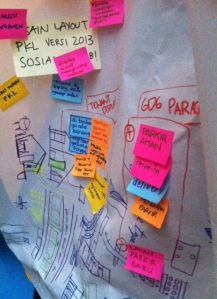
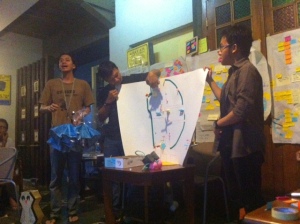
In the second day, the process was continued and completed, up to prototyping and sharing phases. There were four groups, each took a different focus: angkot (a public minibus that serves as a public transportation method that dominates Bandung), pedestrian, DAMRI (city bus) and PKL (mobile food vendors that often cover a parcel of roads and sidewalks). As a closing, each group presented their findings and solutions, all in role-playing, and it was obvious from this phase that everyone enjoyed the workshop. It was a pleasant way to identify actual Bandung mobility problems from different viewpoints, to exercise all forms of creativity and to come up with recommendations that might be solutions for the problems.

The groups proposed products, systems, programs and activities that might release some burden related to mobility and traffic, at different scales. Some might need conventional way of infrastructure improvements, but most could actually be implemented without requiring substantial financial capital and complex bureaucracy, and could be succeeded as long as networks and collaboration among local people and communities are available.

An impression from a participant (Ronaldiaz from Agritektur): Collaboration is an important key point, since this workshop was joined by people with multidisciplinary background. If one participant from each discipline could contribute one solution from his/her field, by collaborating we would be able to give a comprehensive solution. The power of collaboration is indeed frightening!

Thanks to Amelia and everyone involved in the workshop! We had fun – a productive kind of fun – which what we of young productive age actually need, to be able to respond innovatively to endless problems faced by our urban environment.

The results of the four groups were all presented at the next Pre-Event of DesignAction.bdg, PechaKuchaNight.BDG that was held on Sunday evening, 26 May 2013.
Pedestrian team

Pedestrian team

Angkot team at work

Angkot team at work

DAMRI team

DAMRI team

Amelia closing the workshop

Amelia closing the workshop

Amelia assisting a group

Amelia assisting a group

Story of a City Forest

Not every city has a natural forest, moreover a World City Forest, like we have in Bandung: Babakan Siliwangi (BakSil). Now that we have one, what do we do with it? Merely disrupting it by replacing the trees with massive concrete buildings would be unimaginable, since that is the same as destroying the forest; but this is what seems to be the near future of BakSil City Forest if local people and communities do nothing about it.

Forest Walk at Babakan Siliwangi. (c)GalihSedayu2013

Forest Walk at Babakan Siliwangi. (c)GalihSedayu2013

Therefore, several communities have been holding events in this area to activate the idle space, while inviting more people to interact with the forest. Among the communities is Bandung Creative City Forum (BCCF), an independent organization that has previously hold two events to intervene BakSil. The first one was in 2011, during TUNZA: having BakSil declared as a World City Forest and building a canopy walk, presently called ForestWalk, at the premise. The second one was in 2012, with an event called Lightchestra as the opening of Helarfest2012: a three-days sound- and light-play in the forest, with an open-air concert of local indie bands, painting artists’ live performances, a photography contest, a paper lantern workshop for children, communities that perform best at night such as B.U.L.B. (Barudak Urban Light Bandung, a light graffiti community) and Bandung Urban Jedi; also collaborating with an environmental organization to limit and measure solid waste (food packaging, plastic bags, etc.) produced during the event.

"Al Fresco" forest picnic at Forest Walk during REGIA. (c)GalihSedayu2013

“Al Fresco” forest picnic at Forest Walk during REGIA. (c)GalihSedayu2013

This time, as the first 2013 program, BCCF held “Regia”, which aimed to refresh our relationship with our only city forest. The name “Regia” was taken from a dominant tree species that grows within the area, Delonix Regia, or Flamboyan in local name. During the two days of Regia, 20-21 April 2013, a lot of people gathered for various events, such as “Al-Fresco” or potluck picnic at the ForestWalk, children activities and games, open library, photo exhibition, morning yoga, forest dinner, live blues performance “Blues Leuweung” by several local blues musicians, and a discussion session about urban forest to close the series of event. An infographic, that was especially made for this event and was published in a regional newspaper and online social media, presents a number of facts about BakSil City Forest and how important it is for us.

From time to time, we need to celebrate our public space. Especially in a dense, growing city with substandard infrastructures like Bandung, whose inhabitants often need to take their own initiatives to improve their living environment.

After Regia, it seemed that there is hope that the company who has the developing right over BakSil would postpone its plan to build any commercial entity on the area. But our hope is yet again on trial, due to today’s update that the developer now has possessed permission to actually build a restaurant. Irritated as we are, we shouldn’t lose focus and conduct, within our capacity, smart responses to this issue. Let’s just make sure with all of our might that the story of our city forest continues for generations, onwards.

Related links:

Today’s news: the company is granted a permission to build on that area

Why we should care about our city forest

I wish these trees could stay

BCCF event announcement: REGIA

A photo essay by Galih Sedayu: on REGIA event

A photo essay by Galih Sedayu: about a series of graffiti that protests the commercialization of the city forest

Why we should care about our city forest

Regia Infographic

Regia Infographic by BatasFana (c)2012

Babakan Siliwangi, a Green Open Space in Bandung, is maintained as a preserved area up to today. On September 27, 2011, Babakan Siliwangi was declared as a World City Forest by the United National Environment Program (UNEP) in TUNSA event (an International Children and Youth Conference on Environment). There are not too many people, even those living in Bandung, know about Babakan Siliwangi City Forest, including a number of its interesting facts. Therefore, a wider dissemination is necessary, in order to reintroduce Babakan Siliwangi City Forest, among other by conducting a variety of creative activities in the area, and by spreading the information about the area. Following are a number of facts about Babakan Siliwangi City Forest.

In the earlier days, there were twelve fresh water springs within Babakan Siliwangi City Forest area, but today only one is left. Soil water surface has been reduced from 22,99meter to 14,35meter (data from 1999). If the area of this city forest is reduced, so will the soil water surface, due to the reduction of its absorbing area.

Babakan Siliwangi City Forest is a habitat for 120 plant species and 149 animal species. It is also a transit spot for six species of migrating birds. If this forest area is gone, the migration route of these birds will be cut.

Trees that grow within the area are, among others, Cola (Cola nitida) and Sempur (Dillenia Indica L.), but the dominant one is Flamboyan (Delonix Regia). Plantations in this area function as a buffer for air and noise pollutions. Whoever spends time in the middle of this city forest will feel a sense of serenity, although it is located very near to crowded big roads.

The width of canopy from the trees that grow in the forest reaches up to 5 hectares, while the width of Babakan Siliwangi area itself is only 3.8 hectares. The canopy functions as a shade that can reduce stress in human beings that stand under the area, since the trees also produce Oxygen.

The function of trees in this area as CO2 absorbance reaches up to 13,680 kilograms per day, while releasing O2 up to 9,120 kilograms per day. If the price of pure O2 is up to IDR 25,000 per liter, then the economic value of Babakan Siliwangi reaches up to IDR 148,000,000. From this calculation, it can be figured that if the area of Babakan Siliwangi is reduced even “only” up to 20%, Bandung will have a loss of about IDR 10 billion.

This information is only a few, compared to all the facts around Babakan Siliwangi City Forest, and these are facts that can mostly be observed and measured. However, beyond these facts, there are other evidences such as people’s interaction, communal activities, and social relationships that are established due to the existence of this unique, open urban space, such as this city forest. Such advantages cannot merely be quantified, since their widespread impacts and sustainability cannot be measured in a short, limited time scope. Judging from the height of activities in this area, which shows the crucial role of an urban space that invites its citizens to come out and enjoy their habitat, it can be concluded that Babakan Siliwangi City Forest should be preserved as a qualified Green Open Space that is kept open for all Bandung citizens.

*the Indonesian version of this article was published in Pikiran Rakyat

On Technology Transfer

The other day I asked @OutofPoverty, who was welcoming questions via Twitter, the following:

Based on your experiences, what factors caused failure in technology transfer?

@OutofPoverty answered:

1)   Technology that is too expensive

2)   Failure to design for the market

3)   Absence of last mile supply chain

4)   No attention to business principle

OutofPoverty

The reason I asked this had to do with a lot of design projects by our industrial design students, both within an academic scope and extra-curricular programs, and also numerous research, experiments and projects by our industrial design research group, especially the ones that take place in rural or remote areas. In those areas, essential needs and problems are obvious; however, the answer is not always “design” as in a “tangible product”, but sometimes it’s the infrastructure that hinders access, unaffordable materials, or substandard resources. Designers often have to think beyond the tangible product, by creating also a system that supports the availability and delivery of the product. With it, comes the aspect of technology transfer, as well.

Theoretically, the concepts of “appropriate technology” and factors that guarantee its sustainability once it is implemented are familiar to us, but still, not all technology transfer works for every case. Therefore, I wonder what others in a similar line of works have experienced.

The answer confirmed that there should always be a realistic economic calculation for any solution, next to other crucial factors such as usability and access. Thanks, Paul Polak & team! 🙂

DesignAction.bdg Pre-Events 1 and 2

DAbdg putihTime flies, when you’re having fun. Like what we’re having now – approaching DesignAction.bdg – when we realize that the first pre-event has just passed and the second one suddenly appears at the corner!

Slide15The first pre-event was an Expert Opinion Polling, where Riset Indie (an independent research community) teamed up with HMP ITB (Planning Department students society at ITB) in gathering expert opinions concerning the issues of urban mobility in Bandung and processing the input using Delphi Method to come out with conclusions. The event took about four hours in one Saturday morning (April 23), seemingly short, but went quite lively and yielded interesting results.

How it looks from the back of the room during the EOP session

How it looks from the back of the room during the EOP session

What was so exciting about this first pre-event is how we managed to gather so many experts in a room for a focused purpose, eminent stakeholders from different backgrounds (academics, government, communities, etc.) – something that usually occur in a different setting, hosted by a formal institution, instead of an independent community. We are quite honored to have such trust in conducting this session. Another exciting thing is that we actually confirmed a number of assumptions concerning the issues of urban mobility, and that we can use the data from this event to move on to our next plans. Riset Indie is currently arranging the data to be accessible online, in a friendly format (i.e. infographics), with the hope that any audience can contribute to the issues, or even to offer realistic solutions. Congrats and salute to Riset Indie and HMP ITB! Have fun preparing another pre-event, Angkot Day, with all its sub-events!

Slide16The second pre-event takes place next weekend, April 5-6: an internal workshop on Design Thinking, facilitated by Amelia Hendra, whose years of experience from working as a designer at IDEO Shanghai would add to our insights on design thinking method. The workshop is limited to 30 people with various backgrounds (educators, designers, engineers, academics, artists, social workers, etc.), all of whom belong to the organizing team for DesignAction.bdg. It is important for us to have this workshop, since the event we’re preparing is about Design Thinking, while all of us (except Adi Panuntun, who will assist Amelia in the workshop), have next to zero experience concerning Design Thinking methods.  (Although we might have practiced parts of the methods, but with no structured phases and evaluation.) The workshop will bring up the theme urban mobility. At the end of the workshop, we hope to understand more about Design Thinking as a method to exercise our creativity in order to gain innovative, doable solutions for challenges around urban mobility in Bandung. We are really looking forward to having this workshop!

Bring it on! 🙂

Links to media about EOP:

BandungNewsPhoto: BCCF Bakal Gelar Polling Memecahkan Masalah Kemacetan di Kota Bandung

AntaraNews.com: Komunitas Kreatif Petakan Masalah Kemacetan Kota Bandung

Aktual.co: Komunitas Kreatif Petakan Masalah Kemacetan Bandung

About DesignAction.bdg:

DesignAction.bdg, coming soon!

Design Thinking? Design Action!

Tote in Collaboration

BAGOES TOTE IN COLLABORATION

all_sm

TITA LARASATI | RIDWAN KAMIL | DENDY DARMAN | REKTI – THE S.I.G.I.T | ARKIV

Apa kesamaan dari seorang arsitek, musisi, graphic artist, toy designer dan comic artist? Mereka sama-sama mencintai bumi dan melakukan kolaborasi untuk kelestarian lingkungannya.

baGoes, merek tas lipat (foldable bag) karya Greeneration Indonesia, berkolaborasi dengan lima artis inspiratif Bandung untuk membuat lima desain Tote bag. Lima artis tersebut adalah Ridwan Kamil (arsitek), Tita Larasati (comic artist), Rekti The S.I.G.I.T (musisi), Arkiv (artist/ toy designer), dan Dendy Darman (graphic artist).

fold_sm

Tujuan dari kolaborasi ini adalah untuk mendukung Kampanye Diet Kantong Plastik (www.dietkantongplastik.info) yang mengajak masyarakat bijak dalam menggunakan kantong plastik. Gerakan pengurangan penggunaan kantong plastik saat ini sedang menjadi trend yang dilakukan oleh berbagai pihak mulai dari komunitas, retailer, hingga pemerintah.

baGoes sebagai salah satu tools untuk berdiet kantong plastik juga ingin turut serta mendukung kampanye petisi #PayforPlastic di www.change.org/id. Ditargetkan 500.000 orang menandatangani petisi ini hingga 22 April 2013.

Tote bag telah mengalami perkembangan dari semula berfungsi untuk kepraktisan, menjadi salah satu item paling digemari di industri fashion. Jitesh Patel dalam bukunya The Tote Bag (2011), menyatakan bahwa,

Tote bag adalah sebuah eco produk di abad ini yang ditujukan untuk menggantikan kantong plastik sekali pakai”.

Kolaborasi untuk produk Tote bag ini merupakan usaha baGoes untuk mengembalikan fungsi Tote bag ke akarnya sebagai alternatif kantong plastik, bersamaan dengan fungsinya kini yang juga sebagai fashion item. 35% dari total penjualan yang merupakan hak para artis, akan didonasikan untuk Kampanye Diet Kantong Plastik.

“Saya tertarik berkolaborasi karena menyelamatkan lingkungan itu butuh cara-cara kreatif. Salah satunya adalah dengan konsep Diet Kantong Plastik. Karena kreatif, orang harus diberi pilihan gaya hidup, maka tasnya pun ga bisa asal-asalan. Jadi sambil menyelamatkan lingkungan, dia merasa pede saat memakai tasnya.” Ujar salah satu artis yang akrab disapa Kang Emil ini.

Apa yang menarik dari desain setiap artis? Pesan yang mereka sampaikan sangat identik dengan ciri khas karya seni mereka masing-masing. Ridwan Kamil, menggambarkan pentingnya keseimbangan antara perkembangan peradaban manusia dengan kelestarian lingkungan. Tita Larasati menggambarkan berbagai belanjaan organik yang ditampung dalam reusable bag, dengan harapan dapat mensugesti masyarakat untuk menggunakannya ketika berbelanja. Rekti The S.I.G.I.T, menggunakan gaya black comedy, menyindir keserakahan manusia dalam usaha pelestarian lingkungan. Arkiv, dengan desainnya yang unik, melawan gagasan bahwa seni harus dipisahkan dari dunia konsumerisme yang berlebihan dan budaya massa. Dendy Darman dengan desain khasnya menggambarkan pohon sebagai payung bumi, pelindung alam semesta dan isinya.

“ Harapan saya, kolaborasi ini bisa berdampak baik untuk kampanye Diet Kantong Plastik.Ga banyak orang yang mikirin gerakan seperti ini. Giliran ada orang yang mikirin ini, masa sih kita ga bantu?” ungkap Dendy Darman.

tita_sm

baGoes Tote Kolaborasi dapat diperoleh di www.baGoes.co.id secara preorder sampai dengan 31 Maret 2013 dan di beberapa distributrion point pada bulan April. baGoes juga akan berpartisipasi di ARTE (Indonesia Arts Festival) yang diadakan tanggal 29 – 31 Maret 2013.

Untuk mengetahui informasi lebih lanjut tentang baGoes dan kolaborasi kami dengan lima artis, cek video kami di http://bit.ly/WhiKw2 atau kunjungi www.baGoes.co.id.

Press Contacts: Dwita Arlinda p. +6282116694578 | e. [email protected]

From Bawet to the World

The League of Change official billboard.

The League of Change official billboard.

As I mentioned in a previous post; I’m a mere supportive onlooker of this community. This time they’re at it again. The League of Change was held again in Bandung, to select Indonesian team for Homeless World Cup (HWC) 2013 in Poland!

Approaching Bawet "soccer field", which is actually an empty space below Pasupati flyover.

Approaching Bawet “soccer field”, which is actually an empty space below Pasupati flyover.

Media exposure, subsequent to their achievement at HWC in Mexico City, has made their reputation reach to a much wider audience, who got inspired as well. Nonetheless, the team stays humble, but still aims for improvement. For, this time, there is also a women team!

The League of Change (LoC) gathered several teams from all over Indonesia, all bearing the stigma as marginalized and/or discriminated groups of society. Through football, their fellowship strengthens, from what I witnessed upon watching the finals of LoC.

The championship was held at a very insignificant venue; an empty, dusty space under a flyover, surrounded by dense urban kampongs, in a district called Bawet (an abbreviation for Bandung Wetan). However simple, this venue holds lots of unbeatable memories of events, such as when the 2012 national team played soccer for 24-hours non-stop as a proof of their vow when their prayer for gathering enough funding to go to HWC in Mexico City was granted. This place contains tears of disappointments and joys, shouts of anger and pride, whispers of sadness and hope. It is Alive with emotions.

The soccer field is determined by four "walls" and high nets.

The soccer field is determined by four fences with high nets.

It is from this Place that LoC formed, once again, national teams (men and women!) for HWC 2013. Congratulations, good people, for you have achieved what not just anyone can, by having the Courage to accept, the Willingness to excel and the Hard Work to prove it all. Take our hopes and inspirations along, show the world that you’re indeed “greater than trophies, more honorable than any title”!

Parktivity: Let’s Come Out and Play!

“Activate your public space” might seem strange as a slogan for a city with public parks and facilities that are in a good condition, and whose citizens need no encouragement to come out and enjoy public spaces. But this is not the case in Bandung. Neglected public facilities have become a “new normal”.  City parks become too messy/ dark/ dangerous, or – if one looks pleasant enough – often inaccessible.

Agritektur station at Parktivity

Agritektur station at Parktivity

It is due to this reason that a number of communities in Bandung are attempting to make the parks more pleasant; one of them is Culindra. This community runs a program called Parktivity, and the one that just happened this weekend, at Panatayuda Park, Bandung, was the second. In Parktivity, Culindra takes a city park and creates all kinds of events on a decided day, collaborating with several other communities. The events so far included a garage sale, a barter market, outdoor “board” games, live music, a workshop on garbage separation and water reservation (biophores), and so on. At this second Parktivity, Agritektur, a community that supports local farmers, held an open kitchen and an “outdoor fine dining” experience.

At their station, made of wooden crates and blackboards, Agritektur offered us to choose a menu, then let us pick our preferred (locally grown) ingredients (plated on a tray made of woven lidi/ palm leaf ribs). Some of the available ingredients were already sliced and portioned into cups: cherry tomatoes, capsicums, onions, broccoli, carrots, cucumbers, salad leaves, mushrooms (2 varieties), chicken and beef. Eggplants and zucchinis were available in whole, to be picked out off a wicker basket. After being paid for, the ingredients were cooked by a couple of guys (majoring in tourism department of a university), and, once cooked, served on a lidi plate.

They have provided a long table covered with white tablecloth, decorated with pots of yellow flowers, so we could sit and chat and hover over someone else’s freshly-cooked dishes with different ingredients. This setting intrigued conversations and provide a sort of mixed experience between “dining” and “picnic”, and even “open air concert” if a live music happened to be performing on stage.

In this 2nd Parktivity, improvement was apparent, despite some hiccups, which should be handled with few difficulties in the next events. The impact – to urge people to use neglected parks – might not yet be obvious, but we won’t find out if we don’t start somewhere. So, let’s come out and play!

Parktivity05

Chicken & Mushroom Fajitas

Parktivity07

Mushroom Steak

Parktivity06

Eggplant with Curry Sauce

Parktivity01

Choosing ingredients

Parktivity02

Outdoor Kitchen

Parktivity04

Directly cooked for you!

Parktivity09

Lights play

Parktivity08

Stage

Parktivity11

Live music: The Milo (photo by: Fiki)

Creativity comes from the heart

Our Art, Design and Environment class yesterday was taught by Dr. Ratna Panggabean, one of our senior lecturers, from Craft Department. She specializes in textile craft and has spent a substantial amount of time working with indigenous people within that context.

In this class, these art, craft and design students are expected to understand that any artifact that materializes as their creations will have an impact to the environment. They also have to understand how the Spirit to Create emerges within them, which was the message from yesterday’s lecture, of which some points are derived, as follows:

Positive vibes radiate from a person who is overwhelmingly in Love.

Positive vibes radiate from a person who is overwhelmingly in Love.

Each person would radiate whatever aura is within him or her. Therefore, you can sometimes feel uncomfortable with a person, whom you tend to avoid or take a distance from, due to the negative ambiance. On the contrary, you would be attracted to a person who releases good vibes, and you would want to be around the person to absorb the positive energy.

How would one possess the good vibes? It is from feeling Love, for anything. One can be very much in love with another person, or with a pet, or even with the surrounding nature. Among the most known physical expression urged by this feeling is a smile. But people who Create, and who have the skills to materialize their thoughts and feelings, are able to express this overwhelming feeling through their works. This is what sometimes people refer to as Creativity that comes from the heart.

The point of this subject continues to the indigenous people who create objects due to their Love and Respect for nature, for particular moments, for the Greater Being, and for any other things that might come to mind. These artifact, which reflect the sincere feelings, are often created through genuine dedication and a lot of hard work, and therefore bear the consequences of being highly attractive.

=====

This session was like a reminder that one can actually influence another in an individual creativity process. The phrase “You bring out the best in me” might be a form of such phenomenon, where one becomes motivated to perform his/her best. Just imagine if one such process meet another in a collaboration, in projects and/or programs that contribute positively to society, and the environment. It might be a start to something significant if each of us can just enhance our positive vibes!