Category Archives: design

contribution to improve and encourage sustainable life style by design

TARAJE

Among the many particular skills that are possessed by craftsmen in rural villages of Tasikmalaya is producing bamboo veneer manually, and laminating the veneers into seamless ‘frames’. However, the products that apply the ‘frames’ could not present the actual potentials of the craftsmanship and the bamboo frames. This design attempts to use and expose the particular skill of producing bamboo frames and apply them to a contemporary product that fits the lifestyles of current, urban users. This postman bag, branded TARAJE, has come out as one of the results. More products with a similar production concept are still being developed.

TARAJE: laminated bamboo, framing a postman bag

TARAJE: closing up on the bamboo frame

Design: M. Ihsan

Experiment with Bamboo Strips

An experiment to create bamboo products with appearances uncommon to what we have seen so far in Indonesia has resulted in the following forms.

An arrangement of bamboo 'ribbons', sliced delicately

Sliced ribbons, top view

Bamboo strips, laminated and mold into a desired form, exhibited at Campus Center ITB

Laminated & molded bamboo strips, closed-up

These experiments are conducted by Deny Willy & Apikayu Foundation

LAMPION

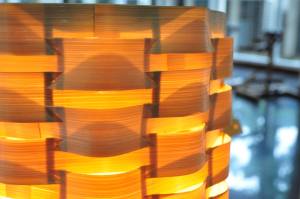
A meticulous crafting skill is needed in the production of this prototype. Stripes of bamboo veneer are slightly sliced at the sides, so they can be attached to each other, forming a bigger tubular shape that functions as a lamp cover.

LAMPION, closed-up

LAMPION, exhibited at Campus Center ITB

Design: Deny Willy/ Apikayu Foundation

KRANG

This lighting set is made of bamboo veneer as its basic material. The veneer was produced manually, with a particular crafting skill that is gradually diminishing,  and is usually applied as an additional, insignificant element of a product. It was a pity, since bamboo veneer actually possesses superior characters, if explored properly. This KRANG product attempts to prove the actual potentials of bamboo veneer, a material that is previously considered as inferior.

KRANG, exhibited at Campus Center ITB

Design: Deny Willy/ Apikayu Foundation

Pincuk Set

The design of these eating utensils are based on bamboo veneer as the main production material. This design was among the shortlisted in AwiAwiMandiri, a bamboo product design competition held by Saung Angklung Udjo in 2009.

Pincuk Set, exhibited at Campus Center ITB

Pincuk Set, exhibited at Campus Center ITB

If you’d use one, first put a layer of banana leaf on the ‘plate’ as a base for the food. You’d hold the Pincuk ‘plate’ with one hand, and you may eat the food either directly with your other hand, or use one of the folded bamboo-veneer cutlery. The perfect kind of food is the typical Indonesian snacks, which are often accompanied by thick sauce and served in bite-sizes. Wouldn’t it be more appetizing if you enjoy your meals with one of these sets?

Design: M. Ihsan, A. Syarief

Vetiver Root (Garut)

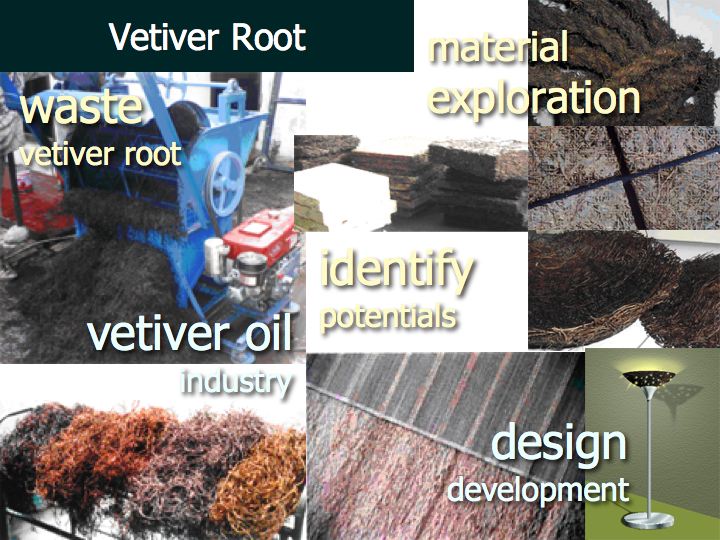
The vetiver root industry in Garut, West Java, always produces an abundant of waste, after the roots are pressed for oil. The pile of roots, if not burned immediately, would rot and cause unpleasant sights and smells. A research to make use of the material was conducted by pressing the material and forming it into desired shapes, in order to make functional products.

Vetiver root in Garut

Mendong (Tasikmalaya)

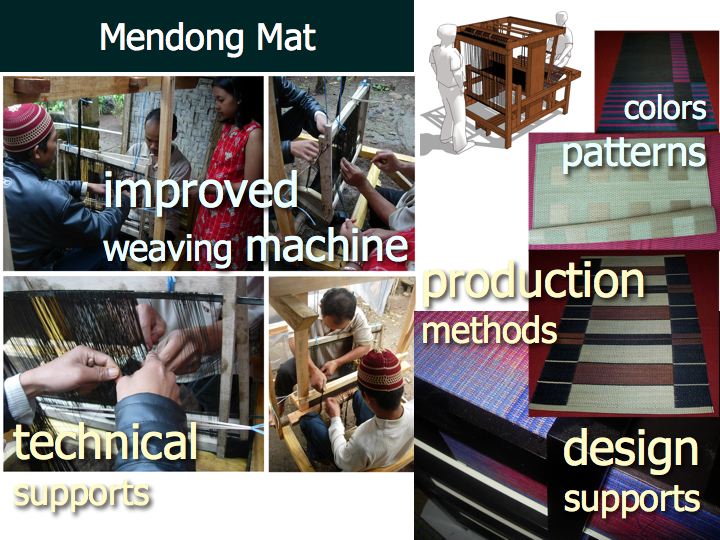
Mendong material, a variety of grass that grows in abundant in Tasikmalaya, West Java, has been woven into mats for generations. However, its industry grew stagnant, due to the absence of product development and quality improvement. A team of design researchers from ITB took this matter into account and provided a number of the following solutions: training in dyeing techniques, colors and patterns improvements, as well as innovative applications of mendong mats into three-dimensional products. Moreover, the team also designed a manual weaving tool, as an improvement of the old variety, in order to improve production efficiency and capacity.

Mendong in Tasikmalaya

Lidi by Meirina Triharini

Coconut mid-ribs, or lidi in the local language, is a material that has been used widely in Indonesia, but mostly as brooms or placemats, with no further thoughts put into it. For her graduation project at Industrial Design ITB, Meirina took this presumably inferior material and conducted experiments to explore it further, resulted in a number of interior elements: lighting accessories, containers, tableware, etc.

Lidi by Meirina Triharini

Rebirth by M. Fadli

For his graduation project at Industrial Design ITB, M. Fadli put his attention to the leather waste from footwear industries in Cibaduyut, with sizes that are too small to be produced into ‘by-products’ such as key chain hangers and wallets. He designed a system, cutting the small pieces with pound knives of particular shapes, then ‘weave’ the pieces to form a series of bags.

Rebirth by M. Fadli

Rubber Seats by Jeffry Oktavius

Cibaduyut area in West Java is famous for its footwear industry. However, along with the production, comes also the mount of waste from the shops, whether leftover materials or rejected, deformed pieces. Among the wasted materials is rubber, of which Jeffry took as a case and processed it into stripes, to be woven into seats for his graduation project at Industrial Design ITB.

Rubber Seats by Jeffry Oktavus