Tag Archives: ITB

Why do people run out of a building when a quake happens?

Because it’s not the quake that kills them; it’s the building. Why do we make unsafe buildings? Don’t we learn anything from nature that has produced excellent examples of perfect shelters?

One of Prof. Bando’s presentation slides, showing viruses, ‘sheltered’ by their forms

These questions were often heard recently at our department, Industrial Design at ITB, during lectures by Professor Takaaki Bando, from Science of Design Department, Musashino Art University, Tokyo, who has been staying for almost one year in Bandung. His passion toward biomimicry, Buckminster Fuller’s concepts, bamboo and structures is obvious from his energy during the presentations. Now that his one-year period at ITB is almost up, as a closure Prof. Bando conducts a Bamboo Shelter Project. He’ll deliver an open lecture concerning this project so, comprehensive explanations should come from him, but as far as I know, this project is a realization of a shelter concept that is save for people living in it during quakes, flood, and such. The form is obviously a slight modification of a Bucky Ball, which is strongly inspired by structures of virus molecules and the form of Apollo 11 that landed the first human on the moon in 1969 (Prof. Bando has also delivered a lecture concerning interconnected inspirations within the history of great designs).

Detail of the structure’s joint system

This project involves not only students from Industrial Design department, but also from other departments in ITB such as Architecture, Interior Design, Visual Art, Aerospace Engineering, and Civil Engineering.

The realization itself is not without challenge. First, it was the supply of material – in less than one week, around 800 sliced bamboo had to be provided, cut according to the precise, required measurements. A number of requirements had to be compromised, among others concerning the bamboo slices: initially, the skin of the bamboo should still be intact, which was not possible considering the amount of wasted slices that would be generated while lots of slices are needed. This skinless-bamboo condition might affect the strength of the structure, but we’ll never know for sure until we try it full scale. All other flaws, especially the detailed, technical ones that are happening during the building process, are not ones that can’t be solved, and they added to the valuable experience.

How the shelter looked on Day-3: still completing the ball shape, before inserting the platform (support) into the ball

Although not fully equipped with ‘real’ dwelling facilities, this bamboo structure serves as a model of a safe shelter. As Prof. Bando mentioned in one of his lectures, “Design does not explain how society is, but how it can be”. This bamboo shelter is surely the beginning of a process in discovering how humanity may thrive and cope with extreme global changes. So- let’s discuss some more: you’re all welcome to attend Prof. Bando’s lecture on Monday, 26 March 2012 at FSRD ITB!

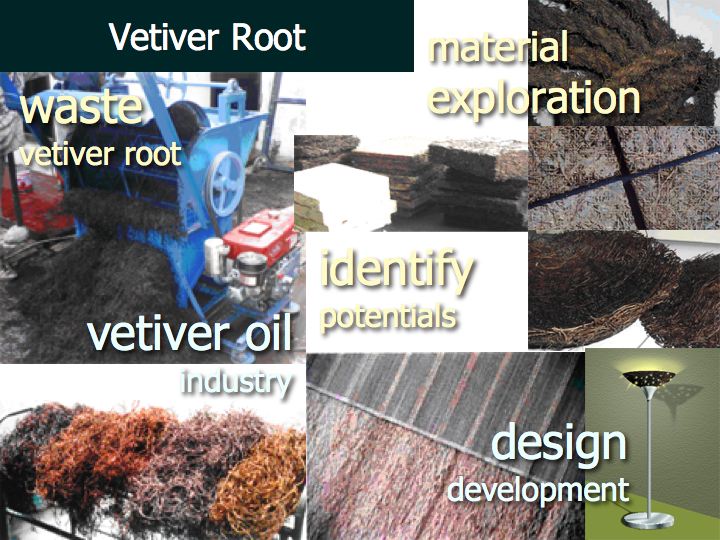
 

Vetiver Root (Garut)

The vetiver root industry in Garut, West Java, always produces an abundant of waste, after the roots are pressed for oil. The pile of roots, if not burned immediately, would rot and cause unpleasant sights and smells. A research to make use of the material was conducted by pressing the material and forming it into desired shapes, in order to make functional products.

Vetiver root in Garut

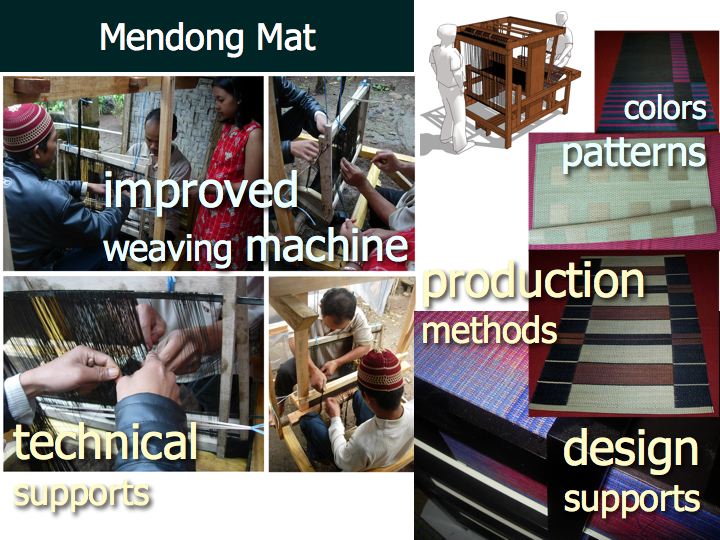
Mendong (Tasikmalaya)

Mendong material, a variety of grass that grows in abundant in Tasikmalaya, West Java, has been woven into mats for generations. However, its industry grew stagnant, due to the absence of product development and quality improvement. A team of design researchers from ITB took this matter into account and provided a number of the following solutions: training in dyeing techniques, colors and patterns improvements, as well as innovative applications of mendong mats into three-dimensional products. Moreover, the team also designed a manual weaving tool, as an improvement of the old variety, in order to improve production efficiency and capacity.

Mendong in Tasikmalaya

Lidi by Meirina Triharini

Coconut mid-ribs, or lidi in the local language, is a material that has been used widely in Indonesia, but mostly as brooms or placemats, with no further thoughts put into it. For her graduation project at Industrial Design ITB, Meirina took this presumably inferior material and conducted experiments to explore it further, resulted in a number of interior elements: lighting accessories, containers, tableware, etc.

Lidi by Meirina Triharini

Rebirth by M. Fadli

For his graduation project at Industrial Design ITB, M. Fadli put his attention to the leather waste from footwear industries in Cibaduyut, with sizes that are too small to be produced into ‘by-products’ such as key chain hangers and wallets. He designed a system, cutting the small pieces with pound knives of particular shapes, then ‘weave’ the pieces to form a series of bags.

Rebirth by M. Fadli

Rubber Seats by Jeffry Oktavius

Cibaduyut area in West Java is famous for its footwear industry. However, along with the production, comes also the mount of waste from the shops, whether leftover materials or rejected, deformed pieces. Among the wasted materials is rubber, of which Jeffry took as a case and processed it into stripes, to be woven into seats for his graduation project at Industrial Design ITB.

Rubber Seats by Jeffry Oktavus

Sasanti by Felicia Simon

Copy, bind and print shops/services around a university would release not only research papers and works of students, lecturers and researchers, but also the waste of the works, such as the excess of papers and plastics. Felicia Simon aimed to reduce the plastic waste (from book covers, binders, etc.) by processing and turning it into a series of room divider for her graduation project at Industrial Design ITB.

Sasanti by Felicia Simon

CanStool by Fammina Rismaya

Aluminum drink cans are consumed daily in a great number, which add to the pile of garbage that are not properly treated, moreover recycled, in urban areas in Indonesia – while drinks in cans are still being widely produced and consumed. In her graduation project, Fammina attempted to reduce the waste problem by turning the cans into a stool, through the process of pressing and fixing them together. In this project, she also designed a simple, manual tool to process this material for small-scale industries.

CanStool by Fammina Rismaya

Can’an by Dian Suri

Tembesu wood is originated from Palembang, the capital city of South Sumatra province, and is popular as one of the main materials in timber industry. The waste of tembesu timber industry is in blocks of wood pieces, which are too small to be a construction element or any structural product, but are too big and valuable to let burn as garbage. Dian Suri saw the potential of this raw material and turned it into a series of jewelry and body accessories that carry the theme of Palembang ethnicity for her graduation project at Industrial Design ITB.

Can'an by Dian Suri