My previous post is dated August 2024. It is now April 2025 and lots of momentous things have been happening! Here’s the rest of 2024.

On 22-23 August 2024 another round of Connecti:City, an annual International Conference on Creative Economy, took place at Gedung Sate, organized by the West Java Creative Economy and Innovation Committee (KREASI), hosted by the West Java Province. Connecti:City was first held in 2019 as a means to convene on creative hubs, creative economy, and creative city. This event commonly comprises a conference, an exhibition, a launching of the latest PROSPEK (a report on Creative Economy development and opportunities in West Java) that contains the much-awaited West Java Creative Cities Index; lately Connecti:City also held Creative City Dialogue that invited the focal points of UNESCO Creative Cities in SouthEast Asia. In 2024, the theme was “Creative Diplomacy: The Role of Creatives in Driving Impactful Regional Development”, and the sessions were divided into People, Place, Policy. Policy Recommendations as the result of Connecti:City 2024 can be accessed here (downloadable for free).


 On 27 August 2024, I shared about “Future Workforce in The Creative Economy: Creative Community Network Roles & Impacts” in a Panel Discussion on “Leaving no one behind: Preparing a skilled workforce in the creative economy”, as a part of a Workshop on Promoting Social Inclusion in the Creative Economy Sector to Accelerate SDGs Achievement in Indonesia, held by the UN Department of Economic and Social Affairs (UNDESA) and The Ministry of Tourism and Creative Economy (Kemenparekraf). Here I got the chance to meet Putri Ariani, who is globally recognized for her participation in AGT 2023. On stage, she delivered her messages on equality, on being consistent in what we choose, and on spreading positivity in every step we take.


 On 7 September 2024, I went to Malacca, Malaysia, for a talk and a workshop titled “Placemaking & Identity: City Branding & Placemaking for Community Resilience” as a series of event called “Vibrant Melaka: Creating A People-Centric Living Space“. Happy to hook up again with Jia-Ping and roam about in a city full of heritage and stories! My stay was too short, so I could only get a glimpse of the city, which got me wanting to explore more. The open night market, renewed river bank, revamped old houses and shops, public parks, museums; all adaptive reuse of existing heritage, powered by design, supporting policy, substantial resources, and leaders’ commitment. Another good practice for our typical SEA cities.


I don’t recall ever having posted about this here: I (assisted by Amira and Qonita) wrote an essay for an IFACCA Report on Culture as a Public Good: Navigating its role in policy debates, that was launched in July 2024. On 23 September 2024, IFACCA hosted an online discussion on that publication. I’ll make a separate post about this.


 The next adventure should also be posted separately! The Global Creative Economy Council (GCEC) made a study trip to Central Asia: Bishkek (Kyrgyzstan), Almaty (Kazakhstan) and Tashkent (Uzbekistan) – where we participated in the 3rd edition of the World Conference on Creative Economy (WCCE), 2-4 October 2024. As a member of WCCE International Steering Committee, I was right away occupied with WCCE matters and ‘duties’. But before arriving in Tashkent, I was fully immersed in an amazing experience, witnessing how the creatives in Central Asia, aptly represented by Daniar (a fellow GCEC member) and his Ololo communities & networks in Kyrgyzstan, struggle and thrive. I wish, one day, our creative practitioners could visit Bishkek and Almaty to experience and learn firsthand how they establish their hubs and conduct their businesses.




After the Central Asia trip, there were momentous events, too, such as the National Coordination Meeting of ICCN in Jakarta, 8-9 October 2024; the National Congress of ADPII in Jakarta, 10-12 October 2024; Bandung Creative Week talk show on Bandung Creative Economy Roadmap at The Hallway Space, 14 October 2024. Then come another big trip: UNESCO Cities of Design Subnetwork Meeting at Asahikawa, followed by an extra trip to Kobe and Nagoya, 20-30 October 2024. Which obviously deserves its own post, too.


On 4 November 2024, a sudden call brought me to Bali, to speak about “Indonesia Creative Economy Development Strategy” in a Creative Economy Workshop with Organization of African, Caribbean, and Pacific States (OACPS), held by OACPS and the Indonesia Ministry of Industries. Some materials were prepared by the Ministry of Tourism and Creative Economy, since I was filling in for them, so I only added several slides from my viewpoints as a non-ministry personnel, but as an academia and community member. I was excited, noticing that OACPS members were keen to explore the CE sector and pursue its development within their own contexts.


A busy end of the year. On 8 November 2024 I spoke in the Urban Future Leaders Summit on “Livable Cities: Ways to enhance urban living conditions through intelligent infrastructure, inclusive design, and community-centric approaches” at ITB. On 10 November 2024 I went to Malang, attending their annual FM:IX event and talking about “Active Citizens with Powerful Impact make a Creative City: What It Takes for Bandung to Become A Creative City of Design”. On 15 November 2024 there was an online technical training on CE Development for Sukabumi Regency Government, where I delivered the subjects, “Perkembangan Ekonomi Kreatif Global” & “Perkembangan Ekonomi Kreatif Nasional”.
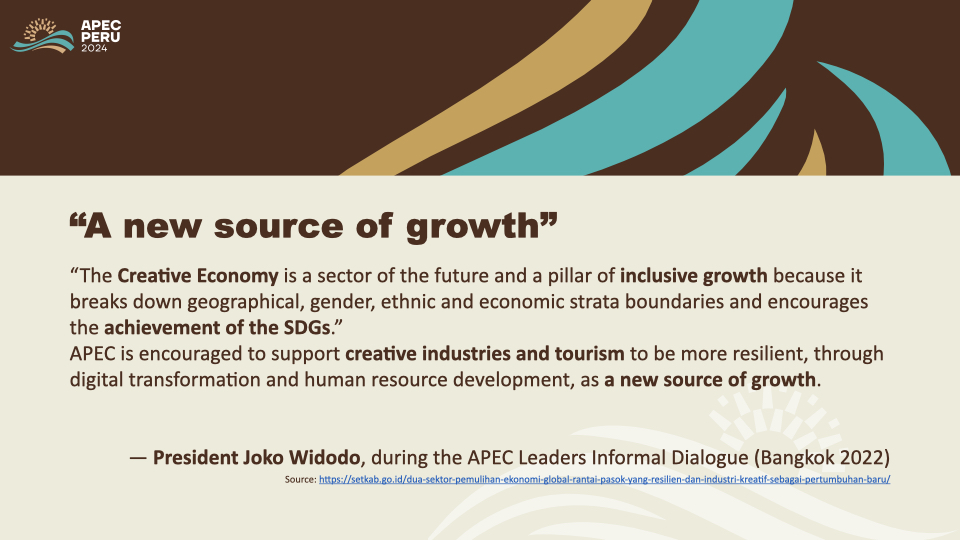
It was such an honor for me to participate in the CREATIVE APEC 1st International Meeting of Creative Economy on 19 November 2024, where I had an opportunity to share online about “Indonesia Creative Economy Development Strategy: Experiences in promoting the development of the Creative Economy in the APEC Economies”. I prepared a video presentation beforehand, to avoid any tech glitch, which was a great idea since there was also a challenge for me to join the event in real time (our time zones are 24 hours apart). We got connected when I talked in the Asia-Pacific Economic Cooperation (APEC) Forum, with the theme “Technologies, maker movement and tourism Entrepreneurship in Creative Tourism: Innovation and Technologies in Tourism” in Peru, early June 2024.


On 23 November 2024 there was another National Coordination Meeting of ADPII that was held at Dedato, South Tangerang; on 24 November 2024 I attended the launch of Porter Pamphlet vol.2 at Mbloc Jakarta, which was quite exciting because my graphic diary is a part of that zine, along with other works by distinguished Indonesian authors/ poets/ artists! On 1 December 2024 I appeared in a talkshow on “People and Place: Enhancing Space Quality for Creative Communities” of Festival Gaung Bandung with the theme, “Where Creativity Meets Community”, held by GUNADHARMA, the association of architecture students of ITB; on 6-7 December 2024 I went to Malang again to attend two congresses: ALMI and Ilmuwan Muda Indonesia, where I got a chance to participate in ALMI Knowledge Sharing session on “Culture, Art, Science”. On 12 December 2024, I spoke about “Good Practice in Climate Action in Bandung City of Design UCCN” in an event called “Heritage, Creative Crafts and Lifelong Learning Communities” hosted by Sukhothai in Thailand, a city with three UNESCO titles: UNESCO World Heritage Sites, UNESCO Creative Cities Network, and UNESCO Global Network of Learning Cities. Again, it was such an amazing experience; lots to learn on how living culture and traditions can provide added values, if managed properly. On 13-14 December 2024, ICCN gathered in South Tangerang for the annual ICCF. In this occasion, ICCN launched a book “Retrospektif Kota Kreatif” and a manifesto for “Culture-Based Creative Economy Sector Development for Sustainable Development”.


There’s a first time for everything. In my case, it’s doing a podcast. On 20 December 2024, I was asked by our (then) Dean of the Faculty of Art & Design, Dr. Rikrik Kusmara, to have a recorded conversation with our elected rector, Prof. Tatacipta Dirgantara. It turned out to be fine; I’ve worked with him and his faculty (Mechanical and Aerospace Engineering), so the talk went smoothly. It even seemed that we needed more time to further explore his stances, ideas, and concrete plans for our campus!


Well, these pretty much summed up the rest of 2024. Will have to update faster for 2025!