Category Archives: education

How to change education from the ground up

Here are some excerpts from a recent talk (published July 18, 2013) by Sir Ken Robinson. Wanting it or not, this speech made me think about our new, ridiculous national curriculum, composed by the government “up there”, untouched by the actors of education themselves: teachers and learners – and how we can actually change them from the ground level. Schools are not factories that print certificate to rank children’s “intelligence”; they should be a pleasant place where children maintain and discover their love for learning.

==========

[youtube=http://www.youtube.com/watch?v=BEsZOnyQzxQ&w=560&h=315]

The basics of education: science, technology and math, are necessary, but not sufficient.

The basics of public education, or why we invest in a system of mass public education, has the following purposes (not labeling, just as a reference, and not in particular order):

(1) Economic.

Education has powerful economic purposes. It does and it should. But the economic system of that day was industrialism, which is why the system looks the way it does. It is not that system anymore for us.

If we are to meet the “economic” requirement of education we need to have a system that promotes creativity and adaptability.

Adaptability: Organizations are not like machines, they are like organisms. They are living entities, made out of people, feelings, motivations, roles, aspirations, passions, and ambitions. And if the organism doesn’t respond to changes in its natural environment – just as in the natural world – it dies.

Creativity: We need companies that are consistently and systematically creative.

Students coming out of college find it difficult to come up with something new. That’s because they are educated on the standard routine of routine testing, multiple-choice tests.

(2) Cultural.

It’s a small enough planet as it is, but it has becoming more and more populated. But in any case, the ethical reasons as well as strategic ones, we formed education that enables people to understand how they came to think as they do, why their values are as they are, why their patterns of lives are as they are, and why other people are different. We need reformed education that helps people to understand their own cultural identity and what formed it and those of other people.

Now for that we need a broad education… the arts, the humanities, to social studies, not just to technical subjects.

(3) Social.

We need a form of education that engages this generation in the processes on which communities are organized and governed. And there are a lot of evidences on disengagements, that people are pulling away from those roles.

“Every generation has to discover its democracy” (on election)

It is very important that we take parts in these civil discourses. You don’t do that in education by giving people lessons on civics. You do it by having a culture which embodies these processes of participation, and great schools do that.

In the end, education is personal. It’s about people. It’s not about components or machines.

And if we know about people: they are different. They’re driven by different talents, different abilities, different passions, different interests and different motivations. One of the signature features of humanity is Diversity. Of course it contrasts sharply with one of the organizational principles of education, which is Conformity.

But if we don’t understand that education is about People and Individuals in all their diversity and multiplicity, then we keep making the mistakes that we make. If we’re treated as a machine… rather than a human process, then we’ll run ourselves into a cul-de-sac.

When we’re talking about changing education “from the ground up”, that’s the “ground” that I mean. Most political strategies start from the top-down: “if we can get people to conform, everything would improve”. And the evidence is quite the contrary: the more the government go in the “control” mode, the more they misunderstand the level of teaching and learning, the more they misunderstand the process of education.

So we have a situation here in the UK now, where most of the major teaching units have passed a vote of “no confidence” of the government’s education strategy. That shouldn’t promote a smug expression of satisfaction on the government. That should keep them awake all night, thinking, “How badly have we got this wrong?” You cannot improve education by alienating the profession that carries it out.

Recognizing that education can be encouraged from the top down is one thing. But it can really be improved from the ground up by the people who do the work. Because in the end it’s not ministers or states who’re teaching all of our children.

“The Empty Space” by Peter Brook: if you’re really concerned to make theater the most powerful experience that can be, we have to decide what we mean when we say “theater”. We have to get back to basics and focus on what is fundamental. And he answers that question in a brief passage in the book by performing a thought experiment. Essentially he says, “If you take a theater performance, what can you take away and still have it? What’s the core? What’s the irreducible minimum?”

You could take away the curtains, you could take away the script, the stage crew and the lighting, you can get rid of the director, definitely, you can get rid of the building. You don’t need any of that. The only thing you can’t get rid of, and still had “theater”, is an actor, in a space, and somebody watching.

Theater describes the relationship between the audience and a performance. That’s the relationship that we mean. So if we want to make theater the most powerful experience that can be, we have to focus on that relationship between the performer and the audience. And, he said, we should add nothing to it, unless it helps. And of course a lot of what we add to theater distracts the relationship and substitutes for it.

It is an exact analogy with education: the heart of education is a teacher and a learner. And we have, overtime, obfuscated that relationship with every type of distraction. We have testing regimes, testing companies, political ideologies, political purposes, subject loyalties, building codes, all of these timetables and schedules.

That’s why we can spend all day long discussing education and never mention teaching or learning. But if there’s no teaching or learning happening, there is no education going. So if we’re going to improve education, we have to improve that a bit. And everything else has to not getting in the way of it.

So the focus on teaching and learning to me is vital.

Now what we know about learners, about children, is that children are learning organisms. Children don’t need to be helped to learn, for the most part. They’re all born with a vast variation of appetite for learning.

You don’t teach your child to speak. Most kids get to learn to speak in the first year and a half or so in their life, but you don’t teach them. They just pick it up. You nudge them, you encourage them, but you don’t teach them to speak. We do teach them to write. That’s a different thing. Writing appeared much later in human evolution than speech.

But my point is: children have a vast appetite for learning. And it only starts to dissipate when we educate them. That’s to say, when we put them in buildings, designed for the purpose. And put them in charade ranks and start to force-feed them information in which they may or may not have interest.

But learning happens anyway, and with the new technology it’s happening more and more. If we really want education to be more effective, we have to focus on the process of teaching and learning. And teaching has become reduced, in the political discourse, to a kind of delivery system (“your job is to deliver the national curriculum”). Teaching has become a kind of delivery system and teachers have become a kind of functionaries in the administration of cash.

Actually, teaching is an art form. It’s not enough to be a good teacher to know your stuff, though you need to know it. But more than that, you need to excite people about the material. You need to engage them. You need to pick their imagination, to feel their creativity. You need to drive their passion for it. You need to get them to want to learn this. You need to find a point of entry. That’s the gift of a great teacher.

One of the ways that we improve education is by recognizing it happens at the point of where teachers and learners meet. If it doesn’t happen there, it doesn’t happen at all, in formal, organized education systems.

So you can’t improve education by ignoring that relationship, or demeaning it. But it also means, if you are in that relationship, you hold the tools of powers right in your hands. You can change the system yourself. You don’t need to wait for anybody to do it.

A school, just like a child, or a teacher, is not a component. They are living organisms. Living, breathing entities. A school is a community or reciprocating individuals who develop their own culture, their own way of seeing things, their own habits and rituals, and so on.

There isn’t a single point of influence. The teachers in the system, the head teachers, are just as influential in their own world as the policy makers. If you are a teacher, if you are a school principle, if you’re a superintendent, if you run a school district, so far as the kids are concerned who go to your school, you are the education system.

If you began to change your practice, if you began to change the environment of the school, if you – in other words – concentrate on your   in the school as a part of the larger climate, eventually you start to affect the whole. That’s how our social movements happen.

Human culture is essentially unpredictable. But it accumulates over the creative activities of individuals feeding off each other. That’s how organic growth happens.

When I said that revolution is needed, and it should start from the ground up, it’s already happening. The system is already adapting. The part of the system that is not adapting is the high level of government policy.

The real role of leaders, when it comes to education: whether you are a teacher, or head teacher, or head of a district – your proper role, if you have a loving relationship with education – is not to try to command and control it, but to recognize your place in climate control. And if you can help to change the climate of expectation in education, if you can change what’s happening at the ground, then you’ve changed the world.


==========

Related posts in this blog:

Passion, Creativity, Element, Energy

Imagination, Creativity, Innovation

Bandung 2035

DAbdg putihOnly very few things are more exciting than having the chance to determine your own future. This time, the chance came as a workshop called Riung Gunung, which invited children to create a city of their desires. This workshop was held by Sahabat Kota, a community that focuses on conducting activities that provides a fun way to educate children about urban environment, as a Selasar Kids Program and also as one of the pre-events of DesignAction.bdg.

As mentioned in the previous post, Riung Gunung completed the workshop last week and is currently having an exhibition of the results. At the opening, the participants (children aged 8-12) acted out the conditions and current problems of Bandung, and their wishes for this city are translated into concepts and models. This exhibition goes on at Selasar Sunaryo Art Space until July 21, 2013, and some highlights will be selected and exhibited again during DesignAction.bdg on October 1-3, 2013 at the conference venue, Bumi Sangkuriang, Bandung.

Tokens of the regents that should be gathered in order to heal Sang Hyang Riung Gunung

Tokens of the regents that should be gathered in order to heal Sang Hyang Riung Gunung

Riung Gunung workshop was an adventurous one. The kids were divided into groups that represent five regions of Bandung and were given a mission: to heal Sang Hyang Riung Gunung, a spirit that lives in Bandung who has been ill due to the current conditions of Bandung. In order to do that, they must gather Sang Hyang Riung Gunung’s six regents, who live in mountains that are surrounding the city of Bandung, which represent six sectors of a city: (1) marketplace and trading, (2) cleanliness and landfill, (3) nature and parks, (4) urban housing and neighborhood, (5) sports and health, and (6) balance of knowledge, environment and social aspects. They were to gather tokens of these regents and put the pieces together to complete a puzzle.

During this mission, the kids were taken to a high density neighborhood to talk to the local inhabitants about their daily lives and mobility. They had a ride on a train (which, in this case, was the kind of train commonly used by mid- and low-income people), went to a marketplace and a Puskesmas (a clinic or health center that normally serves low-income people). They also went to a landfill and recycling center and public parks, before walking up the tower of Gedung Sate (currently the office of West Java governor), to have a good view over the city of Bandung.

Report books and photos of their adventures throughout the city: marketplace, train, health center, etc.

Report books and photos of their adventures throughout the city: marketplace, train, health center, etc.

These kids made reports, noted down as much data as they could absorb by all their senses, expressed their wishes in poems and drawings, composed a dramatic storytelling performance and created a city according to their desires in three-dimensional miniatures of the city. All these materials can be viewed at the exhibition, including a documentary video that records their activities.

Viewed briefly, their main messages are not far from what we are longing for our own living environment: peaceful neighborhoods, fun public parks, a smooth transportation system, pleasant shops, maintained historical buildings, surrounded by lots of playgrounds, plants and trees, and friendly animals. This is the City of Bandung in 2035, the kind they decide to live in.

What’s most moving was to see, during the opening of the exhibition, how these kids could articulately explain their plans through all their models and reports, happily, and full of spirit. It is obvious that they are proud of their works! Let’s hope that they would fondly remember this experience, and also not forgetting the fun process of achieving all these results, when they reach the age of mature citizens of Bandung, when they would have already become professionals, who could make actual contributions to the city. Let’s hope that they remember their dreams and desires, make them happen with their own hands, and leave footprints that they can also be proud of!

Salute to Sahabat Kota for the hard work and much respect to the volunteers who have pulled off this program successfully! 🙂

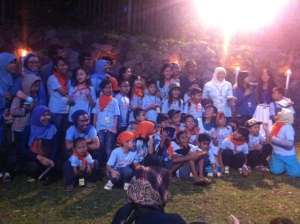
Farewell photo of the workshop participants and their instructors after the opening of the exhibition

The green part of that wall is Tangkuban Parahu mountain, from where cable cars come and go into the City of Bandung

The green part of that wall is Tangkuban Parahu mountain, from where cable cars come and go into the City of Bandung

Crayons are available for those who want to add ideas

Crayons are available for those who want to add ideas

You can tell that this is somewhere in the center of Bandung by the railway

You can tell that this is somewhere in the center of Bandung by the railway

Brainstorming ideas and illustrations

Brainstorming ideas and illustrations

The five regions of Bandung for each group

The five regions of Bandung for each group

Riung Gunung: children as co-designers

DAbdg putihChildren are important stakeholders of a city. In the next 20-30 years, they will be the ones taking over and making decisions for the city. However, they are often neglected, or not taken into account, by public facilities and infrastructures that are built in Bandung. The streets – and even sidewalks – are too dangerous for them to walk or ride bicycles alone, city parks are neither closed nor unkempt, playgrounds are almost non-existent, and so on. It is due time that they should say their desires for the city and to be listened to. This is the main reason why Riung Gunung is on!

REV [RG]Poster_05 (pendaftaran)

Riung Gunung promotional poster

Riung Gunung is a workshop organized by Sahabat Kota, a community/organization in Bandung that has been active in holding programs and events for children and youth who want to learn about the City of Bandung and urban life. As a part of the pre-event series approaching DesignAction.bdg, Riung Gunung is coming up really soon as the next one. This workshop is held for 60-90 children between the ages of 9 to 12, whose main task is to make a scenario of Bandung 2035. In this 6-days workshop, they will go through the phases of exploration, city adventure, envisioning, co-design workshop, and realization. As a result, they will make a model or a physical miniature of the city according to their design, and will act it out, according to the systems they create. These results will be performed and exhibited on July 7, 2013, at Selasar Sunaryo Art Space, a gallery at the North of Bandung, and also during DesignAction.bdg event on October 1-3, 2013.

The 30 instructors who will accompany these children during this workshop have been having their own workshops in order to be prepared with appropriate knowledge, with the following subjects: design thinking, sustainable development, child psychology, education for sustainable development, city planning, performance, games, child handling and creativity.

Detailed program of Riung Gunung

Detailed program of Riung Gunung

We are really looking forward to having this workshop. Hope for a lot of fun and incredible results!

More about Sahabat Kota: http://kisahsahabatkota.wordpress.com/

Sahabat Kota at Facebook: https://www.facebook.com/sahabat.kota

Sahabat Kota at Twitter: https://twitter.com/sahabatkota

Sahabat Kota videos at YouTube: http://www.youtube.com/user/komunitassahabatkota

On Technology Transfer

The other day I asked @OutofPoverty, who was welcoming questions via Twitter, the following:

Based on your experiences, what factors caused failure in technology transfer?

@OutofPoverty answered:

1)   Technology that is too expensive

2)   Failure to design for the market

3)   Absence of last mile supply chain

4)   No attention to business principle

OutofPoverty

The reason I asked this had to do with a lot of design projects by our industrial design students, both within an academic scope and extra-curricular programs, and also numerous research, experiments and projects by our industrial design research group, especially the ones that take place in rural or remote areas. In those areas, essential needs and problems are obvious; however, the answer is not always “design” as in a “tangible product”, but sometimes it’s the infrastructure that hinders access, unaffordable materials, or substandard resources. Designers often have to think beyond the tangible product, by creating also a system that supports the availability and delivery of the product. With it, comes the aspect of technology transfer, as well.

Theoretically, the concepts of “appropriate technology” and factors that guarantee its sustainability once it is implemented are familiar to us, but still, not all technology transfer works for every case. Therefore, I wonder what others in a similar line of works have experienced.

The answer confirmed that there should always be a realistic economic calculation for any solution, next to other crucial factors such as usability and access. Thanks, Paul Polak & team! 🙂

Design Thinking? Design Action!

Design Thinking? Design Action!

Catatan dari d.confestival di Jerman, 20-22 September 2012

Tita & Fiki, dengan latar tenda sirkus yang merupakan venue utama d.confestival

Tita & Fiki, dengan latar tenda sirkus yang merupakan venue utama d.confestival

Pada tanggal 20-22 September 2012 lalu, BCCF diundang ke Jerman untuk berpartisipasi dalam d.confestival, sebuah konferensi internasional pertama mengenai Design Thinking yang diadakan di Hasso-Plattner-Institut (HPI) School of Design Thinking di Potsdam. Dalam acara ini BCCF diminta untuk mempresentasikan program-programnya yang telah dan sedang berlangsung, terutama yang berhubungan dengan tema d.confestival ini: Re-Designing Your City. Awalnya adalah ketika direktur dari HPI School of Design Thinking, Prof. Ulrich Weinberg, yang berada di Bandung sebagai salah satu pembicara utama di Artepolis ITB, hadir di Lightchestra. Lightchestra yang digelar sebagai acara pembuka Helarfest2012, berupa sebuah konser musik dan cahaya di hutan Babakan Siliwangi dengan tujuan mendekatkan masyarakat pada keberadaan Hutan Kota Dunia tersebut, rupanya sangat berkesan bagi Prof. Weinberg, apalagi setelah beliau mendapatkan informasi mengenai berbagai program yang telah digarap oleh BCCF. Prof. Weinberg menyatakan bahwa yang telah dilakukan oleh BCCF dan berbagai komunitas di Bandung adalah aplikasi Design Thinking yang sebenarnya, yang selama ini teori dan konsepnya mereka sampaikan di kampus-kampus d.school (sebutan untuk School of Design Thinking), sehingga beliau mengundang BCCF untuk tampil dalam d.confestival sebagai salah satu presenter.

Salah satu diorama di d.school

Salah satu diorama di d.school

Di d.school ini, para mahasiswanya terdiri dari mahasiswa dari perguruan-perguruan tinggi yang berbeda, dengan disiplin ilmu yang berbeda pula, yang bergabung selama satu tahun dalam d.school untuk bekerja dalam tim dalam menyelesaikan permasalahan dan tantangan yang diberikan oleh berbagai perusahaan yang berkolaborasi dengan HPI. Setelah masa ini selesai, para mahasiswa kembali ke kampus asalnya masing-masing dan menyelesaikan studinya di sana, namun semuanya telah membawa pengalaman Design Thinking, kreativitas, dan semangat berkolaborasi antar disiplin ilmu. Sehingga tidak heran bila peserta d.confestival ini tidak hanya terdiri dari desainer, seniman atau orang-orang yang bekerja dalam bidang “kreatif”, tapi berasal dari berbagai bidang ilmu, seperti ekonomi, sosial, kimia, teknologi informasi, dan sebagainya.

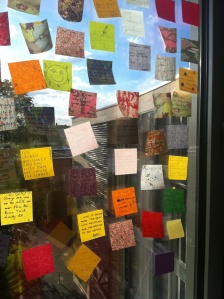
Salah satu proses studi design thinking dengan menuangkan ide lewat tulisan di atas Post-It warna-warni

Salah satu proses studi design thinking dengan menuangkan ide lewat tulisan di atas Post-It warna-warni

Acara yang berlangsung selama tiga hari tersebut digelar di kampus HPI, dengan tema “Sirkus”, sehingga venue utamanya bukanlah sebuah aula biasa, melainkan sebuah tenda sirkus yang didirikan di lahan kampus. Untuk melengkapinya, serombongan pemain sirkus profesional dikerahkan untuk menyelingi acara. Jadi tidak heran bila di kampus tersebut tampak berkeliaran pengendara sepeda roda satu, juggler, dan sebagainya. Hal ini mengakibatkan suasana konferensi menjadi lebih mudah cair, dan – terutama karena bentuk ruang yang bundar – menghilangkan hirarki antara para ahli yang menjadi narasumber berpengalaman, dengan para mahasiswa dan peserta lain.

Detail dari acara ini pun digarap dengan baik. Mulai dari gelang semi-permanen yang menjadi “tanda masuk” peserta di semua venue, “koin HPI” yang digunakan di setiap waktu makan, hingga bantal dan selimut berwarna oranye cerah yang disediakan di tenda-tenda makan semi terbuka.

Hari pertama diisi dengan presentasi para pembicara utama dan beberapa sesi parallel. Hal yang paling menarik di hari ini adalah presentasi berjudul The Difference between Design Thinking and Design, yang dibawakan oleh Oliviero Toscani (fotografer, desainer kampanye iklan kontroversial United Colors of Benetton) dan George Kembel (co-founder dan Direktur Eksekutif d.school Stanford University), di mana keduanya menjelaskan posisi masing-masing dalam isu Design Thinking ini.

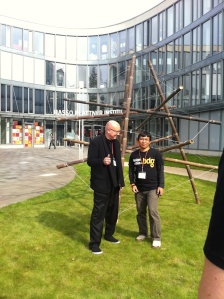
Prof. Ulrich Weinberg, direktur HPI d.school dengan Andry dan struktur bambo tensegrity yang baru selesai dibangun

Prof. Ulrich Weinberg, direktur HPI d.school dengan Andry dan struktur bambo tensegrity yang baru selesai dibangun

Hari kedua adalah di mana tim BCCF melakukan presentasi dan dua workshop. Dalam salah satu workshop ini, BCCF berkolaborasi dengan Andry Widyowijatnoko, dosen Arsitektur ITB yang baru menyelesaikan studi doktoralnya di Aachen. Di workshop ini Andry mengundang peserta untuk membangun bamboo tensegrity structure, di mana batangan-batangan bambu saling terhubungkan dengan tali logam, tanpa saling bersentuhan. Ketika seluruh bagian bambu dan tali logam sudah selesai dihubungkan, struktur bambu ini dapat diposisikan dalam berbagai arah. Struktur bambu ini kemudian berfungsi sebagai semacam tiang ‘totem’, di mana semua orang dapat berjejaring dengan menggantungkan identitas dan pesannya mengenai Design Thinking yang dituliskan di atas kertas yang disediakan oleh BCCF.

Di workshop yang satu lagi, tim BCCF berkolaborasi dengan Prof. Eku Wand dari HBK Braunschweig dan KBRI di Berlin, mengajak peserta bermain angklung. Hubungannya dengan Design Thinking? Di sini angklung merupakan representasi dari individu, yang memiliki karakter tersendiri. Namun sebuah lagu hanya dapat dimainkan bila masing-masing angklung dapat bekerja sama dan saling melengkapi, seperti halnya kolaborasi antar disiplin ilmu dalam mencapai inovasi.

Presentasi dilakukan di Feedback Room, di mana kasus “Redesigning Your City” di berbagai belahan dunia ditampilkan, masing-masing selama 15 menit, lalu dilanjutkan dengan diskusi dan tanya-jawab. Karena keterbatasan waktu, tentu tidak semuanya mendapat kesempatan menanggapi, sehingga setiap orang yang masuk mendapatkan satu lembar kertas untuk diisi dengan tanggapan, usulan, dan sebagainya. Kertas tanggapan ini, setelah diisi, dapat diberikan langsung pada presenter yang membawakan subyek yang ditanggapi.

Presentasi di Feedback Room

Presentasi di Feedback Room

Dalam kesempatan ini, tim BCCF menyampaikan sekilas informasi mengenai Bandung (ada pertanyaan, “Bandung itu kota di negara apa?”), sejarah berdirinya BCCF, dan aktivitasnya yang “merancang ulang kota”, seperti TUNZA, Lightchestra, Kampung Kreatif, dan Semarak.bdg, dan berbagai program Urban Acupuncture yang telah dan sedang dilaksanakan. Di awal presentasi, BCCF menyatakan belum pernah mendalami Design Thinking, meskipun menurut Prof. Weinberg menyatakan bahwa yang kita lakukan selama ini adalah Design Thinking, sehingga yang disebutkan di presentasi (dan semua materi yang dibawa) menerakan Design Action, sebab itulah yang kita lakukan. Selain slide, BCCF juga menampilkan video-video pendek dari berbagai event tersebut. Tanggapan yang diperoleh BCCF sangat positif, sebab rata-rata yang hadir, pada awalnya belum pernah mendengar tentang Bandung, namun langsung menyatakan ketertarikannya untuk mengunjungi Bandung dan melihat sendiri program-program BCCF, dan bahkan menyatakan minat untuk berkolaborasi dengan kota asal mereka masing-masing. Hal yang dinilai paling menonjol dari BCCF adalah kemampuan kita untuk berkumpul dan bekerja sukarela demi kehidupan kota yang lebih nyaman untuk semuanya, dan semangat kita untuk selalu berbagi, yang seluruhnya dilakukan dengan cerdas dan dengan daya kreatifitas tinggi.

Di hari ketiga, yang merupakan hari terakhir dari rangkaian d.confestival, tim BCCF menyimak presentasi Prof. Kees Dorst (dari Sydney University of Technology), yang menguraikan konsep dan analisa mengenai Design Thinking, yang memetakan berbagai kasus yang terjadi di Sydney. Dari presentasi ini lah BCCF menyadari bahwa kekurangan utama kita adalah hampir tidak adanya analisa atau evaluasi yang terstruktur terhadap berbagai program yang selama ini kita jalankan.

Ruang bundar di tengah-tengah tenda sirkus di penutup acara

Ruang bundar di tengah-tengah tenda sirkus di penutup acara

Di akhir acara, penyelenggara mempersilakan siapa pun yang bersedia untuk maju dan duduk di tengah-tengah lingkaran tenda sirkus, untuk dapat mengutarakan pendapat, kritikan, dan sebagainya, terhadap Design Thinking dan d.confestival. Hal ini juga di luar kebiasaan konferensi pada umumnya, di mana hal-hal disimpulkan dan dibuatkan resumenya oleh sebuah tim perumus yang terdiri dari orang-orang yang terpilih. Saat penutupan d.confestival, tim BCCF mendadak diminta untuk sekali lagi melakukan workshop angklung untuk seluruh peserta. Sambutan para peserta terhadap acara penutupan ini sangat meriah, dan permainan angklung berhasil meninggalkan kesan gembira bagi setiap peserta yang hadir.

Sisa waktu di Berlin dimanfaatkan oleh tim BCCF untuk membuka kontak dan mengawali jejaring dengan berbagai komunitas dan organisasi di Berlin, seperti Create Berlin, Webcuts, Asia-Pacific Berlin Forum, dan International Design Center Berlin. Berbagai rencana kolaborasi telah didiskusikan, dan siap untuk dilanjutkan dan diwujudkan oleh berbagai komunitas di Bandung. Berikutnya? BCCF harus tetap mempertahankan kontribusi positifnya terhadap Kota Bandung, dan Bandung harus sanggup menjadi tuan rumah untuk acara sejenis d.confestival, yang berskala internasional dengan detail yang digarap baik, dan melibatkan berbagai unsur masyarakat dan disiplin ilmu, demi memperoleh solusi yang inovatif dalam menghadapi tantangan kehidupan urban di masa mendatang.

Oktober 2012,

Tim BCCF: Fiki & Tita

Science, Technology, Society – 2

Some pointers I noted from the first session of “The Role of Science, Technology and Arts in Predicting Social Phenomena” seminar, held by the Research Group for Humanity Studies (Faculty of Arts and Design), Institute of Technology Bandung on July 11th, 2012.


Forensic Linguistic

From the speech of Prof.Dr. Aminudin Aziz about the role of forensic linguistic in predicting and analyzing social-political phenomena in Indonesia:

A linguist is different from a polygot. A polygot has multi-language ability, a linguist has the ability to analyze languages without having to be able to speak many languages.

Analysis tools

A part of a forensic job is to place someone’s origin based on his/her name and speech intonation, to find a language’s data, to investigate whether a statement is actually made by a certain person.

How? Language has a regular structure. The speaker is consistent in his/her speech.

Patterns

Asian language structure has a circular pattern; the speakers tend to go around and around on a subject before coming right to the point. Anglo-Saxon has a linear pattern; the speakers straightforwardly state their minds. The Arabic language has a parallel pattern; the speakers present one important fact after another, so all these important facts come in a bulk to the audience/ listener.


From the speech of Roby Muhamad, MSc, MA, PhD:

Do we need Science to explain social phenomena?

If a scientist talks about social phenomena, he would likely get responds such as, “I knew that already”, or even “You went to school for that?”

This is because social phenomena can be responded by common sense.

Intuition is good to make sense, to give meanings, but not to understand the world.

Intuition is sometimes wrong, since it’s very specific, acquired from experience that is different from one person to another.

Social phenomena are unpredictable. The most possible thing is to predict the probability. It’s a matter of relevance, so the trick is to predict what is relevant.

It’s a matter of relevance

Internet untuk ilmu sosial adalah seperti teleskop untuk fisika, atau mikroskop untuk biologi. Untuk pertama kali dalam sejarah manusia, interaksi, perilaku dan sikan manusia terekam dalam jumlah besar di Internet.

Kemampuan belajar dan beradaptasi dengan cepat

lebih penting daripada mengantisipasi masa depan


Lots more interested things to be captured, but – as goes the saying – you’ve got to be there to absorb every detail 🙂

A happiness thermometer

Science, Technology, Society – 1

Some pointers I noted from the first session of “The Role of Science, Technology and Arts in Predicting Social Phenomena” seminar, held by the Research Group for Humanity Studies (Faculty of Arts and Design), Institute of Technology Bandung on July 11th, 2012.

From the opening speech by ITB Vice Rector for Academic Affairs and Student Affairs:

The Circle

There is a connection between cellular phones, motorbike-taxi, and the logging of Gunung Kidul forest.  Forest farmers cut down more trees of the forest, even the younger ones, to be able to afford cellular phones and motorbikes. These farmers, who used to use the motorbike-taxi service to get home, are now able to call their sons, who now now have their own motorbikes, to pick them up. The motorbike-taxi service gradually disappeared, and so did the trees, and – following – so did these farmers’ jobs, due to the diminishing woods to harvest. Considering this circle, it is obvious that (the desire for) technology influences social conditions.

The biggest challenges  faced by (American) scientists of today are health, material science and sustainable energy.

So far, engineers have been considering only the output of the technology: function, effectiveness,  and all other tangible and quantifiable results. They rarely consider the intangible result: the impact to society.

From the speech of Ir. Ary Mochtar Pedju, M.Arch:

Technologically excluded regions

Developed countries have science and technology-based economy. Developing countries will never cross the line that borders between industry-based economy and technology-based economy.

Technologically-excluded regions are within a poverty trap. These regions are prone to infectious disease, low productivity and environmental degradation.

Referring to MIT, the traditionally-segregated disciplines: Basic Science & Engineering/Technology and Humanities & Social Sciences, are merging and forming a new group called Science Technology Society, which solves complex, real societal needs/ problems.

We need reformed education.

Science Technology Society

Universities should have inter-disciplinary centers/ labs/ programs that drive the faculties (and then the hierarchic structure), and not the other way around.

An inter-disciplinary “center” should not be a mere physical office(!).  It should be a gate for all local wisdom, a hub for interaction for Government, Business and Academic entities, and should facilitate interdisciplinary projects.

We should examine the cultural & institutional context in which science and technology are rooted.

We need to write history books with broad-based analysis that include the use of technology and how it influence our society in all aspects: economy, politics, etc.

From the discussion session:

There should be a revolution to our middle-school education: eliminate the divisions of Science and Social majors.

Mother tongue: Indonesian?

The Indonesian language is, for most Indonesians, a second language, since it is common for Indonesians to speak a region’s language as their mother tongue. As the impact, Indonesians become non-critical to Indonesian language. Therefore, the term “Speaking Indonesian language properly and correctly” should be replaced with “Speaking Indonesian language appropriately and according to context”.

Why Are We Wired?

WHY ARE WE WIRED?

Tom Gaiser | 27111701

Classmates wired

Wired?  Are we so connected that we begin to loose our own self identity?  Who am I that I must define myself by my online relationships?  Am I a page on Facebook?  Or have I become the repository of a zillion apps?  Are people apt to meet friends in real life only to share physical space while  meeting more friends online.  If cyber is space, is it outer space or inner space or  in-between space?  Really,  it is a matter of the sustainability of the human soul.  Man has been concerned about the sustainability of his soul for a while.  Well, the Greek philosophers had no problem with man’s soul.  Drama and comedy certainly dealt with man’s follies.  Shakespeare made the human condition dense with substance.  Then came the Industrial Revolution.  Charles Dickens warned us.  For the first time in human history a product of man’s invention would begin to control us.  Even in war it would no longer be man against man, an honorable way to lay waste upon our selves.  NO,  we’d have machines do this for us.  Now philosophers, like Sartre and Ortega y Gasset would write of the dehumanizing of the human soul.

But wait, there was a new revolution.  What about freedom?  Freedom to do as we please.  You know, free spirit, free speech, free sex, freedom of choice.  The soul was set free, yay to that.  Our parents could have nothing to do about this.  Family and work required sacrifice?  Yes, that is a question.  They would define work and family, and religion for that matter, as a goal, something to honor, not a sacrifice. Because it was all about sustainability.  Why as a family did we grow our own vegetables and poultry besides cooking our own meals. Ever heard about the book “Chicken Soup for the Soul”?  Why did the wash “go out to dry” rather than into the dryer?  Why did my father teach me how to repair the house and service the car?  Well, it had something to do with maintaining a budget.  It also had something to do with maintaining the soul of the family.

Amish girl online

But let’s get back to the wired phenomena.  We all, well, I hope at least most of us, have seen the photos of landfills full of obsolete PC’s or the poor people of some poor country disassembling electronic devices for their poisonous innards. (At least the latter is an effort to recycle.)  But what about the constant need for the latest electronic device?  And why are we so dependent on these devices for our social well being?  I believe it is all about judgment.  Truthfully, there is a lot of good with this new age of  information communication technology.  I can see my daughter’s new hair cut from half way around the world, as well as talk with her for free.  It’s through an app called Tango.  That is good for the soul.  And certainly the instant access of information about how we can sustain the world as well as research for our school and work projects revolutionizes knowledge.  Even the latest issues regarding the Green Revolution are disseminated through the electronic media. But that’s just it, electronic devices are tools and the “media is just the messenger”.  It is only when these electronic devices consume all our time and when the messages obscure our own thoughts, that the sustainability of the human, each individual’s, soul is in danger.

LET’S BE WIRED FOR THE GOOD OF IT.

Sadar Lingkungan di Perempatan

Sadar Lingkungan di Perempatan

Ilhamsyah | 27111018


Sebuah Perempatan di Bandung

Sepeda Motor Sebuah Efesiensi Kehancuran

Tulisan ini berawal dari pengalaman penulis ketika memutuskan beralih  mempergunakan roda dua (sepeda motor) dari sebelumnya menggunakan kendaraan umum (Angkutan Kota). Dengan aktifitas dan mobilitas yang tinggi penulis berasumsi menggunakan sepeda motor dapat mencapai waktu tujuan dengan cepat. Selain itu berdasarkan pengalaman, satu liter bensin dapat dipergunakan untuk beraktifitas dalam satu hari dengan 3-4 tujuan, bisa dibayangkan jumlah rupiah yang di hemat mencapai Rp.15.000,-/hari. Namun tanpa disadari keefesienan tersebut berbanding terbalik dengan aktifitas yang meninggi. Dalam penjelasan lain, dengan waktu yang tersisa dari aktifitas yang sebelumnya menggunakan kendaraan umum, dimanfaatkan untuk aktifitas tambahan yang berarti jarak yang ditempuh bertambah banyak. Fakta di lapangan menunjukan ternyata jumlah sepeda motor di Indonesia telah menembus lebih dari 50 juta unit di tahun 2010 (Tempo.co), menempatkan negara Indonesia di posisi pertama se-Asia Tenggara. Bahkan di DKI Jakarta populasi sepeda motor hampir melewati jumlah penduduknya. Berarti tujuan efesiensi ternyata menimbulkan problem lingkungan lain, yaitu hampir setiap individu pengguna jalan raya turut berperan menghasilkan karbondioksida dari pembakaran bahan bakar fosil melalui sepeda motor.

Pembahasan ini akan lebih difokuskan di Kota Bandung saja, dimana aktifitas sehari-hari penulis menggunakan sepeda motor. Di Kota Bandung kendaraan umum yang paling populer adalah angkutan umum atau kadang masyarakat Kota Bandung menyingkatnya menjadi Angkot. Dari beberapa pembicaraan dengan pengemudi angkot mereka mengeluhkan turunnya jumlah penumpang karena telah beralih menggunakan sepeda motor. Diasumsikan dengan satu angkutan umum yang dapat membawa penumpang 12 orang, terpecah menjadi 10 orang menggunakan sepeda motor. Perbandingan ini akan tidak fair karena angkutan umum (mobil) memiliki kapasitas mesin kurang lebih 1500cc, sedangkan motor pada umumnya berkisar 100cc hingga 115cc. Namun bagaimana pembicaraan ini dapat dikaitkan dengan isu lingkungan dalam mencari solusi desain yang berwawasan lingkungan?

Desain Berkelanjutan

Desain berkelanjutan berdasarkan kutipan dari Wikipedia adalah filosofi perancangan obyek fisik, lingkungan binaan dan layanan untuk mematuhi prinsip-prinsip berkelanjutan ekonomi, sosial dan ekologi. Jadi kurang lebih desain berkelanjutan hadir sebagai respon terhadap krisis lingkungan global, pesatnya pertumbuhan ekonomi seiring pesatnya perkembangan populasi manusia, menyusutnya sumberdaya alam, kerusakan ekosistem dan hilangnya keanekaragaman hayati. Jadi desain berkelanjutan adalah konsep dimana perancangan desain ditekankan untuk lebih bertanggung jawab terhadap warisan bagi masa depan kita dan kehidupan yang lebih baik bagi penerus (keturunan) kita. Salah satu prinsip yang ditekankan dalam desain berkelanjutan adalah menekan penggunaan bahan bakar atau energi yang tidak dapat diperbaharui, dalam hal ini bahan bakar fosil (bensin). Disinilah letak keterkaitan antara paparan tentang penggunaan sepeda motor dengan desain yang bertanggung jawab terhadap lingkungan. Penulis akan lebih menekankan desain sebagai sebuah sistem dalam menganalisa permasalahan diatas.

Fakta di Jalan Raya

Dari pengalaman yang dirasakan penulis saat mengendarai sepeda motor, sering terjebak di perempatan yang memiliki durasi lampu merahnya lumayan lama, terkadang ada yang sampai 250 detik atau setara 2 menit 10 detik. Sebagai contoh perempatan Jalan R.E. Martadinata dan Ahmad Yani yang durasinya bisa mencapai 240 detik (3 menit), atau perempatan Jalan Soekarno Hatta dan Jalan Kiaracondong yang mencapai 250 menit (4 menit 10 detik). Sebuah waktu yang cukup lama untuk membakar bensin secara percuma, karena jarak tempuhnya hanya 0 kilometer. Menurut data yang didapat, mesin dengan kapasitas 100 hingga 115cc akan menghabiskan 2 hingga 5cc bensin dalam kondisi diam (jpmautomotive.blogspot.com). Tidak besar sih, tapi bila dijumlahkan dengan populasi motor yang ada serta mobilitas yang tinggi bisa dibayangkan berapa ribu liter bensin per hari terbuang percuma hanya untuk kondisi diam. Hal ini sering mengganggu penulis ketika terjebak pada setiap perempatan, maka solusi sederhana dari penulis yaitu dengan mematikan mesin motor sambil menunggu saatnya lampu hijau. Proses ini selalu dilakukan disaat berhenti di setiap perempatan, namun disesuaikan dengan kondisi durasi lampu lalu lintas saat merah, apabila terlalu singkat tidak memaksakan mematikan mesin. Keberadaan penunjuk waktu di setiap lampu lalu lintas cukup membantu penulis untuk ancang-ancang menyalakan mesin kendaraan, jadi tidak terjebak lampu hijau sedangkan mesin motor masih dalam kondisi mati, ini akan sangat mengganggu pengguna jalan lain. Selain itu sebagian besar sepeda motor yang ada, terutama model terbaru, sudah dilengkapi dengan electric starter dengan menggunakan baterai kering, jadi proses menyalakan mesin tidak perlu repot-repot menggunakan kick starter (manual).

Namun sistem ini menjadi percuma apabila dilakukan oleh penulis seorang diri, tidak ada efeknya bagi lingkungan secara nyata, hanya memenuhi rasa tanggungjawab penulis terhadap lingkungan. Lalu bagaimana cara untuk menggerakan para pengguna sepeda motor lainnya untuk memiliki kesadaran yang sama yaitu mematikan mesin kendaraannya di setiap lampu merah perempatan tersebut. Penulis melihat peluang dengan memanfaatkan fenomena sticker lucu yang sering ditempatkan bagian belakang (spatbor) sepeda motor. Berbagai macam kata-kata menarik digunakan untuk hanya menarik perhatian pengguna motor lain, yang terkadang kata-katanya menggunakan bahasa daerah (sunda). Penulis berasumsi sticker tersebut bisa dimanfaatkan sebagai ambient media untuk menyebarkan ajakan mematikan mesin motor di saat lampu merah. Selain itu dapat dilanjutkan dengan pembagian selebaran atau brosur di setiap perempatan yang isinya menyampaikan kesadaran berkendara sepeda motor yang tetap peduli pada lingkungan. Atau bisa bentuk lain yaitu dengan memanfaatkan pengeras suara di beberapa perempatan untuk menyampaikan informasi yang sama pula.

Bagaimana dengan mobil? Adakah usaha sama untuk mengurangi pembakaran bensin yang percuma, karena faktanya mobil pun terjebak dalam kondisi yang sama. Penulis menemukan sebuah artikel menarik dari mobil.otomotifnet.com yang mengulas sistem Auto Start/Stop pada mobil BMW terbaru. Prinsipnya komputer yang ditanam dalam mobil akan memerintahkan mesin mobil untuk mati sementara pada kondisi berhenti (dengan mekanisme waktu tertentu), dan perannya akan digantikan oleh baterai untuk menyalakan komponen mobil lainnya (seperti Air Conditioner, Radio, klakson, dan lain-lain). Pada BMW ini merupakan salah satu dari serangkaian teknologi effeciency dynamic yang bertujuan mengurangi emisi gas buang pada kendaraan bermotor. Cukup menarik bila sistem ini benar-benar diterapkan pada setiap kendaraan roda empat di seluruh Indonesia atau bahkan seluruh dunia. Kita tidak akan menjadi paranoid karena membakar bahan bakar bensin untuk sesuatu yang tidak bergerak.

Sumber:

http://www.tempo.co/read/news/2011/08/19/124352572/Kendaraan-Bermotor-di-Indonesia-Terbanyak-di-ASEAN (13 Maret 2012)

www.wikipedia.com/sustainable design (13 Maret 2012)

http://jpmautomotive.blogspot.com/p/eco-drive-way-to-drive-efficienly.html

(13 Maret 2012)

http://www.otomotifnet.com/otonet/index.php/read_tekno/2011/12/17/326390/15/5/Mengenal-Auto-StartStop-Mesin-Mati-Malah-Happy (13 Maret 2012)

“Konsumen Pintar” Bersahabat dengan Alam

‘Konsumen Pintar’ Bersahabat dengan Alam

 Aninda Purnamashari | 27111002

Pernahkah anda menghitung berapa produk yang anda beli setiap harinya? Dan, pernahkah terlintas di benak anda, bagaimana produk-produk itu diproduksi dan efeknya terhadap lingkungan?

Pertanyaan tersebut sebenarnya ingin menyadarkan anda terhadap kenyataan yang saat ini terjadi di bumi kita. Gaya hidup konsumtif masyarakat modern memacu kegiatan produksi massal tanpa memperhatikan efek buruk yang akan mempengaruhi masa depan generasi selanjutnya. Bumi kita yang sudah semakin tua dan rapuh, secara terus menerus disedot kekayaannya tanpa berpikir panjang tentang keberlanjutannya. Dan semakin dirusak dengan limbah-limbah hasil proses produksi. Dampak nyata yang ada di depan mata adalah perubahan cuaca drastis yang dapat kita rasakan sehari-hari.

Limbah rumah tangga

Hal ini sudah menjadi kegelisahan para insan yang aktif dalam lembaga sosial pecinta lingkungan di seluruh penjuru dunia. Berbagai kampanye cinta lingkungan digalakan sebagai reaksi nyata terhadap permasalahan yang ada. Masyarakat dikenalkan kembali dengan gaya hidup natural yang dekat dengan alamnya. Inovasi para desainer sebagai bukti untuk menanggapi permasalahan ini pun satu persatu mulai bermunculan.

Sebagai manusia modern yang memiliki pemikiran terbuka, tentunya hal ini dapat menggugah kita untuk mengubah pola gaya hidup konsumtif dan menjadi ‘konsumen pintar’ yang dapat memilih dan memilah produk-produk yang memberikan dampak paling minim bagi lingkungan. Belum tahu harus memulai dari apa? Bisa kita mulai dari produk yang digunakan sehari-hari. Karena produk sehari-hari ini yang secara kontinu digunakan dan secara kontinu pula akan diproduksi sesuai kebutuhan konsumennya.

Wanita diketahui cenderung lebih konsumtif daripada pria untuk produk yang dipakai sehari-hari. Apabila ditelusuri lagi, kebutuhan wanita memang lebih banyak, mulai dari kosmetik, pakaian, tas, sepatu, dan lain-lain. Sebagai contoh, untuk kosmetik dan perawatan tubuh saja wanita membutuhkan setidaknya sepuluh jenis produk. Untuk muka, kulit, kuku, rambut, dan masih banyak lagi. Apabila wanita-wanita di seluruh dunia ini menjadi ‘konsumen pintar’ yang sadar lingkungan, tentunya mereka akan memilih produk kecantikan yang ramah lingkungan. Sudah diketahui oleh khalayak umum bahwa produk kecantikan yang banyak dijual mengandung bahan-bahan kimia yang dalam proses produksinya merusak lingkungan dengan limbah-limbah beracun dan memiliki dampak yang buruk pada diri sendiri dalam jangka waktu yang panjang.

Eco Conscious Product – Body Shop

Menilik kembali ke masa lalu, nenek buyut kita melakukan perawatan diri yang didapat langsung dari alam. Menggunakan bahan-bahan organik yang terbukti ampuh dan memberikan efek yang baik bagi diri sendiri maupun lingkungannya. Hal ini sudah disadari oleh Anita Roddick, yang pada tahun 1976 dengan membuat toko kosmetik alami yang hingga saat ini dikenal dengan The Body Shop. Menyadur dari berbagai ramuan tradisional yang beliau cari di beberapa negara, Anita membuat produk kosmetiknya dengan bahan-bahan alami.

Merespon berbagai permasalahan lingkungan yang mulai bermunculan, The Body Shop meluncurkan inovasi produk kosmetik yang beretika. Mulai dari proses produksi hingga kemasan yang dapat didaur ulang ketika sudah tidak dipakai lagi. Salah satu inovasi The Body Shop yang paling akhir adalah seri ‘Eco Conscious products’, yaitu produk sabun dan shampo yang meminimalisir dampak yang buruk terhadap lingkungan dan kemasannya terbuat dari plastik yang 100% dapat didaur ulang. Bahan yang digunakan pada produk ini tidak beracun bagi organisme yang hidup di dalam air. Penggunaan kemasan yang 100% dapat didaur ulang ini menjadi salah satu tujuan utama yang saat ini sedang digerakkan oleh pihak The Body Shop terhadap seluruh produknya.

Berbagai kampanye lingkungan dilakukan oleh perusahaan ini untuk mengajak para ‘konsumen pintar’ berkontribusi di dalamnya dan membuat bumi ini menjadi tempat yang lebih baik untuk ditinggali. Toko The Body Shop merepresentasikan konsep natural dan memberi edukasi kepada konsumennya terhadap masalah lingkungan yang sedang dikampanyekan. Informasi yang disampaikan diharapkan dapat memberikan kesadaran terhadap permasalahan lingkungan yang semakin marak dibicarakan akhir-akhir ini.

Sebagai negara yang berada di garis khatulistiwa dengan segala kekayaan alamnya, Indonesia tentunya memiliki keuntungan lebih. Kita memiliki berbagai hasil bumi yang dibutuhkan di seluruh dunia yang hanya tumbuh di daerah tropis. Nenek moyang kita sendiri memberikan warisan yang sangat banyak untuk diaplikasikan pada kehidupan sehari-hari seperti jamu, obat-obatan tradisional sebagai obat herbal yang lebih sehat dibandingkan obat-obatan kimia.

Serambi Botani

Para insan muda dari Institut Pertanian Bogor telah menghasilkan berbagai inovasi yang mengembangkan hasil bumi dari tanah air kita sendiri. Hasil inovasi mereka dinaungi oleh kampusnya, dan dijual umum kepada masyarakat serta mudah diakses. Usaha ini dinamakan Serambi Botani. Hampir sama dengan The Body Shop, Serambi Botani juga memiliki konsep ‘kembali ke alam’. Menyajikan produk-produk yang seratus persen berasal dari alam dan turut menjaga kelestarian alam dan lingkungan. Hasil inovasi yang dikemas dengan cukup baik ini pun dapat dipertanggungjawabkan. Produk-produk seperti ini tentunya dapat menjadi salah satu alternatif bagi para ‘konsumen pintar’ yang sadar lingkungan dan peduli terhadap kesehatan serta turut menggalakkan cinta produk dalam negri.

Tidak hanya perlengkapan kosmetik dan perawatan tubuh, Serambi Botani juga menawarkan produk alami lainnya antara lain madu, obat herbal, aneka olahan makanan yang menggunakan bahan baku lokal, bahan pangan, dan lain-lain. Dengan kemasan sederhana tapi efektif, serta menggunakan bahan-bahan alami, produk-produk dari Serambi Botani turut menyumbangkan eksistensinya sebagai produk harian yang ramah lingkungan dan aman bagi kesehatan. Selain komitmennya sebagai produk yang alami dan sehat, Serambi Botani turut mensejahterakan para petaninya sebagai produsen utama dengan pembagian keuntungan yang adil antara produsen dan pihak pengelola.

Tidak sedikit produk-produk baru yang mencanangkan konsep serupa, dan sebagai ‘konsumen pintar’ harus bisa menentukan yang mana produk yang benar-benar memiliki komitmen terhadap lingkungan dan yang hanya memakai slogan ‘alami’ padahal tidak benar-benar berkomitmen dengan baik. Misalnya, ada produk yang secara proses memang alami dan tidak menggunakan bahan kimia, tapi sayangnya tidak didukung dengan kemasan yang baik. Sehingga ketika produk itu sudah selesai digunakan, kemasan bekas produk tersebutlah yang akhirnya merusak lingkungan kita. Atau contoh lain adalah slogan tersebut hanyalah embel-embel agar penjualan meningkat padahal secara proses produksi hingga akhirnya produk itu tidak terpakai, sama sekali tidak memberikan efek yang baik bagi tubuh kita maupun bagi lingkungan.

Memang tidak mudah melakukan perubahan pola gaya hidup seperti ini. Masih banyak yang dapat kita perbuat untuk melindungi lingkungan alam ini. Namun perlahan tapi pasti. Bumi kita sudah menunggu untuk kita mulai bergerak dan melakukan bukti nyata bahwa kita membutuhkan bumi yang sehat untuk generasi selanjutnya. Jadilah ‘konsumen pintar’ yang teliti memilih produk yang baik. Maka, mari bersahabat dengan alam, maka alam akan bersahabat dengan kita.