Author Archives: Tita Larasati

City, Design, Sustainability

When I was asked to deliver a talk that concerns city, design, and sustainability, I right away browsed the various materials that I have in stock for such subjects, while thinking of a way to integrate them into a legible statement. Most of the audiences, I was told, were (design) students and young delegates from ASEAN countries, so I would have to take into account that not everybody is familiar with Bandung and all its characteristics. All presentation materials, of course, have to do with programs of Bandung Creative City Forum (BCCF), its programs and strategy to create a “creative city”. Here goes.

City - Design - Sustainability

CITY – DESIGN – SUSTAINABILITY

Bandung in Brief

As the capital city of West Java Province, Bandung is populated by about 2,5 million people, of which almost 70% are below 40 years old. Historically, it was among the most cities favored by the Dutch colonial government due to its cool temperature, mountain scenery and hot water springs. It had more to offer: as a resource for quinine and pharmaceutical industry and tea and coffee plantations; it was the first city designed as a garden-city, and where Dutch-Indies architects built art deco buildings. In the 30s, the newest fashion could be found either in Paris or in Bandung, hence the nickname “The Paris of Java” for Bandung in those era. All these historical facts have left cultural heritage beyond mere physical buildings; they left a city whose people are used to having a variety of lifestyles and behaviors, including progressive development in many aspects.

Bandung Potentials

Bandung is located relatively near from Jakarta, the capital city of Indonesia. Surrounding the two cities are smaller towns with material and production resources, which have become an important part of business and R&D activities in Jakarta and Bandung. Among the advantages are easy accesses to material research, product development and production, market studies, manual skills, traditional and cultural resources, and many more, which are often required in creative activities. Therefore, the location of Bandung is much favorable, considering the surrounding resources and the distance to all these resources. Added by the condition of Bandung, which is known for its pleasant mountainous atmosphere, Bandung has its advantages as a Place where creative endeavors are supported and encouraged.

Since the establishment of the first higher education in engineering in Bandung, the city has become home for about 50 universities and other higher education institutions, both for vocational and academic/research levels. These schools have attracted young, talented people from all over the place, who represent the diversity of Bandung citizens. These generations also possess an abundance of energy and ideas. They commonly gather with people who share similar interests, conducting joint programs and numerous activities in various scales, and holding them in many spots in Bandung. The facts that communities in Bandung are high in number and are very active have lead to the conclusion that the main potentials of Bandung are its People and Ideas, added by the advantage of Bandung’s location and condition: Place. The slide that shows four main programs of BCCF (Helarfest, Kampung Kreatif, Simpul Institute, DesignAction.bdg), with their general road map, gives a picture of how these programs work closely to the field of design and creativity.

Design for the City

How is Design contributing to the development of a city and its sustainability? The following slides attempt to answer this question through examples taken from BCCF programs. Presented here are three functions of Design: as a tool, as a practice, and as a method. Firstly, as a tool, the design of our city branding .bdg has taken effect as a code that unify the different creative communities in Bandung, who can still present their individual identity while having also a collective identity as originated from Bandung (by the community’s name before the [dot], and by the “bdg” that follows). As commonly conducted when defining a brand, prior studies on positioning, values, personality, etc. were explored as well, to find the real soul of Bandung, before translating all these manifestations to a visual form: a logo, a brand and its activations that represent the city.

Secondly, as a practice, design for a city can come in many forms, purposes, and scales.

  1. RekaKota project during Semarak.bdg in 2010, where several public spots in the city were each assigned to a group of designers/artists. Each group designed either a shelter, a smoking corner, a public bench, and so on, depending on the particular spot. RekaKota is among the first BCCF events that attempted to implement a collaboration among designers, business sector, and the government, by offering the public facility designs to a brand or company who would invest in producing the facilities while also subtly promoting their brand, and by having the government’s decision to give permission to the location and the facilities, and for tax reduction if the facilities are considered as an advertisement for the brands.
  2. Bandung Public Furniture projects in Helarfest 2008 and 2009, where industrial design students, lecturers and professionals designed and produced a variety of public furniture and put them in public spaces (open space in malls, public parks, etc.). The products had unusual functions and shapes, compared to the benches commonly found in public areas in Bandung, and it was interesting to observe how people appreciate and interact with these products. This project has gradually proven that well-designed products can add to the pleasant experience of people towards their built environment.
  3. An infographic poster from Regia event in 2013 that was published in Pikiran Rakyat, the biggest newspaper in West Java, informed its reader about Babakan Siliwangi World City Forest in Bandung: the dominant tree species, its Oxygen production, its function as a transit place for migrating birds, and so on. Through this clear and easy-to-read graphics, people are expected to gain information and affection towards the subject at the same time, and – in this case – to be aware and care more about Bandung’s only city forest.
  4. Regia in 2013 contained several sub-events, among which one was Forest Dining, where Baksil ForestWalk was turned into a dining place, collaborating with a nearby restaurant. This environment design provided a new experience in dining, where the “floors” were elevated wooden planks and the “walls” were huge, living trees with its hanging roots, leaves and branches, lightened by random colorful spotlights. Furthermore, another Regia sub-event was going on at the same time: Blues Leuweung, where live blues music performed at Sanggar Olah Seni, a cluster of art studios located at the periphery of the forest, and its sounds reached the ForestWalk, which added to this unique dining atmosphere.

All in all, “design for the city” that are presented here can be seen not as a mean to merely decorate or beautify a place. Design is meant to provide proper interaction between people and their surrounding objects and environment, to give clear information inclusively, and to create pleasant experiences for citizens in conducting their daily lives in the city. All design projects by BCCF aim to make urban life more enjoyable.

Thirdly, design as a method to solve problems in the city. DesignAction.bdg (DA.bdg) program at BCCF is a workshop-conference that applies design thinking method to find innovative solutions for urban issues, involving the four stakeholders of a city: the government, business sector, academics and communities. The first DA.bdg in 2013 focused on urban mobility issues, where all participants tried walking, taking angkot and bus, and riding bicycles in the city in the observation/empathy phase. The process continued with re-framing up to prototyping, where participants in groups presented and role-played their recommendations to solve urban mobility problems. DA.bdg2013 had about 250 participants from all stakeholders (government, business sector, academics and communities) who gathered for three full days and interacted intensively with each other; an opportunity that seldom comes. The “creative process” that is commonly used to solve design problem is now no longer the domain for designers only, but can be applied to other conditions, including an urban setting, and even to rethink about policies and regulations, to find where bottom-up and top-down solutions can meet, and so on.

What about the Sustainability?

The term “sustainability” refers to the three aspects of Environment, Economy, and Social-Culture. “Design for the City” by BCCF includes these three aspects as well, in the form of the target of each program: Footprints. The slide that contains BCCF strategy to create a “creative city” describes that all BCCF programs and activities aim to leave either one or more of these footprints:

  • Economic: local people or communities should be able to gain an entrepreneurial mindset and to gradually self-sustain themselves by relying on their own skills and efforts
  • Social-Cultural: local people or communities should be able to express themselves and explore their own characteristics inclusively, particularly through creative activities
  • Environmental/ Artifact: there should be a physical object/ artifact that not only reminds the people/ communities about their creative potentials, but also becomes a tool for their creative expressions, while maintaining the quality of their living habitat

The previous examples left these footprints in various forms:

  • .bdg left a city brand and its activations; it gained a sense of belonging towards the city from the different communities; it also accumulated a sense of Pride that we all a part of Bandung; and it encouraged Bandung citizens to be aware of their identity.
  • Public facility projects left a number of physical objects that have improved the urban experience in Bandung, both for citizens and visitors; the project even led to a change of policy at the municipal level concerning creative expressions in public spaces.
  • Design thinking workshop basically provides a new method of solving problems by exploring the creative potentials from all stakeholders of a city, from different backgrounds and disciplines, since this is how usually innovations emerge.

It can be seen in the slide that contains a few of BCCF portfolio since its establishment in 2008: programs and events that were held to respond to, or attempted to find solutions for, a number of urban issues (in the red circles in the middle): green open space, urban mobility, entrepreneurship, public space, heritage buildings, etc. The processes and results are prototypes and recommendations for the city government and all stakeholders, especially seen from the community level, on how people can contribute to many aspects of a city. All programs and events leave the aforementioned footprints; some are better-maintained than the rest, which proves that they all require active participations from all stakeholders of the city.

Conclusively, it is proven that Design can play an important part in a City development: as a tool, a practice or a method. It so happens that Bandung has this potential at a superior level, therefore we – communities – have been using this strength to build our own living spaces, to make them more pleasant. The Sustainability takes place when all stakeholders understand and are willing to contribute to creating a Liveable, Lovable Bandung! 🙂

Nimmanhaemin

Denah tenant peserta NAP dan brand masing-masing

Denah tenant peserta NAP dan brand masing-masing

Poster dan denah NAP sebagai penunjuk arah

Poster dan denah NAP sebagai penunjuk arah

Kunjungan ke Chiang Mai ini bukan untuk pertama kalinya, tapi kali ini bertepatan dengan peristiwa istimewa di sana: Chiang Mai untuk pertama kalinya mengadakan Design Week, berbarengan dengan berlangsungnya acara tahunan Nimmanhaemin Art&Design Promenade (NAP) yang ke-15. Apa yang membuat NAP ini menjadi sangat menggemaskan dan membuat penasaran? Karena sebenarnya kita pun bisa membuat hal serupa yang tidak kalah serunya!

Nimmanhaemin adalah sebuah distrik di Chiang Mai yang merupakan tempat berkumpulnya berbagai showroom, studio dan kantor desain dan seni dalam berbagai bidang. Sekitar 14 tahun lalu, beberapa desainer yang bekerja di Nimmanhaemin berinisiatif untuk mengundang para designer-maker, desainer pemula dan seniman muda untuk menggelar karya mereka di wilayah tersebut dalam sebuah acara tahunan, sebagai kesempatan bagi mereka untuk memperkenalkan karya mereka langsung ke khalayak ramai. Ternyata inisiatif ini disambut dengan sangat positif, dan telah berjalan secara konsisten tiap tahunnya. Para pesertanya bahkan membuat produk baru dan dalam jumlah terbatas, tidak sedikit pula yang handmade atau merupakan hasil keterampilan tangan, untuk dijual pada event ini, yang jatuh pada masa ketika banyak orang berburu hadiah Natal (5-10 Desember).

Persimpangan koridor PAN

Persimpangan koridor PAN

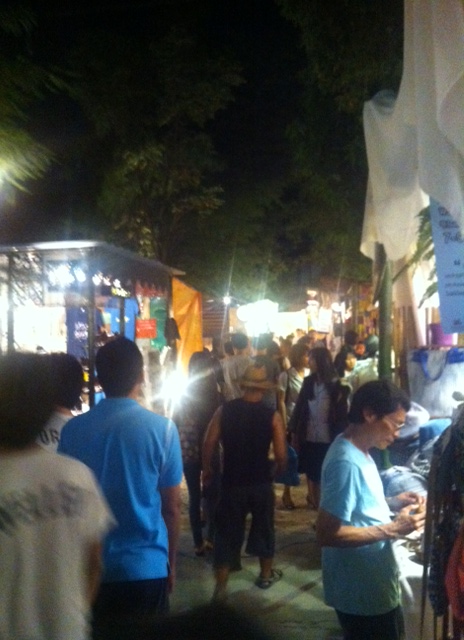
Koridor NAP yang dipenuhi pengunjung

Koridor NAP yang dipadati pengunjung

Booth sebuah organisasi warga lokal

Booth sebuah organisasi warga lokal

Kios makanan tradisional dari warga lokal

Kios makanan tradisional dari warga lokal


Area tempat berlangsungnya NAP merupakan lahan privat, yang para pemiliknya mengijinkan pemakaiannya untuk NAP dengan syarat berbagi hasil dari keuntungan penjualan produk-produk di NAP. Penyelenggara NAP membentuk sebuah tim kurator untuk menyeleksi tenant atau peserta NAP, untuk dapat menjaga identitas NAP sebagai ajang promosi bagi desainer dan seniman muda/ pemula, sekaligus juga menjaga kualitas produk di NAP. Selain itu, penyelenggara NAP juga menyediakan beberapa booth gratis untuk organisasi lokal, seperti pada sekelompok warga yang aktif mendata lingkungan mereka, dll. Selain tenda-tenda untuk produk-produk atau karya-karya terbaru, disediakan juga lokasi untuk makanan dan minuman, baik dari pengusaha muda pemula, maupun untuk warga lokal yang menjajakan berbagai jajanan tradisional. Selama NAP berlangsung, terdapat pula berbagai pertunjukan, live music, dll. Berhubung Nimmanhaemin, lokasi NAP ini, jauh dari pusat kota, penyelenggaranya pun menyediakan beberapa ‘shuttle’, yaitu kendaraan umum dalam kota Chiang Mai (rupanya mirip Mikrolet di Jakarta) yang disewa dan ditandai khusus sebagai bagian dari NAP, lengkap dengan rutenya, selama event berlangsung.

Pelataran mal Maya

Pelataran mal Maya

Ruang publik di pelataran Maya

Ruang publik di pelataran Maya

Pelataran dan jalan setapak yang dipenuhi pop-up stores

Pelataran yang dipenuhi pop-up stores

Dampak NAP rupanya menjalar ke area sekitarnya. Di sekitar area NAP, tumbuh berjamuran berbagai café dan toko-toko desain dan pernak-pernik, telah dirancang dan mulai dibangun pula beberapa apartemen dan hotel. Salah satu venue terbesar di dekat NAP adalah sebuah mall baru bernama Maya, yang selama NAP berlangsung, pelatarannya dipenuhi oleh sejumlah pop-up stores, café dan food truck, yang sifatnya lebih permanen (sementara NAP hanya berlangsung selama 1 minggu). Hal terpenting yang patut dicatat adalah, meskipun dipadati pengunjung, area NAP tetap terjaga kebersihan dan ketertibannya. Tidak ada sampah sembarangan berceceran, atau pengunjung yang saling mengganggu. Semuanya menikmati suasana dengan santai dan gembira.

Pembuat produk ini gemar pada huruf dan terampil mengolah kayu secara manual

Pembuat produk ini gemar pada huruf dan terampil mengolah kayu secara manual

Ini pengrajin bir, yang mencampurkan teh hijau, dll. pada produk kulinernya

Ini pengrajin bir, yang mencampurkan teh hijau, dll. pada produk kulinernya

Ada beberapa booth yang juga menawarkan workshop DIY products

Ada beberapa booth yang juga menawarkan workshop DIY products

Berkat berlangsungnya NAP selama 15 tahun secara konsisten dan selalu ramai pengunjung, area Nimmanhaemin pun menjadi populer dan bergairah, dan berhasil menarik berbagai sumber daya kreatif dalam bidang seni & desain dan wirausaha untuk menetap di sana, hingga pemodal dan sektor bisnis dalam bidang kreatif untuk berniaga di area tersebut. Bahkan, kabarnya, Chiang Mai Design Week (CMDW) pun diadakan di awal Desember agar para pengunjung CMDW dapat pula sekaligus mengunjungi NAP.

NAP ini contoh nyata bagaimana seni, desain dan kreativitas dapat berkontribusi bagi pengembangan dan keberlangsungan ekonomi dan sosial, sekaligus merupakan bukti berhasilnya kerjasama antara komunitas kreatif, sektor bisnis dan pemerintah yang mendukung inisiatif tersebut, hingga dapat berlangsung langgeng.

Nah, kita mau tunggu apa lagi? Bukankah berbagai modal dasar itu sudah kita miliki semua? Tinggal menguji kemampuan kolaborasi antar pemangku kepentingan yang berbeda, dan menjaga konsistensi daya berkreasi para wirausahawan kreatif kita dalam bidang seni dan desain, sekaligus kuliner!


DS4208

Art, Design, and Environment (SENDAL)

Dear SENDAL participants,

This term we are starting again with Art, Design and Environment (Seni, Desain, Lingkungan/ SENDAL) course. This is an obligatory course for all bachelor students at The Faculty of Art & Design (FSRD), and therefore this class is attended by up to 250 people. Lecturers for this course are from all programs at FSRD ITB: art, craft, interior design, industrial product design, and visual communication design; who are each taking a turn to give an overview about the environmental issues relevant to art and design. As done in previous classes, we will also conduct projects (in groups) in phases; each phase will be graded as assignments, mid-term, and end-term exams.

The theme for this semester is COLLECTIVE IDENTITY (see this post for further explanation). The phases of the assignment, up to the final assignment (screening and exhibition) are as follow:

  1. 14 February 2014 Submission of Ideas/Project Proposals
  2. 28 February 2014 Reviewed Proposals are returned for revision
  3. 21 March 2014 Mid-Term Exam: submission of revised proposals, completed with visualizations and/or additional data
  4. 9 May 2014 Pre-End-Term Exam: submission of assigned documents: reports and (documentary) videos of the projects
  5. 16 May 2014 End-Term Exam: exhibition of all creative intervention documents and results, and screening of the (documentary) videos

Please mind the timing and the preparation of the End-Term Exam, because participants of this class need to arrange everything (the exhibition display, venue, screening set, etc.) themselves, in order to get grades for End-Term Exam. Further questions can be addressed to me directly, or through the lecturer assistants of this class.

Have fun!

tempatsampah.bdg

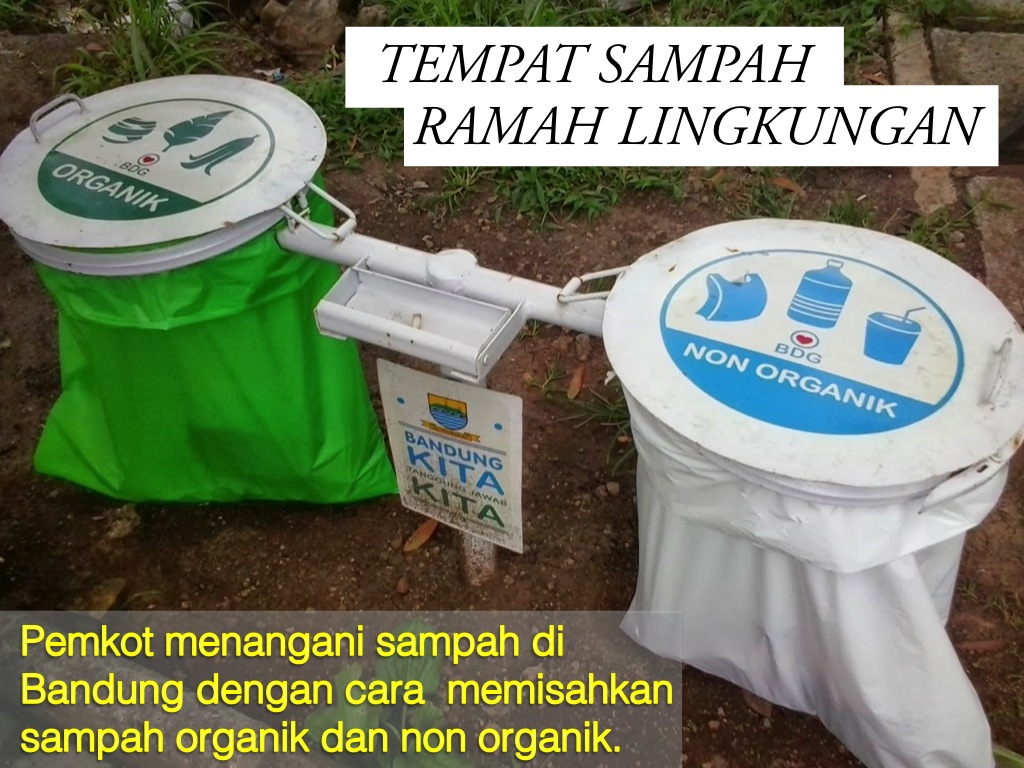
Tempat sampah baru di Bandung

Tempat sampah baru di Bandung

Semester ini, MK Desain Berkelanjutan di Program Studi Magister Desain diselenggarakan lagi. Seperti biasanya, di minggu pertama pertemuan, mahasiswa diminta untuk menyampaikan permasalahan lingkungan yang (dapat) dipengaruhi oleh desain, baik sebagai penyebab maupun solusi.

Salah satu kelompok membahas tempat sampah umum yang baru dimiliki Bandung beberapa minggu belakangan ini. Diskusi mengenai tempat sampah yang terbuat dari plastik biodegradable ini mencakup hal-hal pro dan kontra terhadap jenis material biodegradable itu sendiri, namun dalam sesi ini lebih banyak dibahas juga dari segi Desain. “Desain” di sini bukan hanya berarti penampilan visual, bentuk, dimensi, dan warna, tapi juga dalam hal usability, operasional penggunaan, persepsi pengguna terhadap obyek itu sendiri, penempatan, dan sebagainya.

RK hadir lagi di kelas ini, kali ini bukan sebagai dosen tamu seperti biasanya, tapi secara virtual sebagai wali kota di cuplikan berita mengenai tempat sampah Bandung

RK hadir lagi di kelas ini, kali ini bukan sebagai dosen tamu seperti biasanya, tapi secara virtual, sebagai wali kota dalam cuplikan berita mengenai tempat sampah Bandung

Salah satu segi desain yang dibahas di sini adalah operasional membuka-tutup tempat sampah tersebut. Pada tempat sampah ini, orang harus memegang dan mengangkat handle yang terlekat pada tutup tempat sampah bila hendak memasukkan sampah ke dalamnya. Hal ini tidak biasa, karena desain tempat sampah pada umumnya tidak menuntut penggunanya untuk menyentuh tutup atau lubang buangannya secara langsung. Sebab, biasanya, mulut tempat sampah umum cenderung kotor karena tumpahan sampah yang dibuang, atau karena bekas bakaran puntung rokok yang dimatikan di sana. Sehingga, ketika menghadapi tempat sampah Bandung ini, orang yang merasa jijik cenderung harus menciptakan “sampah baru”, dengan cara menggunakan selembar tissue bersih untuk mengangkat handle tersebut sebelum cepat-cepat memasukkan sampah yang akan dibuang (sekaligus lembaran tissue pemegang handle itu) ke dalam tempat sampah tersebut. Akan lebih manusiawi bila terdapat perbaikan desain yang tidak mengharuskan orang untuk bersentuhan langsung dengan handle atau mulut tempat sampah umum.

Hal lain yang dibahas dari segi desain adalah penggunaan kode warna jenis sampah dan icon/ simbol pada tempat sampah tersebut. Bila akan dilakukan perbaikan desain pada tempat sampah ini, kelompok ini mengusulkan agar terdapat perubahan pada grafisnya, yang didahului dengan studi mengenai kode warna dan icon/simbol yang umum dipakai dan dimengerti sebagai kode pemilahan jenis-jenis sampah, namun juga sekaligus lebih akrab dengan masyarakat umum di Bandung/Indonesia sehingga dapat dimengerti dengan lebih tepat, sesuai dengan konteks lokal.

Jadi bagaimana peran tempat sampah ini terhadap isu keberlanjutan? Sebagai langkah awal, tersedianya tempat-tempat sampah di ruang-ruang publik ini mungkin cukup dapat mengajak warga untuk tidak lagi sembarangan membuang sampah ke jalan, taman dan selokan. Sebagai solusi sementara, tempat-tempat sampah ini mungkin ampuh, namun masih ada permasalahan-permasalahan seputar daya tahan, usability, dan visual pada fasilitas ini, yang berpotensi untuk mengurangi daya gunanya di masa mendatang. Artinya, ada banyak peluang dan kontribusi dari segi desain untuk membuat fasilitas ini lebih berkelanjutan.

[youtube http://www.youtube.com/watch?v=–mToeCkCjc]

What’s Next?

DAbdg putihDesignAction.bdg 2013 was over about three months ago. It was our first attempt to conduct a colossal design thinking workshop-conference in order to find innovative solutions for urban problems; in this case, within the issues of urban mobility. Among our motivations to conduct that event was inadequate infrastructure and public service of Bandung, due to insufficient years of governance at that time.

We consider “design thinking” as among the methods that we could apply to come up with solutions that don’t require complicated bureaucracy, gigantic infrastructure, and massive financing. These are the kind of solutions that are feasible in a short-term, yet effective, although some might be temporary. We did a workshop-conference; we practiced the “fun theory” and we did have fun indeed. A productive kind of fun.

It’s 2014 now and we have a new leader for our beloved city. Our mayor for 2013-2018 is a visionary, progressive person; not to mention that he is the former chair of Bandung Creative City Forum (2008-2012), an organization that has been providing examples and conducting city-scale experiments, in order to show the previous government how a city and its creative potentials could excel.

Within the new mayor’s first 100 days period in office (September-December 2013), most citizens have been benefiting from improvements of public facilities and services in Bandung. The mayor also stated that 2014 is the year for strengthening infrastructure and disciplines. His vision for Bandung is seemingly simple, but quite apt: a livable, lovable city.

twitRK2014

What's next?

What’s next?

Now that the government has a similar line of thinking to ours, what’s next? What could the next DesignAction.bdg be about? It was too “easy” before: to fix a badly-run city. But now that the city seems to be in good hands, we are facing a different challenge. Therefore, in this phase of transition from old to new Bandung, DesignAction.bdg will be very interesting.

Starting a few weeks back, we at BCCF gathered again to find the answer to that “What’s Next?” question. Whatever we do, it is still based on our affection for Bandung and our intention to make it more pleasant to live in. There are lots of issues going around; we even picked one for Helarfest, our other main program. We consider it better if the results of DesignAction.bdg this time could be realized within three months or so.

Idea sketches

Brainstorming

We also consider the municipal programs, improving public facilities and services, and relating them to their impacts to society. How would people react? How would people respond to those improved product and services? What does it mean to live in a maintained city, with accessible public spaces and facilities with good conditions? Are Bandung citizens ready to accept all these improvements; do they have suitable mindsets and behaviors, in order to sustain these pleasant facilities? A bigger question for us would be; what does it mean to be an urban citizen?

Based on these questions, and more and more discussions, which I’m sure will happen a lot more times, we decided that the theme for our next DesignAction.bdg is iden[c]ity. We’d like to encourage our fellow citizens to define who they are, related to their urban habitat. It might seem abstract at this phase, but we have a lot of keywords that can be translated into programs, pre-events, workshops, and so on. Watch our sites http://www.dabdg.bccf-bdg.com/ http://www.bccf-bdg.com  and, hopefully, we could spill more in the coming weeks!

My Gaiman Encounters

My little sister is actually the one who discovered Neil Gaiman’s works first, before I did, and sort of introduced them to me, indirectly. In the first years of my living in The Netherlands (early 2000), Lambiek comics shop in Amsterdam also took part in introducing me to more of his works. It didn’t take long until I became absorbed in them. The Internet era was young, then, when Multiply and Yahoo!Messenger were hip, and mailing-lists were insanely active, and, most importantly, when blogs flourished. And I was happy to find that Neil Gaiman keeps a blog, too, and used to be quite diligent in updating it. So, having been converted to a Gaimanite, I accessed his blog as a daily routine. Coming from a generation whose teenage years were filled with writing mails to their idols overseas (as in: with pen on papers, put them in envelopes, glued stamps on them and actually brought them to a post office), and having to wait for weeks until a response came (or none at all), I really feel the magic of the Internet and blogs. Surprises followed afterward…

It was April 2003; I was halfway pregnant with our second child when I read a pamphlet that announced a Gaiman event in Rotterdam, The Netherlands. In those years, I had to commute weekly, by train, from Amsterdam (home) to Delft (campus) for my doctoral research, and Rotterdam is along the way. I was right away determined to get my first star-struck. I told my sister, who lived in Jakarta, about this event, and she asked me to have a book signed for her. No problem. I planned to bring more stuff for him to sign, anyway: my drawing of Dream and Death.

He's browsing my sketchbook!

He’s browsing my sketchbook!

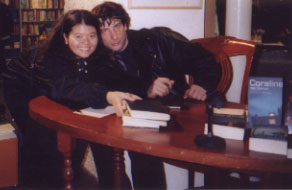
The only photo I have with both of us looking at the camera

Cheers!

Here’s a chronicle of that evening, that used to be up at my Multiply, and now (since Multiply is dead), at my Blogspot: The Day I Met Neil (the links to the photo pages no longer exist). That was my first encounter with Neil Gaiman. The impression stays for years.

Dream and Death in batik

Dream and Death in batik

D-Day 25 April 2003

D-Day 25 April 2003

(facepalm)

(facepalm)

The second encounter was almost invisible. Next to Neil Gaiman’s works, I’m also a fan of Eddie Campbell’s, and as soon as I got my hands on The Fate of The Artist, I like it so much that I had a feeling I should let him know that it is such an amazing work. But how? He hasn’t had any blog then, and there’s no way I could find his email address. So I dared myself to leave a message to him through Neil’s blog, posted a link to my review (at my blog) of The Fate, with the hope that he’d relay the message, considering that they know each other well.

The email that got me jumping out of my chair

The email that got me jumping out of my chair

And then I got my surprise: within a day after I posted that message at Neil’s blog, an email from Eddie Campbell came into my inbox! That was July 2006, he said Neil forwarded him the link to my blog, and signed his email “Richard Siegrist” above an attached photo. I was star-struck again and was too nervous to reply. But I did. I was such a brave girl. (And he’s super nice!) I even drew the moment I almost jumped out of my chair when his email came, and sent the scanned drawing to him.

When I received Eddie's email...

When I received Eddie’s email…

(still star-struck)

(still star-struck)

Couldn't get over it.

Couldn’t get over it.

What happened afterward constituted a series of more surprises: he was willing to endorse my first book (a graphic diary titled Curhat Tita) in 2008, and he and his family hosted me for a weekend at their house in Brisbane, Australia, in 2009. But that’s another story. Now let’s go back to my next encounter with Neil Gaiman…

January 2009. I was back to living in Bandung (West Java, Indonesia), already since the beginning of 2007. My absence from this city comes near to 10 years, so I gradually discovered new establishments, such as a second hand English bookshop that also serves food and drinks, called The Reading Lights. One day I ordered a house-mixed coffee named Neil Gaiman and wrote about it in my Multiply, titled Gaiman is less sensible, compared to Pamuk. I mentioned about it to Neil Gaiman (again, via a posted message in his blog) and thought nothing more of it. Much later, a comment at that article in my blog remarked that Neil mentioned me in his Twitter. What’s a Twitter?! I didn’t know, so I went and checked, and got hooked. [In this case, Neil Gaiman is the one who introduced me to Twitterverse!]

Choose your bev.. er.. author

Choose your bev.. er.. author

My Gaiman peanut-butter coffee

My Gaiman peanut-butter coffee

I got star-struck again, moreover because Neil talked about that coffee in his blog http://journal.neilgaiman.com/2009/01/happy-and-wise-in-our-giant-hologram.html, then a related post followed in April http://journal.neilgaiman.com/2009/04/all-questions-all-time.html. It went viral since The Guardian picked it up and put a piece of article about it: Is Neil Gaiman your cup of novelty coffee? Then drinks with authors’ names went around the Internet for a while, before they died down a couple of weeks (months?) later.

Neil's blog post

Neil’s blog post

The article at The Guardian

The article at The Guardian

Alright, that’s about the end of my story right now. I’m just glad I had the chance to meet a person whose works have accompanied me through most of my commuting trips and journeys, and have succeeded in enticing my thoughts and fantasies. For this small piece of my life, I am eternally grateful.

How to change education from the ground up

Here are some excerpts from a recent talk (published July 18, 2013) by Sir Ken Robinson. Wanting it or not, this speech made me think about our new, ridiculous national curriculum, composed by the government “up there”, untouched by the actors of education themselves: teachers and learners – and how we can actually change them from the ground level. Schools are not factories that print certificate to rank children’s “intelligence”; they should be a pleasant place where children maintain and discover their love for learning.

==========

[youtube=http://www.youtube.com/watch?v=BEsZOnyQzxQ&w=560&h=315]

The basics of education: science, technology and math, are necessary, but not sufficient.

The basics of public education, or why we invest in a system of mass public education, has the following purposes (not labeling, just as a reference, and not in particular order):

(1) Economic.

Education has powerful economic purposes. It does and it should. But the economic system of that day was industrialism, which is why the system looks the way it does. It is not that system anymore for us.

If we are to meet the “economic” requirement of education we need to have a system that promotes creativity and adaptability.

Adaptability: Organizations are not like machines, they are like organisms. They are living entities, made out of people, feelings, motivations, roles, aspirations, passions, and ambitions. And if the organism doesn’t respond to changes in its natural environment – just as in the natural world – it dies.

Creativity: We need companies that are consistently and systematically creative.

Students coming out of college find it difficult to come up with something new. That’s because they are educated on the standard routine of routine testing, multiple-choice tests.

(2) Cultural.

It’s a small enough planet as it is, but it has becoming more and more populated. But in any case, the ethical reasons as well as strategic ones, we formed education that enables people to understand how they came to think as they do, why their values are as they are, why their patterns of lives are as they are, and why other people are different. We need reformed education that helps people to understand their own cultural identity and what formed it and those of other people.

Now for that we need a broad education… the arts, the humanities, to social studies, not just to technical subjects.

(3) Social.

We need a form of education that engages this generation in the processes on which communities are organized and governed. And there are a lot of evidences on disengagements, that people are pulling away from those roles.

“Every generation has to discover its democracy” (on election)

It is very important that we take parts in these civil discourses. You don’t do that in education by giving people lessons on civics. You do it by having a culture which embodies these processes of participation, and great schools do that.

In the end, education is personal. It’s about people. It’s not about components or machines.

And if we know about people: they are different. They’re driven by different talents, different abilities, different passions, different interests and different motivations. One of the signature features of humanity is Diversity. Of course it contrasts sharply with one of the organizational principles of education, which is Conformity.

But if we don’t understand that education is about People and Individuals in all their diversity and multiplicity, then we keep making the mistakes that we make. If we’re treated as a machine… rather than a human process, then we’ll run ourselves into a cul-de-sac.

When we’re talking about changing education “from the ground up”, that’s the “ground” that I mean. Most political strategies start from the top-down: “if we can get people to conform, everything would improve”. And the evidence is quite the contrary: the more the government go in the “control” mode, the more they misunderstand the level of teaching and learning, the more they misunderstand the process of education.

So we have a situation here in the UK now, where most of the major teaching units have passed a vote of “no confidence” of the government’s education strategy. That shouldn’t promote a smug expression of satisfaction on the government. That should keep them awake all night, thinking, “How badly have we got this wrong?” You cannot improve education by alienating the profession that carries it out.

Recognizing that education can be encouraged from the top down is one thing. But it can really be improved from the ground up by the people who do the work. Because in the end it’s not ministers or states who’re teaching all of our children.

“The Empty Space” by Peter Brook: if you’re really concerned to make theater the most powerful experience that can be, we have to decide what we mean when we say “theater”. We have to get back to basics and focus on what is fundamental. And he answers that question in a brief passage in the book by performing a thought experiment. Essentially he says, “If you take a theater performance, what can you take away and still have it? What’s the core? What’s the irreducible minimum?”

You could take away the curtains, you could take away the script, the stage crew and the lighting, you can get rid of the director, definitely, you can get rid of the building. You don’t need any of that. The only thing you can’t get rid of, and still had “theater”, is an actor, in a space, and somebody watching.

Theater describes the relationship between the audience and a performance. That’s the relationship that we mean. So if we want to make theater the most powerful experience that can be, we have to focus on that relationship between the performer and the audience. And, he said, we should add nothing to it, unless it helps. And of course a lot of what we add to theater distracts the relationship and substitutes for it.

It is an exact analogy with education: the heart of education is a teacher and a learner. And we have, overtime, obfuscated that relationship with every type of distraction. We have testing regimes, testing companies, political ideologies, political purposes, subject loyalties, building codes, all of these timetables and schedules.

That’s why we can spend all day long discussing education and never mention teaching or learning. But if there’s no teaching or learning happening, there is no education going. So if we’re going to improve education, we have to improve that a bit. And everything else has to not getting in the way of it.

So the focus on teaching and learning to me is vital.

Now what we know about learners, about children, is that children are learning organisms. Children don’t need to be helped to learn, for the most part. They’re all born with a vast variation of appetite for learning.

You don’t teach your child to speak. Most kids get to learn to speak in the first year and a half or so in their life, but you don’t teach them. They just pick it up. You nudge them, you encourage them, but you don’t teach them to speak. We do teach them to write. That’s a different thing. Writing appeared much later in human evolution than speech.

But my point is: children have a vast appetite for learning. And it only starts to dissipate when we educate them. That’s to say, when we put them in buildings, designed for the purpose. And put them in charade ranks and start to force-feed them information in which they may or may not have interest.

But learning happens anyway, and with the new technology it’s happening more and more. If we really want education to be more effective, we have to focus on the process of teaching and learning. And teaching has become reduced, in the political discourse, to a kind of delivery system (“your job is to deliver the national curriculum”). Teaching has become a kind of delivery system and teachers have become a kind of functionaries in the administration of cash.

Actually, teaching is an art form. It’s not enough to be a good teacher to know your stuff, though you need to know it. But more than that, you need to excite people about the material. You need to engage them. You need to pick their imagination, to feel their creativity. You need to drive their passion for it. You need to get them to want to learn this. You need to find a point of entry. That’s the gift of a great teacher.

One of the ways that we improve education is by recognizing it happens at the point of where teachers and learners meet. If it doesn’t happen there, it doesn’t happen at all, in formal, organized education systems.

So you can’t improve education by ignoring that relationship, or demeaning it. But it also means, if you are in that relationship, you hold the tools of powers right in your hands. You can change the system yourself. You don’t need to wait for anybody to do it.

A school, just like a child, or a teacher, is not a component. They are living organisms. Living, breathing entities. A school is a community or reciprocating individuals who develop their own culture, their own way of seeing things, their own habits and rituals, and so on.

There isn’t a single point of influence. The teachers in the system, the head teachers, are just as influential in their own world as the policy makers. If you are a teacher, if you are a school principle, if you’re a superintendent, if you run a school district, so far as the kids are concerned who go to your school, you are the education system.

If you began to change your practice, if you began to change the environment of the school, if you – in other words – concentrate on your   in the school as a part of the larger climate, eventually you start to affect the whole. That’s how our social movements happen.

Human culture is essentially unpredictable. But it accumulates over the creative activities of individuals feeding off each other. That’s how organic growth happens.

When I said that revolution is needed, and it should start from the ground up, it’s already happening. The system is already adapting. The part of the system that is not adapting is the high level of government policy.

The real role of leaders, when it comes to education: whether you are a teacher, or head teacher, or head of a district – your proper role, if you have a loving relationship with education – is not to try to command and control it, but to recognize your place in climate control. And if you can help to change the climate of expectation in education, if you can change what’s happening at the ground, then you’ve changed the world.


==========

Related posts in this blog:

Passion, Creativity, Element, Energy

Imagination, Creativity, Innovation

Handmade Urbanism

In the first week of June, 2013, BCCF was invited to participate in an exhibition and symposium with the theme Smart Cities: The Next Generation at Aedes Network Campus Berlin, Germany. We were asked three questions that determine the “smart” aspects of our city for the exhibition materials:

  1. How does your project “smarten up” your city?
  2. Why does your city need your project and what challenges are country­‐specific to your urban context?
  3. What are the new behaviors your building/planning/initiative encourages?

While working on the answers, we became more convinced that the strength of Bandung is in its proactive citizens who have been interfering with their own habitat, to make it more livable. Our presentation in Berlin included a series of Kampung Kreatif (Creative Kampong/Neighborhood) program and Helarfest 2012, which brought up issues concerning four elements of the city: river, forest, kampong and park. Next to Bandung, there are also other Indonesian cities such as Jakarta and Medan participating in the event. During the event, it was evident that most growing, dense cities in developing countries are facing similar problems due to overpopulation and underdeveloped infrastructures and facilities, of which solutions mostly depend on the survival ability of the inhabitants.

Handmade Urbanism

Handmade Urbanism book and Urban Future CD

On our last day in Berlin, we found a book whose contents resonate what has been done in the local neighborhoods of Bandung. This book, titled Handmade Urbanism, describes the journeys of five world cities that have brought them to receive the Deutsche Bank Award for their civic initiatives: Mumbai, Sâo Paulo, Mexico City, Istanbul, and Cape Town. The book also comes with a CD, titled Urban Future, containing documentary videos of these cities. Each city has its own issues, which received different treatments as well, and they are not always expensive, nor requiring a substantial amount of budgeting and infrastructures. From the stories, we could learn that all things started small – but they got started anyway – whether from a group of people or an individual, from common villagers or planners/architects to public figures, with different backgrounds.

The examples in Handmade Urbanism show results after about 10 years of the interventions, when citizens could already enjoy the results, where social changes are evident and physical improvements are obvious. Kampung Kreatif program in Bandung started in 2012, now not even 1 year old, and – as experienced in all fields – getting started and maintaining the energy and spirit are the most challenging phase. There is still a long way to go, but we are convinced that we can also keep the program going and reach up to such benefits!

=====

“All over the world, water takes a significant part of a city” – Mumbai

“The problem (of a city) will never be solved if we keep trying to demolish the slum” – Mumbai

“Community-based programs take place and succeed where administration fails” – Mumbai

=====

“City growth as desired by politicians creates greater tensions among its citizens” – Sâo Paulo

“Small gestures (planting, library, mural, etc.) can help create space and connectedness” – Sâo Paulo

More positive activities > more life security > less crime > less reason to demolish the “slum” – Sâo Paulo

=====

“Small scale activities and movements can create great changes in a community” – Mexico City

Next to soccer games, gangs also organize graffiti classes, which have lowered the criminal rates – Mexico City

“A change of an urban space can change the attitudes and activities of the local people” – Mexico City

“Improving accessibility for all (citizens) means improving the quality of life” – Mexico City

“A city is more than a place to make money, people need more than roofs above their heads” – Mexico City

=====

“Teach children to tend a garden, they’ll go home and teach their parents” – Cape Town

“Municipality needs to recognize what has been done at the grass root level, the activism and pro-activeness” – Cape Town

Bamboo Bike from Temanggung

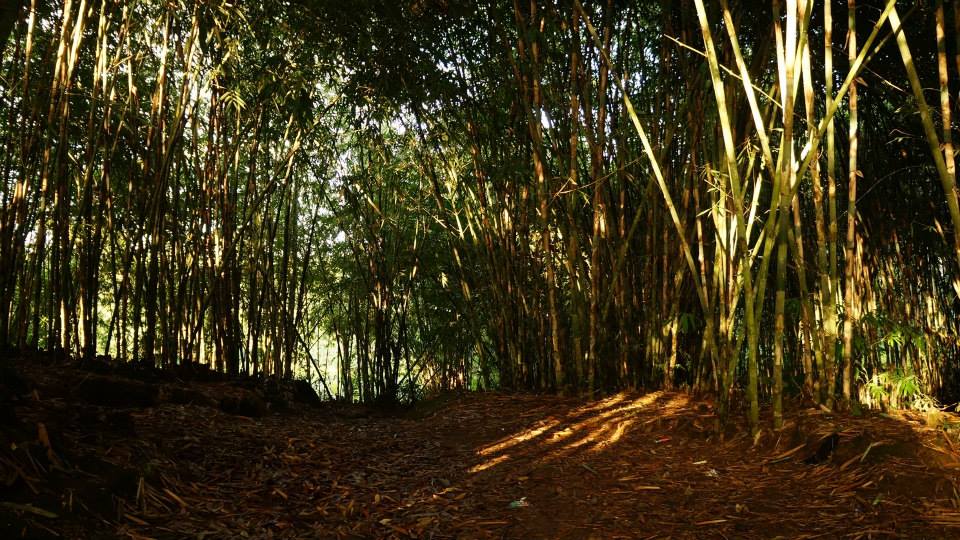
Singgih S. Kartono, one of o2indonesia contributors, is currently testing his bamboo bike prototypes. In these series of photos, taken along the routes of Balun – Kelingan – Citran – Bendokuluk, he shows that bamboo has indeed been a part of village people’s daily lives. More photos from this trip can be seen in his Facebook photo album:  3rd Day Proto#2 Test

More albums that contain Singgih’s bamboo bike prototypes:

Bamboo bike testing

Prototype #2 Bamboo Bike Tested

2nd Day Proto#2 Test

Visit his Facebook for more photos about bamboo bikes, bikes, design workshops, Magno wooden radio, and the mesmerizing, tranquil scenery of Temanggung, Central Java, where he set up his design studio, manufacture and home: https://www.facebook.com/singgih.s.kartono

bamboosinggih01 bamboosinggih02 bamboosinggih03 bamboosinggih04 bamboosinggih05 bamboosinggih06 bamboosinggih07 bamboosinggih08 bamboosinggih09 bamboosinggih10 bamboosinggih11

Bandung 2035

DAbdg putihOnly very few things are more exciting than having the chance to determine your own future. This time, the chance came as a workshop called Riung Gunung, which invited children to create a city of their desires. This workshop was held by Sahabat Kota, a community that focuses on conducting activities that provides a fun way to educate children about urban environment, as a Selasar Kids Program and also as one of the pre-events of DesignAction.bdg.

As mentioned in the previous post, Riung Gunung completed the workshop last week and is currently having an exhibition of the results. At the opening, the participants (children aged 8-12) acted out the conditions and current problems of Bandung, and their wishes for this city are translated into concepts and models. This exhibition goes on at Selasar Sunaryo Art Space until July 21, 2013, and some highlights will be selected and exhibited again during DesignAction.bdg on October 1-3, 2013 at the conference venue, Bumi Sangkuriang, Bandung.

Tokens of the regents that should be gathered in order to heal Sang Hyang Riung Gunung

Tokens of the regents that should be gathered in order to heal Sang Hyang Riung Gunung

Riung Gunung workshop was an adventurous one. The kids were divided into groups that represent five regions of Bandung and were given a mission: to heal Sang Hyang Riung Gunung, a spirit that lives in Bandung who has been ill due to the current conditions of Bandung. In order to do that, they must gather Sang Hyang Riung Gunung’s six regents, who live in mountains that are surrounding the city of Bandung, which represent six sectors of a city: (1) marketplace and trading, (2) cleanliness and landfill, (3) nature and parks, (4) urban housing and neighborhood, (5) sports and health, and (6) balance of knowledge, environment and social aspects. They were to gather tokens of these regents and put the pieces together to complete a puzzle.

During this mission, the kids were taken to a high density neighborhood to talk to the local inhabitants about their daily lives and mobility. They had a ride on a train (which, in this case, was the kind of train commonly used by mid- and low-income people), went to a marketplace and a Puskesmas (a clinic or health center that normally serves low-income people). They also went to a landfill and recycling center and public parks, before walking up the tower of Gedung Sate (currently the office of West Java governor), to have a good view over the city of Bandung.

Report books and photos of their adventures throughout the city: marketplace, train, health center, etc.

Report books and photos of their adventures throughout the city: marketplace, train, health center, etc.

These kids made reports, noted down as much data as they could absorb by all their senses, expressed their wishes in poems and drawings, composed a dramatic storytelling performance and created a city according to their desires in three-dimensional miniatures of the city. All these materials can be viewed at the exhibition, including a documentary video that records their activities.

Viewed briefly, their main messages are not far from what we are longing for our own living environment: peaceful neighborhoods, fun public parks, a smooth transportation system, pleasant shops, maintained historical buildings, surrounded by lots of playgrounds, plants and trees, and friendly animals. This is the City of Bandung in 2035, the kind they decide to live in.

What’s most moving was to see, during the opening of the exhibition, how these kids could articulately explain their plans through all their models and reports, happily, and full of spirit. It is obvious that they are proud of their works! Let’s hope that they would fondly remember this experience, and also not forgetting the fun process of achieving all these results, when they reach the age of mature citizens of Bandung, when they would have already become professionals, who could make actual contributions to the city. Let’s hope that they remember their dreams and desires, make them happen with their own hands, and leave footprints that they can also be proud of!

Salute to Sahabat Kota for the hard work and much respect to the volunteers who have pulled off this program successfully! 🙂

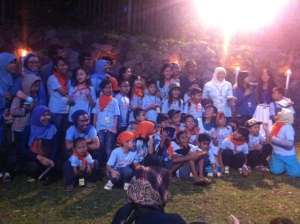
Farewell photo of the workshop participants and their instructors after the opening of the exhibition

The green part of that wall is Tangkuban Parahu mountain, from where cable cars come and go into the City of Bandung

The green part of that wall is Tangkuban Parahu mountain, from where cable cars come and go into the City of Bandung

Crayons are available for those who want to add ideas

Crayons are available for those who want to add ideas

You can tell that this is somewhere in the center of Bandung by the railway

You can tell that this is somewhere in the center of Bandung by the railway

Brainstorming ideas and illustrations

Brainstorming ideas and illustrations

The five regions of Bandung for each group

The five regions of Bandung for each group