Category Archives: design

contribution to improve and encourage sustainable life style by design

Riung Gunung: children as co-designers

DAbdg putihChildren are important stakeholders of a city. In the next 20-30 years, they will be the ones taking over and making decisions for the city. However, they are often neglected, or not taken into account, by public facilities and infrastructures that are built in Bandung. The streets – and even sidewalks – are too dangerous for them to walk or ride bicycles alone, city parks are neither closed nor unkempt, playgrounds are almost non-existent, and so on. It is due time that they should say their desires for the city and to be listened to. This is the main reason why Riung Gunung is on!

REV [RG]Poster_05 (pendaftaran)

Riung Gunung promotional poster

Riung Gunung is a workshop organized by Sahabat Kota, a community/organization in Bandung that has been active in holding programs and events for children and youth who want to learn about the City of Bandung and urban life. As a part of the pre-event series approaching DesignAction.bdg, Riung Gunung is coming up really soon as the next one. This workshop is held for 60-90 children between the ages of 9 to 12, whose main task is to make a scenario of Bandung 2035. In this 6-days workshop, they will go through the phases of exploration, city adventure, envisioning, co-design workshop, and realization. As a result, they will make a model or a physical miniature of the city according to their design, and will act it out, according to the systems they create. These results will be performed and exhibited on July 7, 2013, at Selasar Sunaryo Art Space, a gallery at the North of Bandung, and also during DesignAction.bdg event on October 1-3, 2013.

The 30 instructors who will accompany these children during this workshop have been having their own workshops in order to be prepared with appropriate knowledge, with the following subjects: design thinking, sustainable development, child psychology, education for sustainable development, city planning, performance, games, child handling and creativity.

Detailed program of Riung Gunung

Detailed program of Riung Gunung

We are really looking forward to having this workshop. Hope for a lot of fun and incredible results!

More about Sahabat Kota: http://kisahsahabatkota.wordpress.com/

Sahabat Kota at Facebook: https://www.facebook.com/sahabat.kota

Sahabat Kota at Twitter: https://twitter.com/sahabatkota

Sahabat Kota videos at YouTube: http://www.youtube.com/user/komunitassahabatkota

Design Thinking workshop: urban mobility

DAbdg putihWe plan to hold DesignAction.bdg, an international conference/workshop on Design Thinking, but not all of us have a design background, nor are familiar with conventional design process, and most of us have never experienced Design Thinking approach. Therefore, as one of the pre-events that precede DesignAction.bdg, we held an internal workshop on Design Thinking, by inviting Amelia Hendra (ex-IDEO Shanghai) to be the facilitator. This workshop consisted of an introduction about Design Thinking, then an exercise to use the method within the context of urban mobility issues. It is like doing a simulation of the actual DesignAction.bdg event in a smaller scale.

image

Day One: introduction

The workshop was held on April 5-6, 2013, attended by about 30 participants. In the first day, Amelia introduced herself. It helped that she was born in Indonesia (originally from Pontianak, West Kalimantan), so Indonesian language was used the whole time. During this workshop, she was assisted by Adi Panuntun, founder of Sembilan Matahari and co-founder of Bandung Creative City Forum (BCCF), a movie maker/ video mapping creator who pursued his study in Design Thinking at Northumbria University, UK. The participants are organizing members of/ contributors to DesignAction.bdg event that came from different backgrounds and communities in Bandung, such as Riset Indie, Labtek Indie, Sahabat Kota, Vidour, GrowBox, Sembilan Matahari, KreativeLab, Fight.BDG, ITB (from School of Business and Management, Faculty of Art and Design, and Architecture Department) and UNPAR. Amelia proceeded with giving an overview about Design Thinking method and examples. The participants came up with questions, whether the Design Thinking phases should start from a certain point or if it can be started anywhere, about “extreme users”, and discussed the importance of “reframing”, since this is practically the most important skill required in the process. Lunchtime was filled with a documentary video about Curitiba, which inspires us all: that with few resources we should still be able to move and make changes. The day ended with an assignment that required the participants to break into groups and started a fieldwork: Understanding urban mobility through the lens of Bandung. The participants should map out design challenges: map out key stakeholders, list out interview questions, and divide tasks with team members.

(c)AmeliaHendra2013

(c)AmeliaHendra2013

1 Observe & Understand: Not only about being creative | But also about being empathetic

2 Reframe: Does not start with the answers | But about asking the right questions

3 Ideate: Not only for designers | But also for problem solvers and optimists

4 Prototype: Not only about designing and thinking | But also making, learning, and sharing

5 Co-design: Not only about perfection | But also about perspectives

Processing ideas

Processing ideas

In the second day, the process was continued and completed, up to prototyping and sharing phases. There were four groups, each took a different focus: angkot (a public minibus that serves as a public transportation method that dominates Bandung), pedestrian, DAMRI (city bus) and PKL (mobile food vendors that often cover a parcel of roads and sidewalks). As a closing, each group presented their findings and solutions, all in role-playing, and it was obvious from this phase that everyone enjoyed the workshop. It was a pleasant way to identify actual Bandung mobility problems from different viewpoints, to exercise all forms of creativity and to come up with recommendations that might be solutions for the problems.

The groups proposed products, systems, programs and activities that might release some burden related to mobility and traffic, at different scales. Some might need conventional way of infrastructure improvements, but most could actually be implemented without requiring substantial financial capital and complex bureaucracy, and could be succeeded as long as networks and collaboration among local people and communities are available.

An impression from a participant (Ronaldiaz from Agritektur): Collaboration is an important key point, since this workshop was joined by people with multidisciplinary background. If one participant from each discipline could contribute one solution from his/her field, by collaborating we would be able to give a comprehensive solution. The power of collaboration is indeed frightening!

Thanks to Amelia and everyone involved in the workshop! We had fun – a productive kind of fun – which what we of young productive age actually need, to be able to respond innovatively to endless problems faced by our urban environment.

The results of the four groups were all presented at the next Pre-Event of DesignAction.bdg, PechaKuchaNight.BDG that was held on Sunday evening, 26 May 2013.

Pedestrian team

Pedestrian team

Angkot team at work

Angkot team at work

DAMRI team

DAMRI team

Amelia closing the workshop

Amelia closing the workshop

Amelia assisting a group

Amelia assisting a group

On Technology Transfer

The other day I asked @OutofPoverty, who was welcoming questions via Twitter, the following:

Based on your experiences, what factors caused failure in technology transfer?

@OutofPoverty answered:

1)   Technology that is too expensive

2)   Failure to design for the market

3)   Absence of last mile supply chain

4)   No attention to business principle

OutofPoverty

The reason I asked this had to do with a lot of design projects by our industrial design students, both within an academic scope and extra-curricular programs, and also numerous research, experiments and projects by our industrial design research group, especially the ones that take place in rural or remote areas. In those areas, essential needs and problems are obvious; however, the answer is not always “design” as in a “tangible product”, but sometimes it’s the infrastructure that hinders access, unaffordable materials, or substandard resources. Designers often have to think beyond the tangible product, by creating also a system that supports the availability and delivery of the product. With it, comes the aspect of technology transfer, as well.

Theoretically, the concepts of “appropriate technology” and factors that guarantee its sustainability once it is implemented are familiar to us, but still, not all technology transfer works for every case. Therefore, I wonder what others in a similar line of works have experienced.

The answer confirmed that there should always be a realistic economic calculation for any solution, next to other crucial factors such as usability and access. Thanks, Paul Polak & team! 🙂

DesignAction.bdg Pre-Events 1 and 2

DAbdg putihTime flies, when you’re having fun. Like what we’re having now – approaching DesignAction.bdg – when we realize that the first pre-event has just passed and the second one suddenly appears at the corner!

Slide15The first pre-event was an Expert Opinion Polling, where Riset Indie (an independent research community) teamed up with HMP ITB (Planning Department students society at ITB) in gathering expert opinions concerning the issues of urban mobility in Bandung and processing the input using Delphi Method to come out with conclusions. The event took about four hours in one Saturday morning (April 23), seemingly short, but went quite lively and yielded interesting results.

How it looks from the back of the room during the EOP session

How it looks from the back of the room during the EOP session

What was so exciting about this first pre-event is how we managed to gather so many experts in a room for a focused purpose, eminent stakeholders from different backgrounds (academics, government, communities, etc.) – something that usually occur in a different setting, hosted by a formal institution, instead of an independent community. We are quite honored to have such trust in conducting this session. Another exciting thing is that we actually confirmed a number of assumptions concerning the issues of urban mobility, and that we can use the data from this event to move on to our next plans. Riset Indie is currently arranging the data to be accessible online, in a friendly format (i.e. infographics), with the hope that any audience can contribute to the issues, or even to offer realistic solutions. Congrats and salute to Riset Indie and HMP ITB! Have fun preparing another pre-event, Angkot Day, with all its sub-events!

Slide16The second pre-event takes place next weekend, April 5-6: an internal workshop on Design Thinking, facilitated by Amelia Hendra, whose years of experience from working as a designer at IDEO Shanghai would add to our insights on design thinking method. The workshop is limited to 30 people with various backgrounds (educators, designers, engineers, academics, artists, social workers, etc.), all of whom belong to the organizing team for DesignAction.bdg. It is important for us to have this workshop, since the event we’re preparing is about Design Thinking, while all of us (except Adi Panuntun, who will assist Amelia in the workshop), have next to zero experience concerning Design Thinking methods.  (Although we might have practiced parts of the methods, but with no structured phases and evaluation.) The workshop will bring up the theme urban mobility. At the end of the workshop, we hope to understand more about Design Thinking as a method to exercise our creativity in order to gain innovative, doable solutions for challenges around urban mobility in Bandung. We are really looking forward to having this workshop!

Bring it on! 🙂

Links to media about EOP:

BandungNewsPhoto: BCCF Bakal Gelar Polling Memecahkan Masalah Kemacetan di Kota Bandung

AntaraNews.com: Komunitas Kreatif Petakan Masalah Kemacetan Kota Bandung

Aktual.co: Komunitas Kreatif Petakan Masalah Kemacetan Bandung

About DesignAction.bdg:

DesignAction.bdg, coming soon!

Design Thinking? Design Action!

Tote in Collaboration

BAGOES TOTE IN COLLABORATION

all_sm

TITA LARASATI | RIDWAN KAMIL | DENDY DARMAN | REKTI – THE S.I.G.I.T | ARKIV

Apa kesamaan dari seorang arsitek, musisi, graphic artist, toy designer dan comic artist? Mereka sama-sama mencintai bumi dan melakukan kolaborasi untuk kelestarian lingkungannya.

baGoes, merek tas lipat (foldable bag) karya Greeneration Indonesia, berkolaborasi dengan lima artis inspiratif Bandung untuk membuat lima desain Tote bag. Lima artis tersebut adalah Ridwan Kamil (arsitek), Tita Larasati (comic artist), Rekti The S.I.G.I.T (musisi), Arkiv (artist/ toy designer), dan Dendy Darman (graphic artist).

fold_sm

Tujuan dari kolaborasi ini adalah untuk mendukung Kampanye Diet Kantong Plastik (www.dietkantongplastik.info) yang mengajak masyarakat bijak dalam menggunakan kantong plastik. Gerakan pengurangan penggunaan kantong plastik saat ini sedang menjadi trend yang dilakukan oleh berbagai pihak mulai dari komunitas, retailer, hingga pemerintah.

baGoes sebagai salah satu tools untuk berdiet kantong plastik juga ingin turut serta mendukung kampanye petisi #PayforPlastic di www.change.org/id. Ditargetkan 500.000 orang menandatangani petisi ini hingga 22 April 2013.

Tote bag telah mengalami perkembangan dari semula berfungsi untuk kepraktisan, menjadi salah satu item paling digemari di industri fashion. Jitesh Patel dalam bukunya The Tote Bag (2011), menyatakan bahwa,

Tote bag adalah sebuah eco produk di abad ini yang ditujukan untuk menggantikan kantong plastik sekali pakai”.

Kolaborasi untuk produk Tote bag ini merupakan usaha baGoes untuk mengembalikan fungsi Tote bag ke akarnya sebagai alternatif kantong plastik, bersamaan dengan fungsinya kini yang juga sebagai fashion item. 35% dari total penjualan yang merupakan hak para artis, akan didonasikan untuk Kampanye Diet Kantong Plastik.

“Saya tertarik berkolaborasi karena menyelamatkan lingkungan itu butuh cara-cara kreatif. Salah satunya adalah dengan konsep Diet Kantong Plastik. Karena kreatif, orang harus diberi pilihan gaya hidup, maka tasnya pun ga bisa asal-asalan. Jadi sambil menyelamatkan lingkungan, dia merasa pede saat memakai tasnya.” Ujar salah satu artis yang akrab disapa Kang Emil ini.

Apa yang menarik dari desain setiap artis? Pesan yang mereka sampaikan sangat identik dengan ciri khas karya seni mereka masing-masing. Ridwan Kamil, menggambarkan pentingnya keseimbangan antara perkembangan peradaban manusia dengan kelestarian lingkungan. Tita Larasati menggambarkan berbagai belanjaan organik yang ditampung dalam reusable bag, dengan harapan dapat mensugesti masyarakat untuk menggunakannya ketika berbelanja. Rekti The S.I.G.I.T, menggunakan gaya black comedy, menyindir keserakahan manusia dalam usaha pelestarian lingkungan. Arkiv, dengan desainnya yang unik, melawan gagasan bahwa seni harus dipisahkan dari dunia konsumerisme yang berlebihan dan budaya massa. Dendy Darman dengan desain khasnya menggambarkan pohon sebagai payung bumi, pelindung alam semesta dan isinya.

“ Harapan saya, kolaborasi ini bisa berdampak baik untuk kampanye Diet Kantong Plastik.Ga banyak orang yang mikirin gerakan seperti ini. Giliran ada orang yang mikirin ini, masa sih kita ga bantu?” ungkap Dendy Darman.

tita_sm

baGoes Tote Kolaborasi dapat diperoleh di www.baGoes.co.id secara preorder sampai dengan 31 Maret 2013 dan di beberapa distributrion point pada bulan April. baGoes juga akan berpartisipasi di ARTE (Indonesia Arts Festival) yang diadakan tanggal 29 – 31 Maret 2013.

Untuk mengetahui informasi lebih lanjut tentang baGoes dan kolaborasi kami dengan lima artis, cek video kami di http://bit.ly/WhiKw2 atau kunjungi www.baGoes.co.id.

Press Contacts: Dwita Arlinda p. +6282116694578 | e. [email protected]

Creativity comes from the heart

Our Art, Design and Environment class yesterday was taught by Dr. Ratna Panggabean, one of our senior lecturers, from Craft Department. She specializes in textile craft and has spent a substantial amount of time working with indigenous people within that context.

In this class, these art, craft and design students are expected to understand that any artifact that materializes as their creations will have an impact to the environment. They also have to understand how the Spirit to Create emerges within them, which was the message from yesterday’s lecture, of which some points are derived, as follows:

Positive vibes radiate from a person who is overwhelmingly in Love.

Positive vibes radiate from a person who is overwhelmingly in Love.

Each person would radiate whatever aura is within him or her. Therefore, you can sometimes feel uncomfortable with a person, whom you tend to avoid or take a distance from, due to the negative ambiance. On the contrary, you would be attracted to a person who releases good vibes, and you would want to be around the person to absorb the positive energy.

How would one possess the good vibes? It is from feeling Love, for anything. One can be very much in love with another person, or with a pet, or even with the surrounding nature. Among the most known physical expression urged by this feeling is a smile. But people who Create, and who have the skills to materialize their thoughts and feelings, are able to express this overwhelming feeling through their works. This is what sometimes people refer to as Creativity that comes from the heart.

The point of this subject continues to the indigenous people who create objects due to their Love and Respect for nature, for particular moments, for the Greater Being, and for any other things that might come to mind. These artifact, which reflect the sincere feelings, are often created through genuine dedication and a lot of hard work, and therefore bear the consequences of being highly attractive.

=====

This session was like a reminder that one can actually influence another in an individual creativity process. The phrase “You bring out the best in me” might be a form of such phenomenon, where one becomes motivated to perform his/her best. Just imagine if one such process meet another in a collaboration, in projects and/or programs that contribute positively to society, and the environment. It might be a start to something significant if each of us can just enhance our positive vibes!

DesignAction.bdg, coming soon!

Following are excerpts from my tweets about DesignAction.bdg #designthinking #DesignActionBDG #DAbdg #urbanmobility

=====

Prop DAbdg cover.jpg

This year Bandung Creative City Forum (BCCF) will host the 2nd international conference on design thinking: DesignAction.bdg #DAbdg

Now that about 70% of the world population lives in urban areas, “development” doesn’t always mean “giant structures”.

Solutions other than costly infrastructures should fulfill the needs of urban citizens. Creativity and innovation are crucial.

Therefore BCCF looks into #designthinking and urban acupuncture methods to inject creative interventions to the city.

Why Bandung? Because almost 70% of its citizens are below 40 y.o. This demographic bonus is a huge potential with lots of energy.

These dominant, young, productive citizens should be able to make Change for a better living space. The government can’t do it (alone).

DesignAction.bdg brings out #urbanmobility as the theme. Why? Every time we talk about Bandung, this issue comes up more and more often.

Urban Mobility isn’t merely about roads and vehicles. It’s also about mindsets and city elements that cause obstacles in mobility… such as shops in residential areas, cafes without parking space, schools where private cars take and pick up students.

Where laws are weak, solutions should be made from different viewpoints. #designthinking is therefore used and applied.

DesignAction.bdg conference is in Oct, but lots of Pre-Events, equally important, start in March until July 2013.

In March, Riset Indie team will conduct an expert opinion research, so the whole #DAbdg events can proceed with better strategies, based on data.

In April, BCCF will have an internal #designthinking workshop, to experience the design thinking process, facilitated by a former IDEO designer. #DAbdg

In May, Pecha Kucha Night Bandung is on! Gathering public opinions and having conversations about #urbanmobility issues, in a fun way.

In June, Riset Indie is on the role again: providing new experiences in interacting with Bandung’s notorious “angkot” in “Angkot Day”!

July will see the last series of #DAbdg pre-events: Sahabat Kota holds “Riung Gunung”, involving children as co-designers. Children in this workshop are 9-12yo, but they own the city in 20+years. They have to create their own urban space and mobility NOW.

All results, artifact & documentations from these pre-events will be exhibited and presented at #DesignActionBDG conference in October.

The #DesignActionBDG conference itself aims to give recommendations of #urbanmobility solutions other than conventional infrastructures.

We’ll surely publish more details about #DesignActionBDG conference & pre-events. Follow @BCCF_bdg and stick around for updates! 🙂

***Related post: Design Thinking? Design Action! (in Indonesian)

A Note on Tradition and Design

Traditions are a cultural mechanism. The basic underlying rule is: we do or make things in a particular way because we have always done it this way. This mechanism serves to safeguard the values and identity of a community. It can also strengthen the bonds within the community because of collaboration involved.

There is room for change in a tradition, but only gradual change. If a traditional way of doing things changes too fast, then by definition it is not traditional anymore (or not the same tradition). Traditions can be beautiful, but there is some danger in romanticizing them too much. Human memory is not very reliable. If a tradition lasts more than three generations it is perceived as “always”.

Traditions are invented all the time – it seems contradictory, but it is not. Communities have to adapt to new circumstances and a community that doesn’t innovate will grow stale. An invented tradition will become a “real” tradition if it is embraced by a community. An example is the Balinese kecak dance, based on traditional Balinese dances but choregraphed by two German filmmakers in the 1930s. Some aspects of a tradition can be quite alien, like the patterns characteristic for batik from Cirebon, which have a Chinese origin. Another example, less defined and culturally elevated, is Car Free Day. This new tradition actually creates a new urban community around the modern and abstract value of “we care for the environment”.

A tradition, invented or not, is not owned by anyone and it shouldn’t be forced upon anyone. Otherwise, it will not perform its social function of strengthening the identity and values of the community; it will only enforce someone else’s values.

It is a reality that some traditions or traditional skills will not survive when they are outdated and don’t serve a social purpose anymore. To a certain extent this is a normal process. However, modernization and globalization may speed up this process to an abnormal level. Economic value (the power of money) takes precedence over any other value. Sometimes traditional skills are still preserved by individuals who perform them as a hobby (as happens in Western countries, where modern technology has all but erased traditional craft), and sometimes they are documented by research institutions. This means there can still be hope for reviving such a skill, but it is by no means a secure way of preserving it.

Designers basically say: let’s forget about the way we have always been making things and rethink it completely – make a fresh start and come up with something new. Therefore, compared to a traditional way of making things, design is at the other end of the scale. Designers generally want to optimize the product and the production process. They do this for the sake of novelty and optimization, and not (necessarily) for the benefit of a community. A designer can ask people with traditional skills to make his design for him, or he can use traditional materials, but this has nothing to do with the mechanism of tradition. In so doing the designer uses a tradition, but does not become part of it. The community does not own the design, he does.

It is possible to invent a new tradition by introducing a design in a community of people with traditional skills. But this can only happen if they embrace it, and if the designer is willing to give away his design.

In a tradition change is evolutionary: small and slow, with many iterations. Designers want to achieve as much improvement as possible in one iteration. They want to leap forward, but the discontinuity this causes can destroy a tradition. Although it is possible that a community will benefit from an optimization process by design, again, this has nothing to do with tradition. It is a different mechanism, with a different, even opposite goal, i.e. change and not continuity.

If a designer wants to help a community of people with traditional skills, he has to be careful not to break their tradition’s mechanism. If the goal is to help them economically – a fair enough goal – there is a risk that the “new ways” that are introduced will destroy not only the tradition but with it also the community. For example, some people who catch on fast will make a lot of money (relatively), while others, maybe because they are less smart or “purists”, will remain poor.

Having people with tradional skills execute designs that are owned by a designer is basically providing them with work. In itself it is a good thing that they are still able to use those skills, but they sold them, in a manner of speaking; they don’t own them anymore. If they don’t have a sense of ownership and control towards their skills, there is a risk that they feel no pride for them anymore, will not care for them anymore, will not develop them anymore, and will not necessarily want to hand them over to the next generation anymore – all of which is the opposite of what you want.

One economical problem with many traditional skills is their low value. Realistically speaking, only because they are traditional doesn’t mean they are exceptionally refined skills. Many were developed to provide poor people with cheap utensils (or, poor people could provide themselves with cheap utensils). Nowadays, mass-produced alternatives are available in the market that offer better quality or durability for a good price. Theoretically, it should be possible to “upgrade” traditional skills, i.e. raise quality levels or add client customization, in order to be able to ask a higher price for the product. This is a big change from the perspective of the makers, who are not used to addressing the issues of durability and quality, and have no social connection with the new market they would be aiming at.

You could offer people with traditional skills potentially helpful information about marketing, materials, techniques, finishing, treatments, etc. Show them examples, and very carefully guide them in making their decisions, if at all. Recognize other skills they have besides their making skills (they are more than a production tool). On an economical level, you could try to provide them with access to new market opportunities. Direct selling would be the preferred situation, although in a society dominated by consumerism (the supermarket model) the buying process tends to deteriorate into a mere transaction of money for goods everywhere, which does not “feed” the mechanism of traditional production. Ideally, the makers should never be disconnected from the buyers, and local selling can still cover quite a large area (think what a handphone can do).

It is a good thing to examine if an endangered tradition or skill can be revived or redirected by design, but I think it is a very delicate matter. To begin with, the designer and the craftsperson should be equal partners in this process, but it is not certain that this is possible. The design method is based on rationalized technological conditions, and as such it is a natural enemy of traditional ways of making things. No amount of good intentions can change that.

Cultural preservation and economic development are not exactly good friends, so you have to think of a really clever way of combining both, or you could end up doing neither, or even the opposite.

Sybrand Zijlstra, December 2012

Design Thinking? Design Action!

Design Thinking? Design Action!

Catatan dari d.confestival di Jerman, 20-22 September 2012

Tita & Fiki, dengan latar tenda sirkus yang merupakan venue utama d.confestival

Tita & Fiki, dengan latar tenda sirkus yang merupakan venue utama d.confestival

Pada tanggal 20-22 September 2012 lalu, BCCF diundang ke Jerman untuk berpartisipasi dalam d.confestival, sebuah konferensi internasional pertama mengenai Design Thinking yang diadakan di Hasso-Plattner-Institut (HPI) School of Design Thinking di Potsdam. Dalam acara ini BCCF diminta untuk mempresentasikan program-programnya yang telah dan sedang berlangsung, terutama yang berhubungan dengan tema d.confestival ini: Re-Designing Your City. Awalnya adalah ketika direktur dari HPI School of Design Thinking, Prof. Ulrich Weinberg, yang berada di Bandung sebagai salah satu pembicara utama di Artepolis ITB, hadir di Lightchestra. Lightchestra yang digelar sebagai acara pembuka Helarfest2012, berupa sebuah konser musik dan cahaya di hutan Babakan Siliwangi dengan tujuan mendekatkan masyarakat pada keberadaan Hutan Kota Dunia tersebut, rupanya sangat berkesan bagi Prof. Weinberg, apalagi setelah beliau mendapatkan informasi mengenai berbagai program yang telah digarap oleh BCCF. Prof. Weinberg menyatakan bahwa yang telah dilakukan oleh BCCF dan berbagai komunitas di Bandung adalah aplikasi Design Thinking yang sebenarnya, yang selama ini teori dan konsepnya mereka sampaikan di kampus-kampus d.school (sebutan untuk School of Design Thinking), sehingga beliau mengundang BCCF untuk tampil dalam d.confestival sebagai salah satu presenter.

Salah satu diorama di d.school

Salah satu diorama di d.school

Di d.school ini, para mahasiswanya terdiri dari mahasiswa dari perguruan-perguruan tinggi yang berbeda, dengan disiplin ilmu yang berbeda pula, yang bergabung selama satu tahun dalam d.school untuk bekerja dalam tim dalam menyelesaikan permasalahan dan tantangan yang diberikan oleh berbagai perusahaan yang berkolaborasi dengan HPI. Setelah masa ini selesai, para mahasiswa kembali ke kampus asalnya masing-masing dan menyelesaikan studinya di sana, namun semuanya telah membawa pengalaman Design Thinking, kreativitas, dan semangat berkolaborasi antar disiplin ilmu. Sehingga tidak heran bila peserta d.confestival ini tidak hanya terdiri dari desainer, seniman atau orang-orang yang bekerja dalam bidang “kreatif”, tapi berasal dari berbagai bidang ilmu, seperti ekonomi, sosial, kimia, teknologi informasi, dan sebagainya.
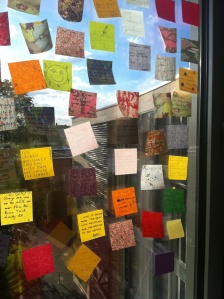
Salah satu proses studi design thinking dengan menuangkan ide lewat tulisan di atas Post-It warna-warni

Salah satu proses studi design thinking dengan menuangkan ide lewat tulisan di atas Post-It warna-warni

Acara yang berlangsung selama tiga hari tersebut digelar di kampus HPI, dengan tema “Sirkus”, sehingga venue utamanya bukanlah sebuah aula biasa, melainkan sebuah tenda sirkus yang didirikan di lahan kampus. Untuk melengkapinya, serombongan pemain sirkus profesional dikerahkan untuk menyelingi acara. Jadi tidak heran bila di kampus tersebut tampak berkeliaran pengendara sepeda roda satu, juggler, dan sebagainya. Hal ini mengakibatkan suasana konferensi menjadi lebih mudah cair, dan – terutama karena bentuk ruang yang bundar – menghilangkan hirarki antara para ahli yang menjadi narasumber berpengalaman, dengan para mahasiswa dan peserta lain.

Detail dari acara ini pun digarap dengan baik. Mulai dari gelang semi-permanen yang menjadi “tanda masuk” peserta di semua venue, “koin HPI” yang digunakan di setiap waktu makan, hingga bantal dan selimut berwarna oranye cerah yang disediakan di tenda-tenda makan semi terbuka.

Hari pertama diisi dengan presentasi para pembicara utama dan beberapa sesi parallel. Hal yang paling menarik di hari ini adalah presentasi berjudul The Difference between Design Thinking and Design, yang dibawakan oleh Oliviero Toscani (fotografer, desainer kampanye iklan kontroversial United Colors of Benetton) dan George Kembel (co-founder dan Direktur Eksekutif d.school Stanford University), di mana keduanya menjelaskan posisi masing-masing dalam isu Design Thinking ini.
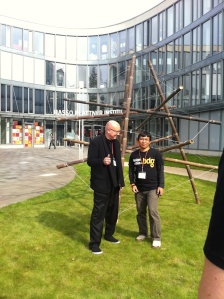
Prof. Ulrich Weinberg, direktur HPI d.school dengan Andry dan struktur bambo tensegrity yang baru selesai dibangun

Prof. Ulrich Weinberg, direktur HPI d.school dengan Andry dan struktur bambo tensegrity yang baru selesai dibangun

Hari kedua adalah di mana tim BCCF melakukan presentasi dan dua workshop. Dalam salah satu workshop ini, BCCF berkolaborasi dengan Andry Widyowijatnoko, dosen Arsitektur ITB yang baru menyelesaikan studi doktoralnya di Aachen. Di workshop ini Andry mengundang peserta untuk membangun bamboo tensegrity structure, di mana batangan-batangan bambu saling terhubungkan dengan tali logam, tanpa saling bersentuhan. Ketika seluruh bagian bambu dan tali logam sudah selesai dihubungkan, struktur bambu ini dapat diposisikan dalam berbagai arah. Struktur bambu ini kemudian berfungsi sebagai semacam tiang ‘totem’, di mana semua orang dapat berjejaring dengan menggantungkan identitas dan pesannya mengenai Design Thinking yang dituliskan di atas kertas yang disediakan oleh BCCF.

Di workshop yang satu lagi, tim BCCF berkolaborasi dengan Prof. Eku Wand dari HBK Braunschweig dan KBRI di Berlin, mengajak peserta bermain angklung. Hubungannya dengan Design Thinking? Di sini angklung merupakan representasi dari individu, yang memiliki karakter tersendiri. Namun sebuah lagu hanya dapat dimainkan bila masing-masing angklung dapat bekerja sama dan saling melengkapi, seperti halnya kolaborasi antar disiplin ilmu dalam mencapai inovasi.

Presentasi dilakukan di Feedback Room, di mana kasus “Redesigning Your City” di berbagai belahan dunia ditampilkan, masing-masing selama 15 menit, lalu dilanjutkan dengan diskusi dan tanya-jawab. Karena keterbatasan waktu, tentu tidak semuanya mendapat kesempatan menanggapi, sehingga setiap orang yang masuk mendapatkan satu lembar kertas untuk diisi dengan tanggapan, usulan, dan sebagainya. Kertas tanggapan ini, setelah diisi, dapat diberikan langsung pada presenter yang membawakan subyek yang ditanggapi.

Presentasi di Feedback Room

Presentasi di Feedback Room

Dalam kesempatan ini, tim BCCF menyampaikan sekilas informasi mengenai Bandung (ada pertanyaan, “Bandung itu kota di negara apa?”), sejarah berdirinya BCCF, dan aktivitasnya yang “merancang ulang kota”, seperti TUNZA, Lightchestra, Kampung Kreatif, dan Semarak.bdg, dan berbagai program Urban Acupuncture yang telah dan sedang dilaksanakan. Di awal presentasi, BCCF menyatakan belum pernah mendalami Design Thinking, meskipun menurut Prof. Weinberg menyatakan bahwa yang kita lakukan selama ini adalah Design Thinking, sehingga yang disebutkan di presentasi (dan semua materi yang dibawa) menerakan Design Action, sebab itulah yang kita lakukan. Selain slide, BCCF juga menampilkan video-video pendek dari berbagai event tersebut. Tanggapan yang diperoleh BCCF sangat positif, sebab rata-rata yang hadir, pada awalnya belum pernah mendengar tentang Bandung, namun langsung menyatakan ketertarikannya untuk mengunjungi Bandung dan melihat sendiri program-program BCCF, dan bahkan menyatakan minat untuk berkolaborasi dengan kota asal mereka masing-masing. Hal yang dinilai paling menonjol dari BCCF adalah kemampuan kita untuk berkumpul dan bekerja sukarela demi kehidupan kota yang lebih nyaman untuk semuanya, dan semangat kita untuk selalu berbagi, yang seluruhnya dilakukan dengan cerdas dan dengan daya kreatifitas tinggi.

Di hari ketiga, yang merupakan hari terakhir dari rangkaian d.confestival, tim BCCF menyimak presentasi Prof. Kees Dorst (dari Sydney University of Technology), yang menguraikan konsep dan analisa mengenai Design Thinking, yang memetakan berbagai kasus yang terjadi di Sydney. Dari presentasi ini lah BCCF menyadari bahwa kekurangan utama kita adalah hampir tidak adanya analisa atau evaluasi yang terstruktur terhadap berbagai program yang selama ini kita jalankan.

Ruang bundar di tengah-tengah tenda sirkus di penutup acara

Ruang bundar di tengah-tengah tenda sirkus di penutup acara

Di akhir acara, penyelenggara mempersilakan siapa pun yang bersedia untuk maju dan duduk di tengah-tengah lingkaran tenda sirkus, untuk dapat mengutarakan pendapat, kritikan, dan sebagainya, terhadap Design Thinking dan d.confestival. Hal ini juga di luar kebiasaan konferensi pada umumnya, di mana hal-hal disimpulkan dan dibuatkan resumenya oleh sebuah tim perumus yang terdiri dari orang-orang yang terpilih. Saat penutupan d.confestival, tim BCCF mendadak diminta untuk sekali lagi melakukan workshop angklung untuk seluruh peserta. Sambutan para peserta terhadap acara penutupan ini sangat meriah, dan permainan angklung berhasil meninggalkan kesan gembira bagi setiap peserta yang hadir.

Sisa waktu di Berlin dimanfaatkan oleh tim BCCF untuk membuka kontak dan mengawali jejaring dengan berbagai komunitas dan organisasi di Berlin, seperti Create Berlin, Webcuts, Asia-Pacific Berlin Forum, dan International Design Center Berlin. Berbagai rencana kolaborasi telah didiskusikan, dan siap untuk dilanjutkan dan diwujudkan oleh berbagai komunitas di Bandung. Berikutnya? BCCF harus tetap mempertahankan kontribusi positifnya terhadap Kota Bandung, dan Bandung harus sanggup menjadi tuan rumah untuk acara sejenis d.confestival, yang berskala internasional dengan detail yang digarap baik, dan melibatkan berbagai unsur masyarakat dan disiplin ilmu, demi memperoleh solusi yang inovatif dalam menghadapi tantangan kehidupan urban di masa mendatang.

Oktober 2012,

Tim BCCF: Fiki & Tita

Why Are We Wired?

WHY ARE WE WIRED?

Tom Gaiser | 27111701

Classmates wired

Wired?  Are we so connected that we begin to loose our own self identity?  Who am I that I must define myself by my online relationships?  Am I a page on Facebook?  Or have I become the repository of a zillion apps?  Are people apt to meet friends in real life only to share physical space while  meeting more friends online.  If cyber is space, is it outer space or inner space or  in-between space?  Really,  it is a matter of the sustainability of the human soul.  Man has been concerned about the sustainability of his soul for a while.  Well, the Greek philosophers had no problem with man’s soul.  Drama and comedy certainly dealt with man’s follies.  Shakespeare made the human condition dense with substance.  Then came the Industrial Revolution.  Charles Dickens warned us.  For the first time in human history a product of man’s invention would begin to control us.  Even in war it would no longer be man against man, an honorable way to lay waste upon our selves.  NO,  we’d have machines do this for us.  Now philosophers, like Sartre and Ortega y Gasset would write of the dehumanizing of the human soul.

But wait, there was a new revolution.  What about freedom?  Freedom to do as we please.  You know, free spirit, free speech, free sex, freedom of choice.  The soul was set free, yay to that.  Our parents could have nothing to do about this.  Family and work required sacrifice?  Yes, that is a question.  They would define work and family, and religion for that matter, as a goal, something to honor, not a sacrifice. Because it was all about sustainability.  Why as a family did we grow our own vegetables and poultry besides cooking our own meals. Ever heard about the book “Chicken Soup for the Soul”?  Why did the wash “go out to dry” rather than into the dryer?  Why did my father teach me how to repair the house and service the car?  Well, it had something to do with maintaining a budget.  It also had something to do with maintaining the soul of the family.

Amish girl online

But let’s get back to the wired phenomena.  We all, well, I hope at least most of us, have seen the photos of landfills full of obsolete PC’s or the poor people of some poor country disassembling electronic devices for their poisonous innards. (At least the latter is an effort to recycle.)  But what about the constant need for the latest electronic device?  And why are we so dependent on these devices for our social well being?  I believe it is all about judgment.  Truthfully, there is a lot of good with this new age of  information communication technology.  I can see my daughter’s new hair cut from half way around the world, as well as talk with her for free.  It’s through an app called Tango.  That is good for the soul.  And certainly the instant access of information about how we can sustain the world as well as research for our school and work projects revolutionizes knowledge.  Even the latest issues regarding the Green Revolution are disseminated through the electronic media. But that’s just it, electronic devices are tools and the “media is just the messenger”.  It is only when these electronic devices consume all our time and when the messages obscure our own thoughts, that the sustainability of the human, each individual’s, soul is in danger.

LET’S BE WIRED FOR THE GOOD OF IT.